14 Hallway Lighting Ideas That Will Make Every Guest Stop and Stare
Walk into a home where the hallway lighting is done right, and you feel it instantly — before you even notice the furniture, the paint color, or the décor. There is something almost magnetic about a well-lit corridor. It pulls you in. It makes you feel welcome. And honestly? It tells you everything you need to know about the rest of the house.
Most homeowners pour their energy — and their budget — into lighting the living room, kitchen, and bedroom. The hallway gets whatever is left over. A builder-grade flush mount. One lonely ceiling light that flickers on rainy days. Maybe a dusty overhead that still has a 60-watt incandescent bulb from 2009.
But here is the thing: your hallway is the first space every person in your life walks through. It sets the mood before anything else does. Get the lighting right here, and the whole house feels more intentional — more alive.
We went deep into what the top interior designers and home décor experts across the US are actually doing right now, studied what competitors are covering, and then went further. These are 14 hallway lighting ideas that are genuinely fresh, practical, and stunning — the kind that make your hallway work for you instead of just existing.
Hallway Lighting Deserves More Credit Than You Give It
Before we get into the ideas, let us set the scene. Hallways have a tricky job. They need to be bright enough to navigate safely at midnight, soft enough to feel cozy in the evening, and visually interesting enough to anchor the home’s overall style — all at the same time.
The mistake most people make is treating hallway lighting as a single decision. One fixture, done. But hallway lighting is really a system — layers of light working together at different heights and intensities. When you understand that, everything changes.
Now let us get into the ideas. These are not your typical “add a pendant light” suggestions. These go deeper, more specific, and far more useful.
Staircase-Riser LED Lighting for a Floating Step Effect
This one works beautifully in homes where the hallway connects to a staircase — which is most American homes. Instead of lighting the hallway from above, you bring the light down to floor level by installing thin LED strips along the vertical face (the riser) of each stair step.
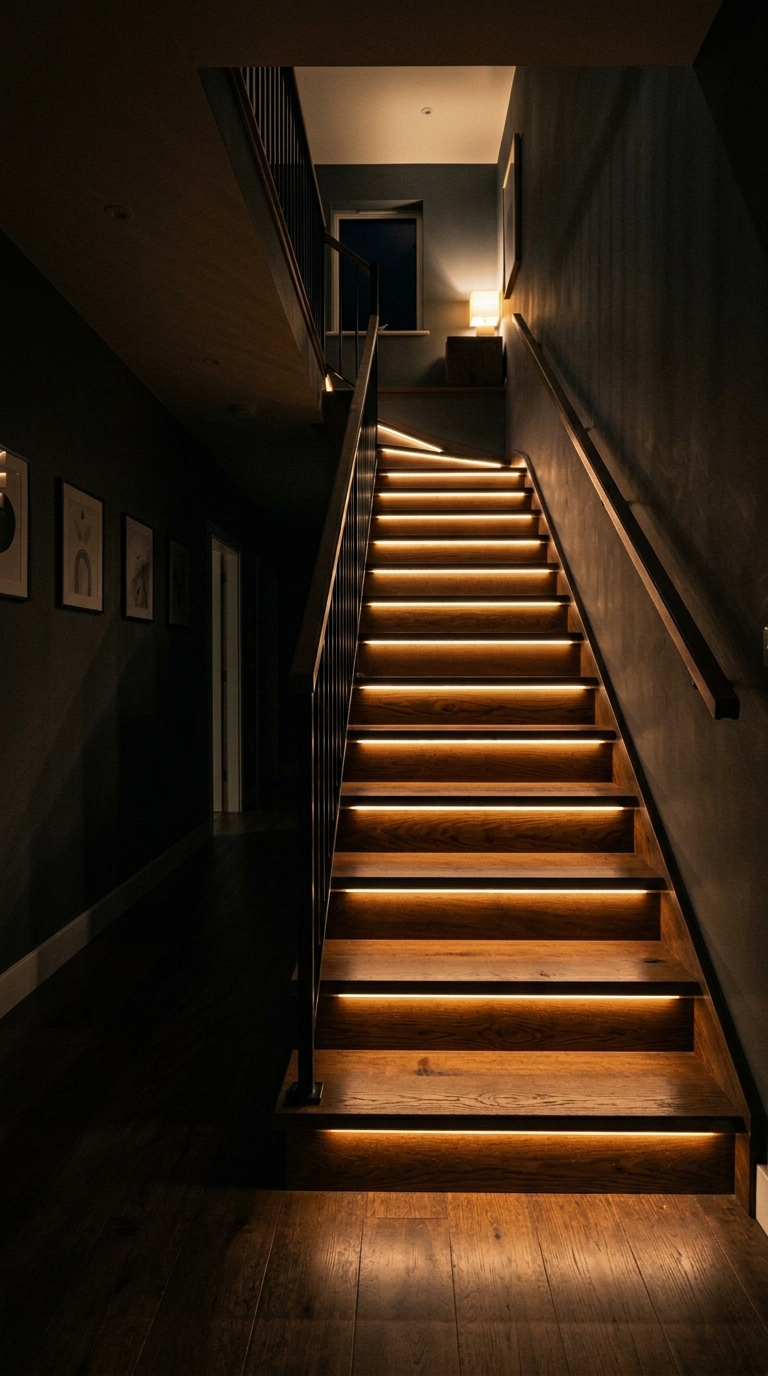
The effect is genuinely stunning. Each step appears to float above the ground. The warm glow travels the length of the stairs and spills into the hallway below, creating a gradient of light from the floor upward. No harsh shadows. No blinding overheads. Just this cool, modern glow that makes your staircase look like it belongs in an architecture magazine.
Here is how to do it properly:
- Use warm white LED strips (2700K–3000K) for a cozy, inviting tone
- Choose aluminum channel extrusions to hide the strip and diffuse the light evenly
- Add a motion sensor so the steps light up automatically when someone approaches at night
- Keep the strips set back slightly from the front edge so the light source itself stays hidden
The safety benefit is real too. No more fumbling for switches at 2 a.m. or worrying about guests missing a step.
Picture Rail Lighting — Turn Your Hallway Into a Mini Art Gallery
Picture rail lighting is one of the most underused ideas in American homes, and once you discover it, you will wonder why you waited. The concept is simple: you install a slim track or rail near the top of the wall (or at ceiling height), and from that rail hang adjustable mini spotlights that point downward, each one aimed at a framed photo, painting, or piece of art.
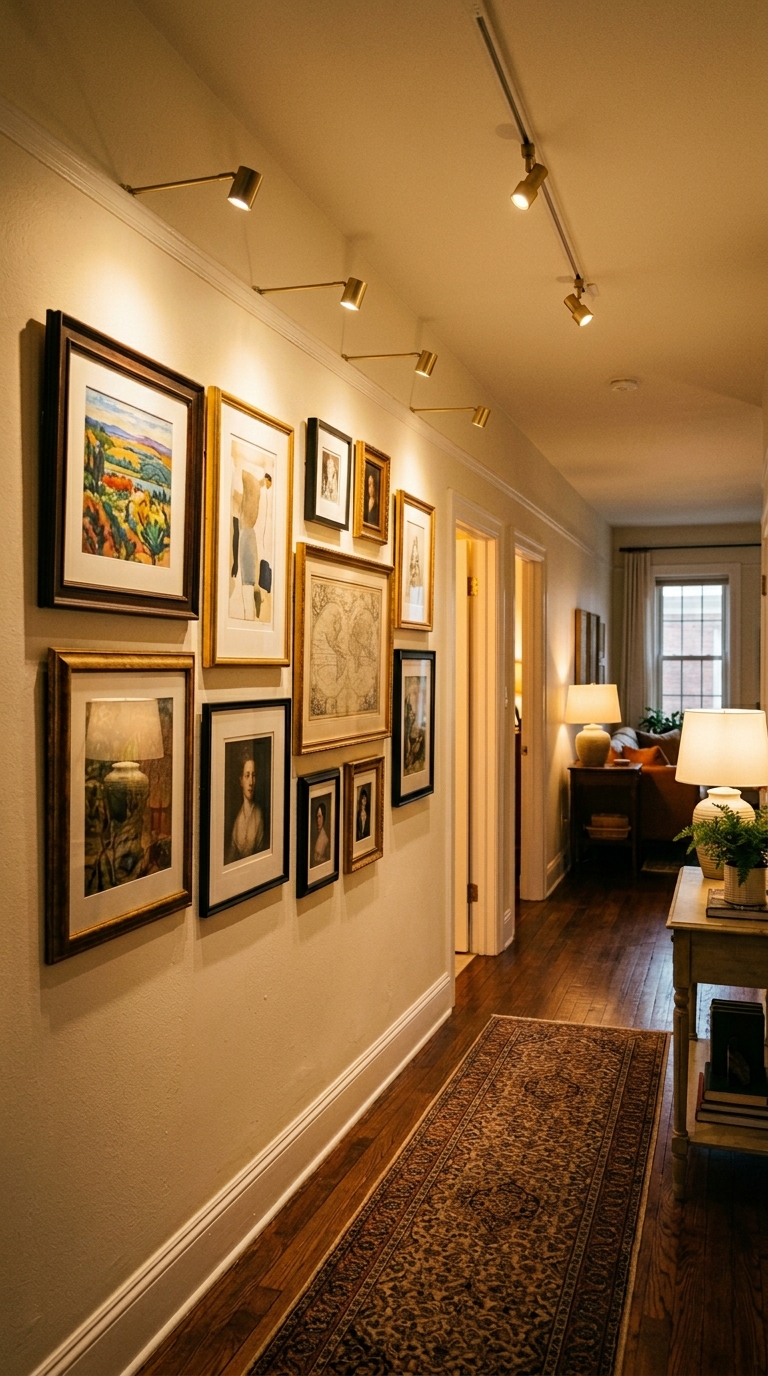
The effect transforms your hallway from a passageway into a curated gallery space. Every time you or a guest walks through, the artwork is properly lit — not just hanging on a wall, but showcased.
What makes this different from standard track lighting:
- The rail runs along the wall, not the ceiling, so it works in hallways with low ceilings
- Each light hangs on a wire and is adjustable in height — perfect for displaying art at different sizes
- You can swap out art seasonally and simply re-aim the light without any rewiring
- Slim brass or matte black rail finishes look intentional and high-end, not industrial
For a hallway lined with family photos, this approach makes those images feel like they genuinely matter — which they do.
Recessed Niche Wall Lighting — Built-In Glow Boxes
This idea takes more commitment, but the payoff is incredible. You work with a contractor to cut shallow rectangular niches — typically 4 to 6 inches deep and about 12 inches wide — directly into the hallway wall. Inside each niche, you install concealed LED strip lighting along the interior perimeter.
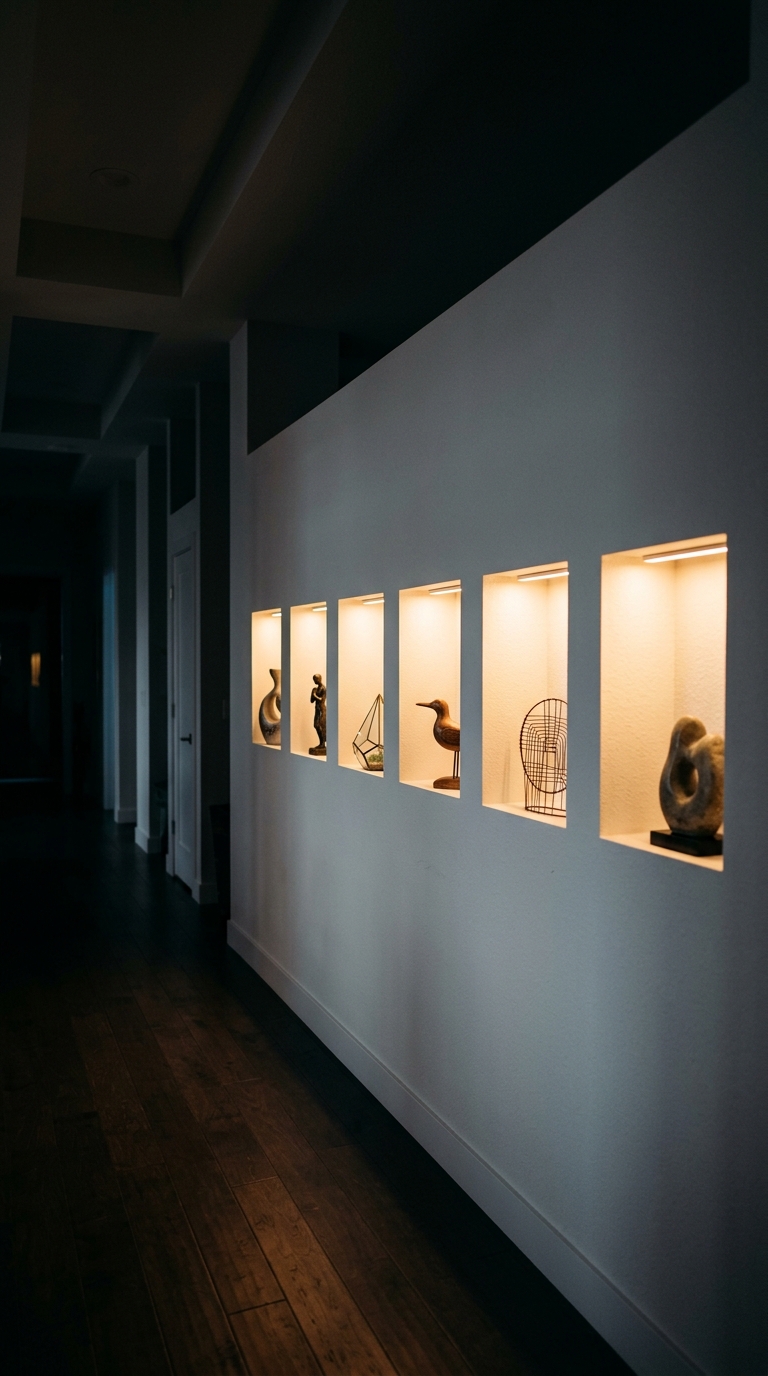
The niche glows from within. You place small decorative objects inside — a ceramic vase, a succulent, a sculptural figurine — and those objects are bathed in this warm, intimate light. The surrounding hallway stays softly illuminated by the glow emanating from each niche.
This approach works especially well in:
- Long hallways where you need rhythmic visual interest along the length
- Hallways with no wall space for hanging art (narrow corridors where frames would feel cramped)
- Contemporary or transitional home styles where built-in architectural details elevate the overall design
You can space the niches every 3 to 4 feet and use them to tell a story — family heirlooms, travel souvenirs, rotating seasonal displays — all beautifully lit.
The Vintage Filament Bare Bulb Row — Industrial Warmth Done Right
You have seen exposed Edison bulbs in restaurants. You have probably admired them. But most people do not realize how well they work in a residential hallway — especially if you do them with intention rather than randomness.
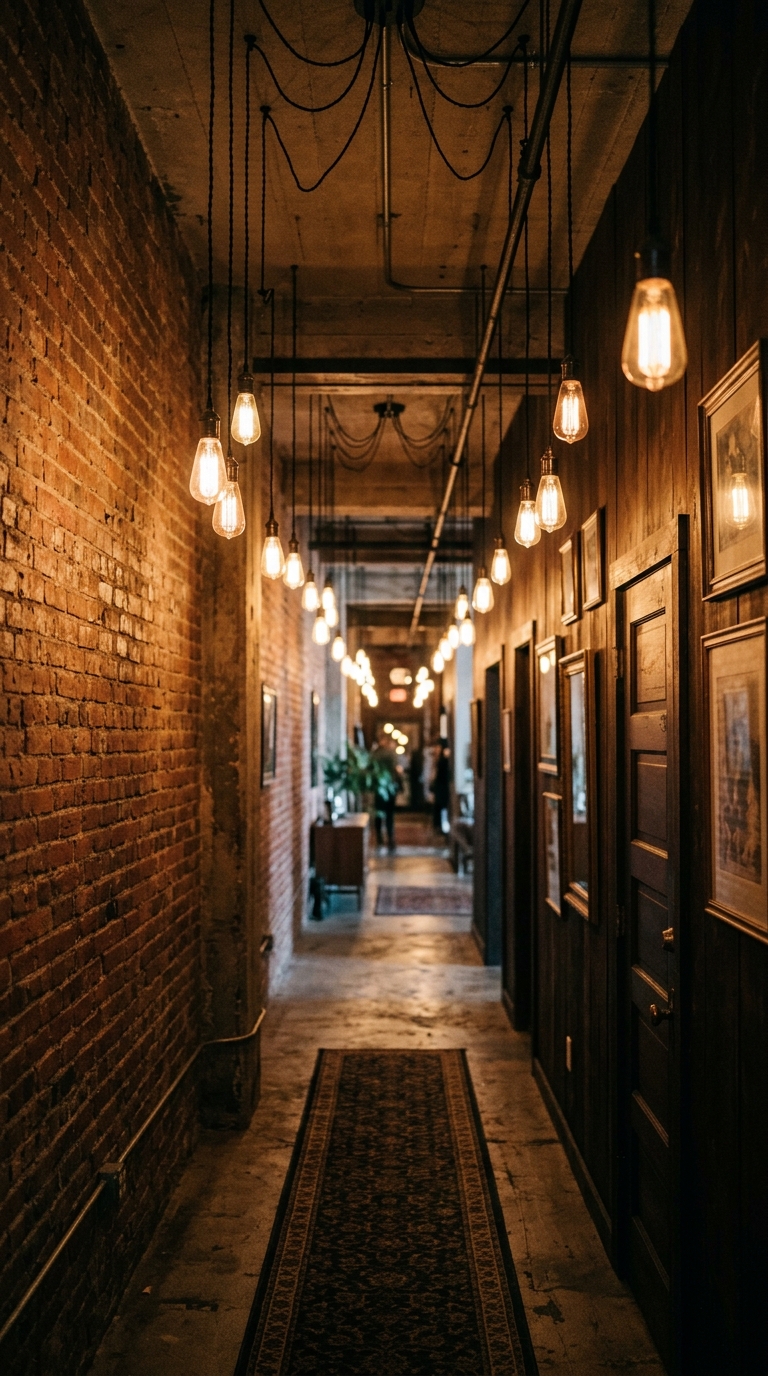
The key is creating a deliberate, thoughtful installation. Run a simple wooden plank or industrial pipe across the ceiling length of your hallway. From that, hang multiple Edison bulb pendants at staggered heights — some at 5 feet, some at 6, some at 7. Use warm amber filament bulbs (2200K–2400K) for that unmistakable golden glow.
The result feels cozy, creative, and completely personal. It also works in hallways of almost any width because the pendants hang centrally rather than jutting out sideways.
A few practical tips:
- Use a single circuit with a dimmer switch so you can dial the warmth up or down based on the time of day
- Choose bulbs with a visible filament — ST58 or G40 globe styles look especially beautiful at hallway heights
- Space pendants 18 to 24 inches apart for a rhythmic, intentional feel rather than a crowded cluster
Integrated Console Table Lamp — The Styled Vignette Approach
Most hallway lighting conversations ignore the floor level entirely. But a carefully placed console table with a beautiful lamp does something that no ceiling fixture can — it creates a moment. A vignette. A little scene that says “someone thoughtful lives here.”
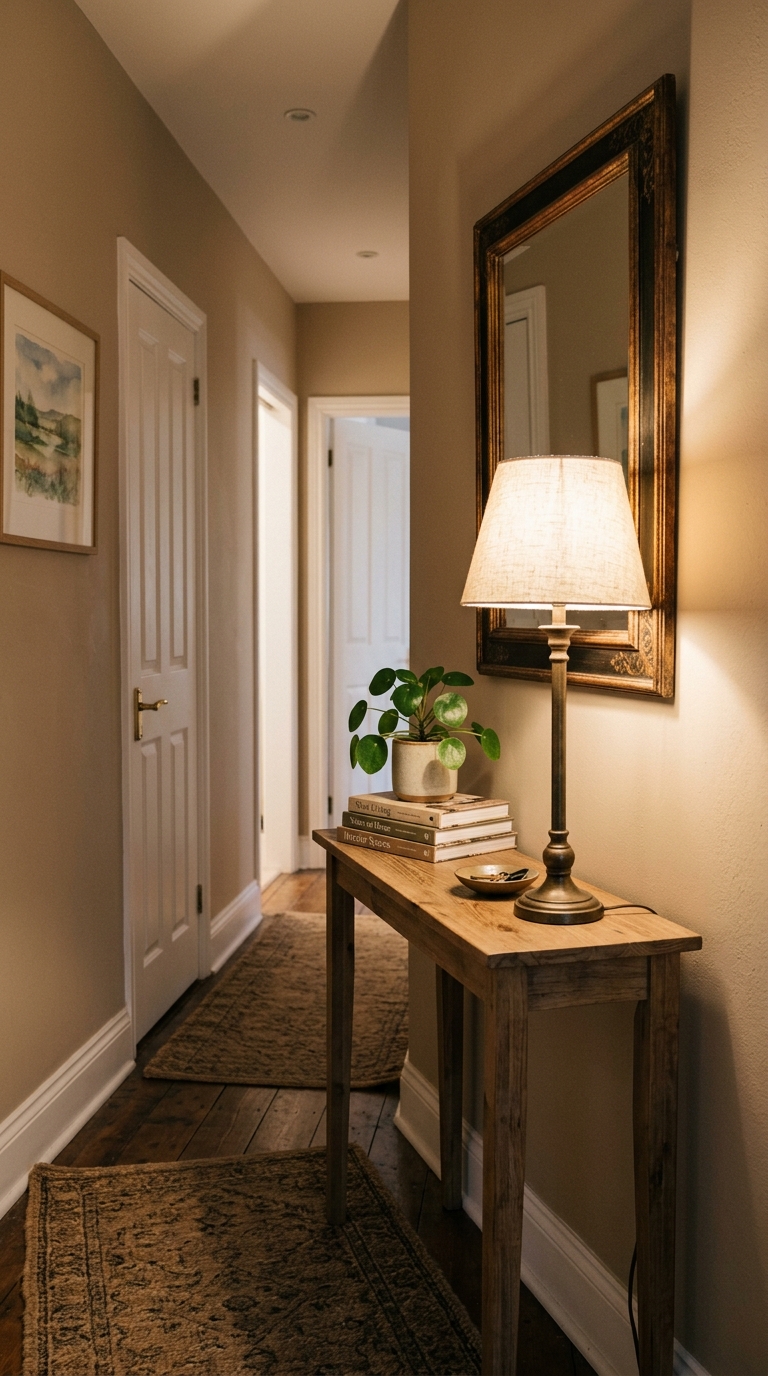
A narrow console table pressed against the wall takes up practically no floor space (12 to 15 inches deep is all you need). On it, you place a slim table lamp with a warm-toned shade, maybe a small plant, a tray, a framed photo. Above it, a mirror doubles the light and makes the hallway feel twice as wide.
This works especially well for:
- Entryway hallways where you want to greet guests with warmth
- Hallways that feel cold or transitional — the lamp humanizes the space immediately
- Homes without access to ceiling fixtures (older construction, rental apartments)
Choose a lamp with a maximum shade width of 16 inches so it does not block foot traffic. Opt for a smart bulb inside so you can set it on a schedule — on at dusk, off at midnight — without ever touching a switch.
Cove Lighting Along a Dropped Ceiling Soffit — The Architecture Trick
This idea requires a bit of construction, but it is one of the most sophisticated hallway lighting techniques used in high-end residential design. You build a shallow dropped soffit — essentially a small lowered ceiling section running along one wall of the hallway — and install LED strips inside the upper ledge of that soffit, facing upward toward the main ceiling.
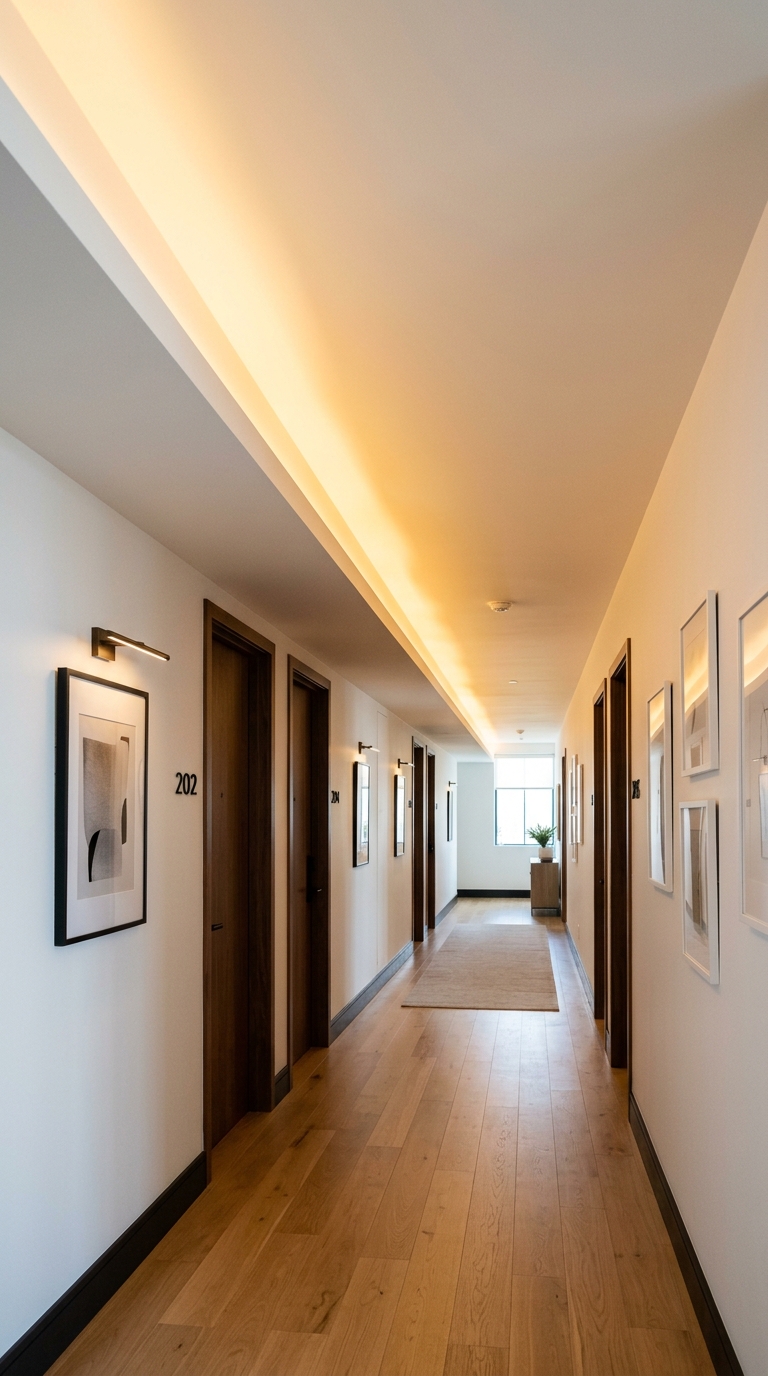
The light bounces off the ceiling and washes the entire hallway in a soft, even glow that has no visible source. It is what designers call “indirect lighting,” and it completely eliminates the harsh shadows that kill the mood in most hallways.
Why this works so well:
- No glare whatsoever — your eyes never look directly at a light source
- The ceiling itself becomes luminous, making even a narrow hallway feel airy and open
- The soffit also gives you a natural place to run wiring, hide HVAC vents, or add crown molding detail
- Dimmable LED strips let you adjust from bright and functional during daytime to moody and intimate at night
Pair this with a dark paint color on the lower walls and the effect is genuinely dramatic — like walking through a five-star hotel corridor.
Uplight Floor Can Lighting — The Drama From Below
Most hallway lighting points downward. Uplighting does the opposite — it fires light upward from floor level, and the dramatic effect it creates is unlike anything a ceiling fixture can produce.
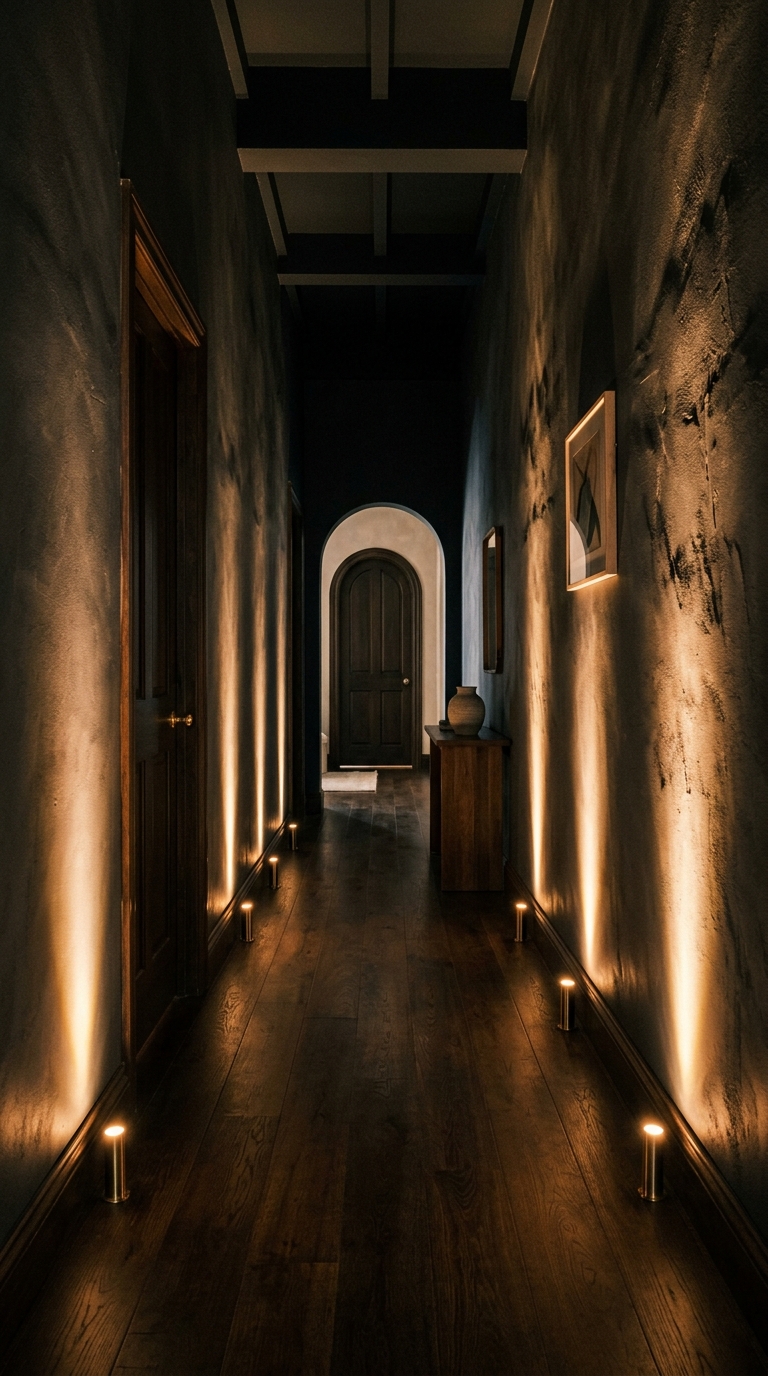
Small, low-profile floor uplights (sometimes called uplight cans or floor washers) install flush with or just above the baseboard. They project a cone of warm light up the wall, creating soft gradients that naturally highlight texture — brick, board and batten paneling, grasscloth wallpaper — in ways that overhead lighting completely misses.
This approach works especially well when you combine it with overhead lighting. Use the overhead for general visibility, and let the floor uplights handle drama and texture. The combination gives the hallway visual depth that photographs beautifully and feels completely custom.
Best uses:
- Hallways with textured wall treatments — the upward light rakes across the surface beautifully
- Long corridors where you want visual interest at multiple levels, not just overhead
- Staircase hallways where uplights placed at the base of the wall guide you toward the stairs naturally
Backlit Mirror — Function and Glow in One Move
A backlit mirror does two things simultaneously: it provides ambient hallway illumination and it makes the wall look like it has a glowing portal in it. Which sounds dramatic, but in practice it looks incredibly refined.
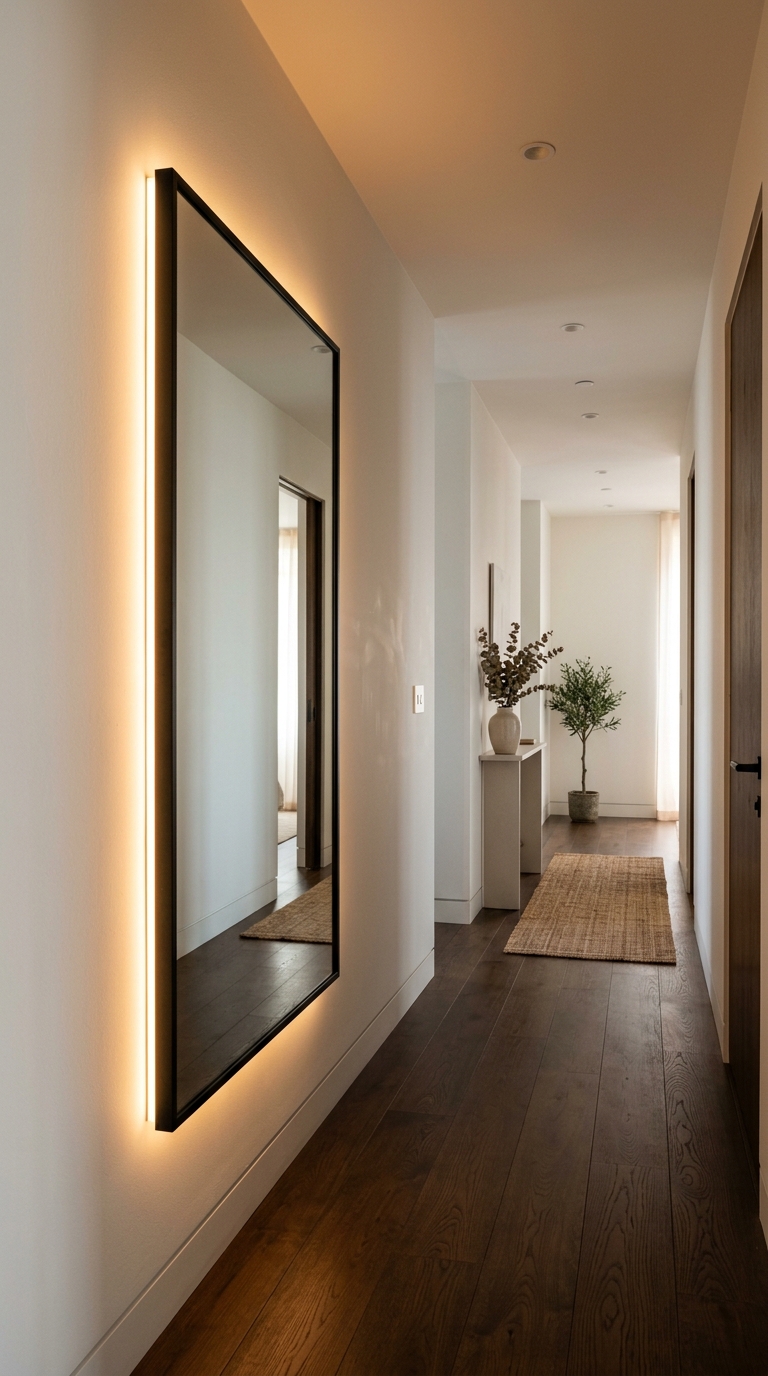
The concept is straightforward. You mount a mirror on the wall with a gap of about 1 to 2 inches between the mirror back and the wall surface. Behind the mirror, you run an LED strip along the entire perimeter. The light bleeds out around all four edges, creating a halo effect that illuminates the surrounding wall softly.
Backlit mirrors are available as complete units from lighting retailers, so you do not have to DIY the electrical work. Sizes range from small accent mirrors (18 by 24 inches) up to full-length statement pieces (24 by 72 inches).
What makes this idea stand out:
- The light is entirely glare-free since the source faces the wall, not your eyes
- It works beautifully in narrow hallways where you want to create the illusion of depth
- The mirror itself reflects hallway light back into the space, effectively doubling your illumination
- It serves a functional purpose — you can check your reflection before heading out the door
Rope Light Silhouette Behind Sheer Drapery — The Soft Diffusion Idea
This one is creative, low-cost, and genuinely beautiful. You hang sheer curtain panels (floor to ceiling) against a flat hallway wall. Behind those panels, along the baseboard or running vertically up the wall, you install LED rope lights or strip lights. The curtain diffuses the light completely, so all you see from the hallway side is a soft, even glow radiating through the fabric.
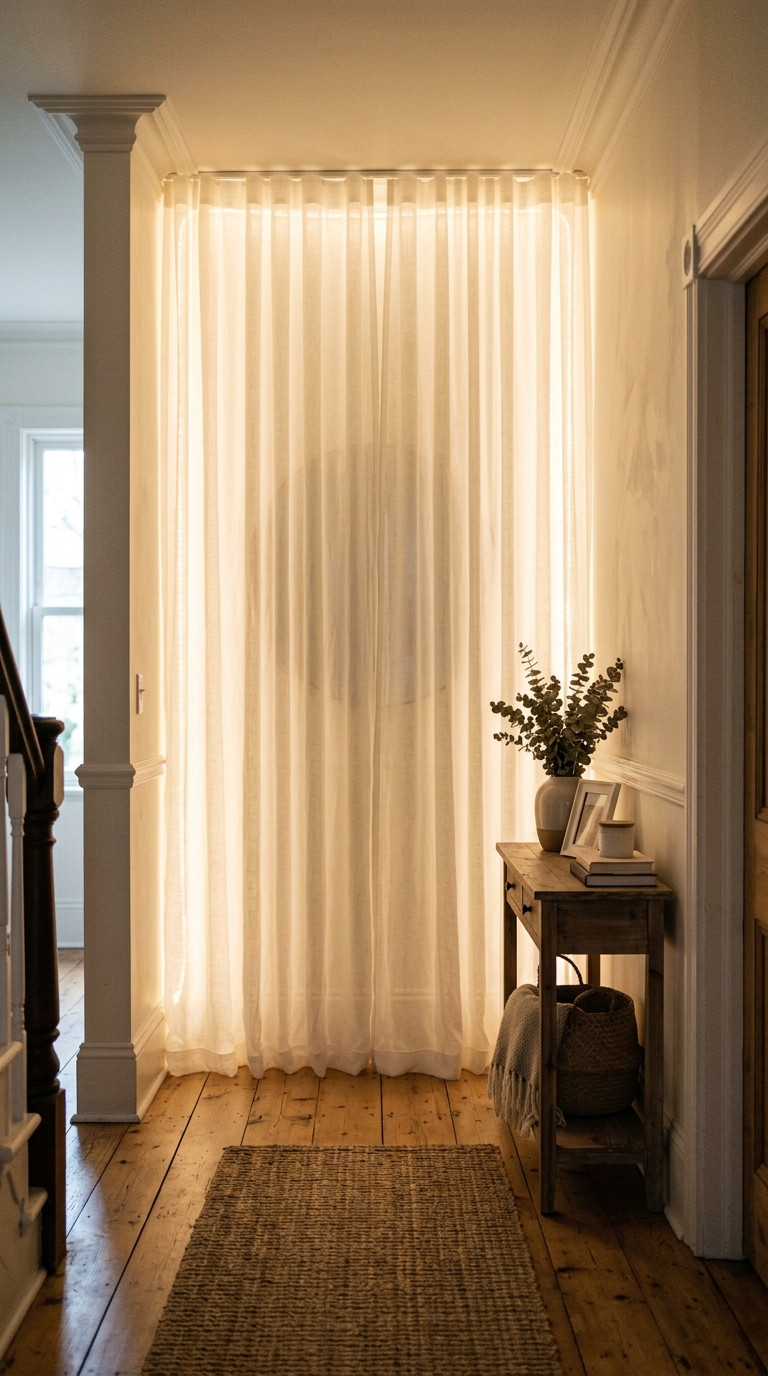
The visual effect is soft, architectural, and a little bit magical — like the wall itself is glowing. It works especially well in hallways that connect to a bedroom or meditation space, where you want a calming, unhurried feeling.
Practical considerations:
- Use warm white or tunable white LEDs at a low lumen output so the light stays gentle
- Choose blackout panels if you do not want the rope light itself visible when the curtain is disturbed
- Sheer linen and voile fabrics diffuse light most beautifully — avoid polyester sheers which create a cheap look
- Keep the LED strip behind the center of the fabric panel so the glow appears even from edge to edge
This idea costs under $150 in most cases and creates a custom, installation-quality look.
Artisan Woven Pendant — Texture You Can Actually See at Night
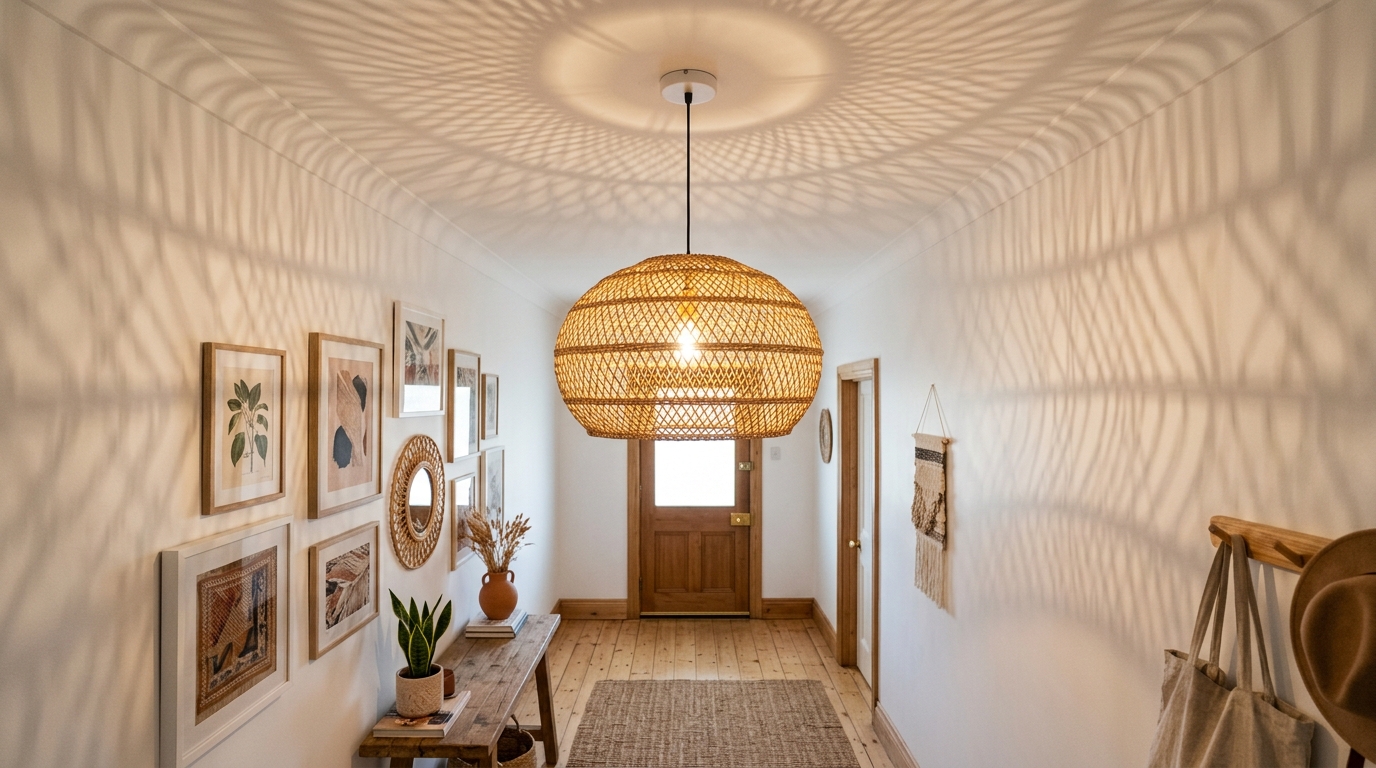
The fixture itself is the artwork in this idea. Woven pendants — made from rattan, seagrass, bamboo, or natural fiber — do something unexpected when you turn them on. The light passes through hundreds of tiny gaps in the weave and projects intricate, lace-like shadow patterns all over the surrounding walls and ceiling.
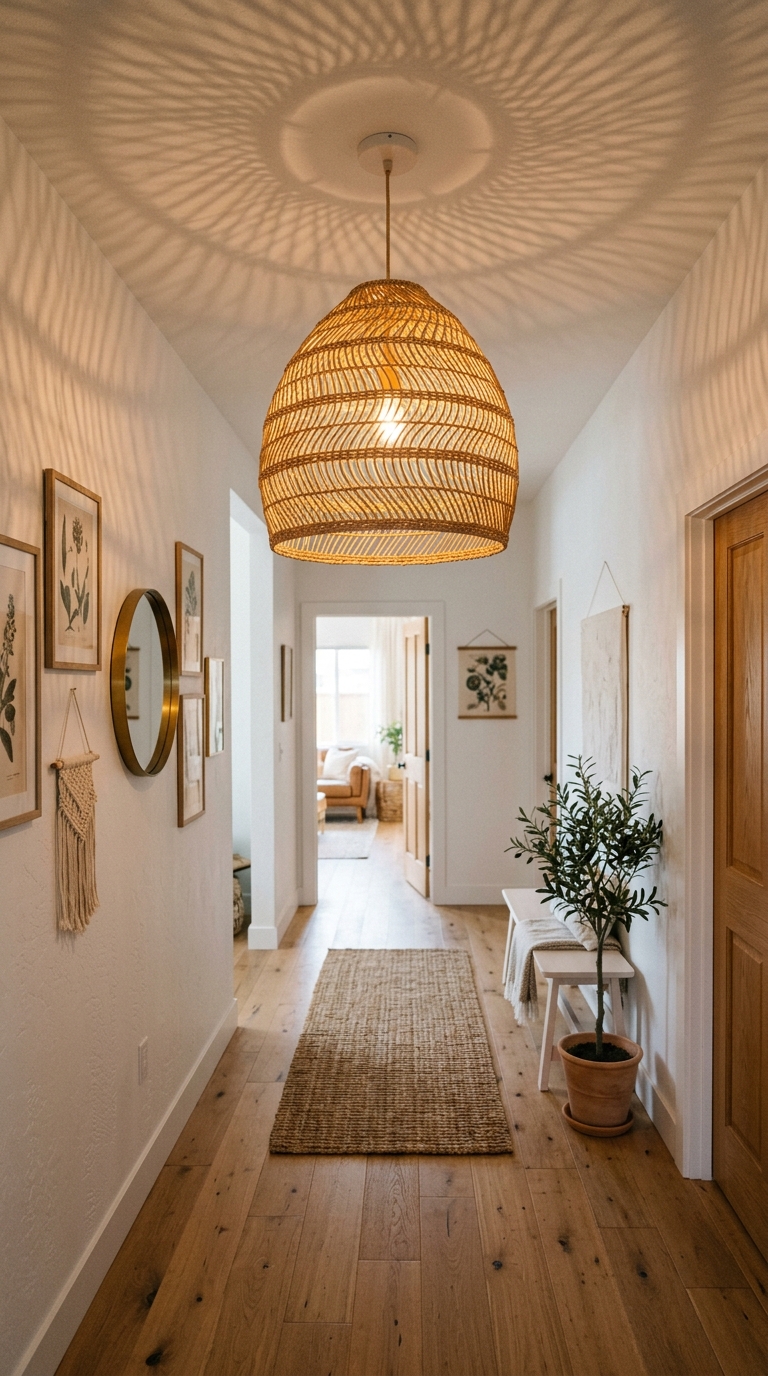
During the day, the pendant is a beautiful sculptural object. At night, it transforms the hallway into a space filled with dancing light and shadow. It is one of those rare lighting choices where the fixture works hard even when it is off.
For hallways specifically:
- Choose a pendant no wider than 60% of your hallway’s width so it does not crowd the space
- Hang it at a minimum of 7 feet from floor to bottom of shade to maintain clear headroom
- Pair it with warm Edison-style bulbs (2400K–2700K) to emphasize the amber tones in natural fiber materials
- Works best in hallways with white or very light walls so the shadow patterns show clearly
This idea pairs wonderfully with natural materials elsewhere in the hallway — a sisal runner, wood console table, or linen wall art.
Color-Tunable Smart Strip Under the Handrail — The Subtle Nighttime Guide
You likely have a handrail running along your hallway staircase. Now imagine that handrail having a thin line of warm light underneath it — just enough to softly illuminate the stair treads below without waking anyone up or needing to flip a switch.
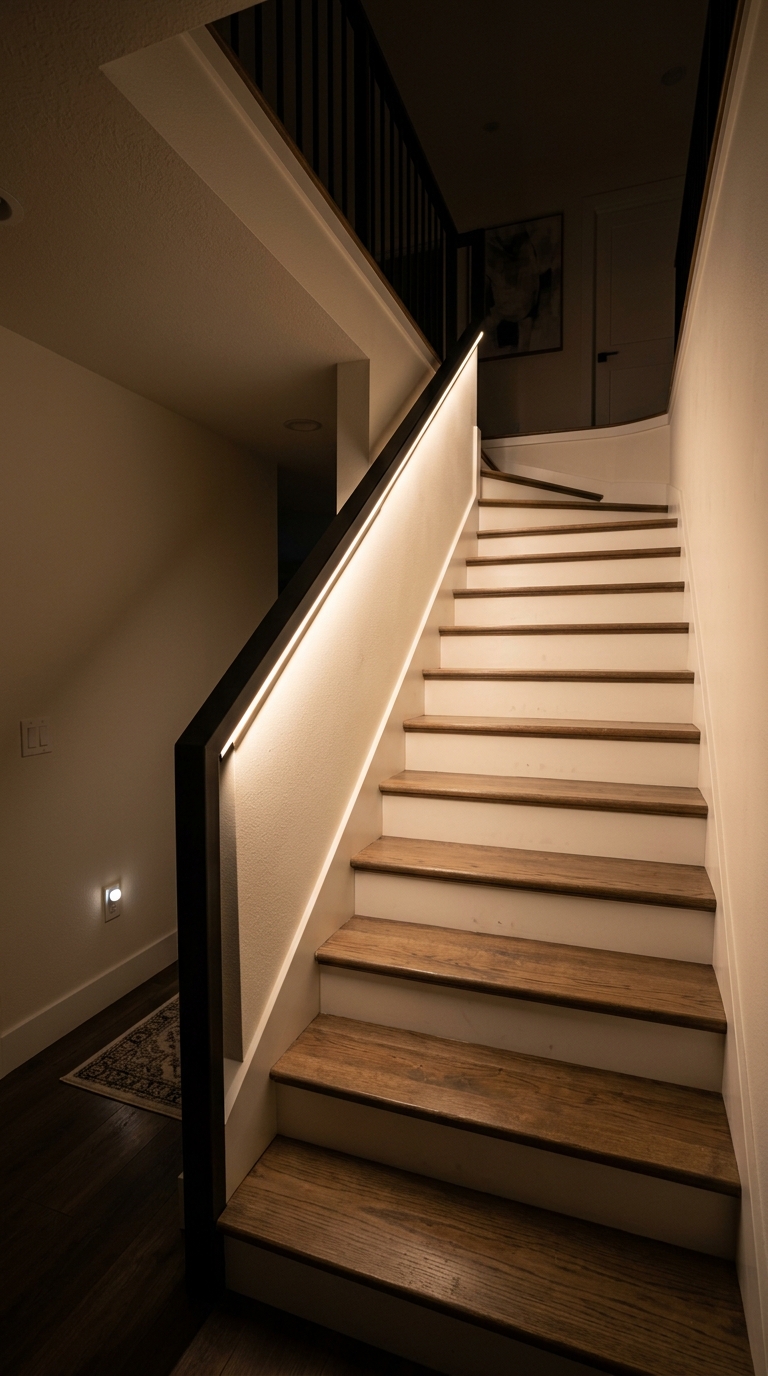
Color-tunable LED strips installed along the underside of a handrail give you daylight-warm light during daytime and an ultra-dim, amber nighttime mode that acts like a built-in nightlight for the entire staircase and hallway. The light points straight down onto the stairs, illuminating exactly where your feet go — which is where you actually need light at 3 a.m.
Connect these to a smart hub or simple motion sensor and the setup is completely hands-free:
- Motion triggers the light to come on at 10% brightness during nighttime hours
- During daytime the same strip runs at full warm white for general stair illumination
- Color tuning lets you shift from cozy 2700K in the evening to slightly cooler 3500K in the morning
- The strip itself is hidden from view — you only see the light, never the source
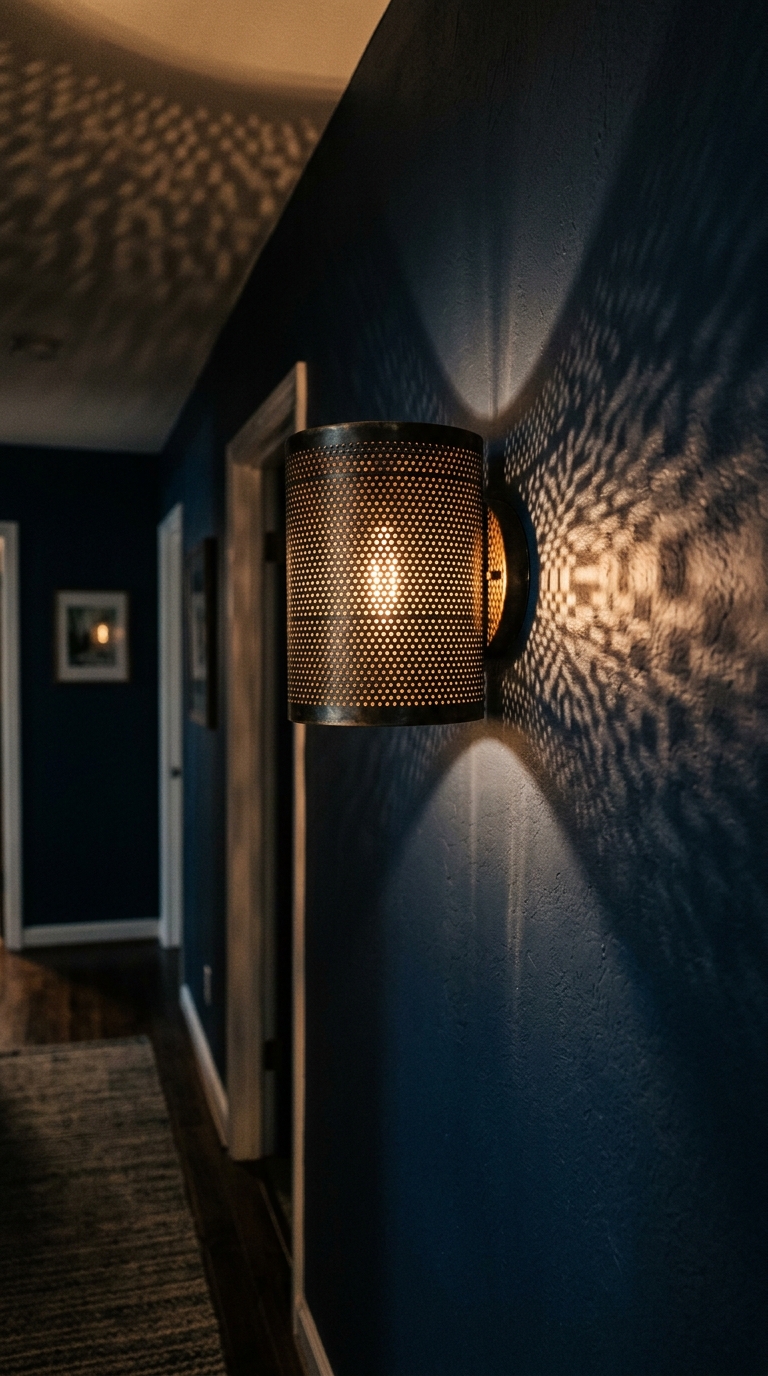
The Perforated Metal Shade Sconce — Shadow Play as Wall Art
Standard wall sconces cast light in fairly predictable ways. But sconces with perforated metal shades — shades punched with geometric patterns, floral cutouts, or abstract designs — turn the wall behind and around them into a canvas.
Every hole in the shade becomes a point of light projected outward. The pattern lands on the wall in beautiful, sharp detail. Depending on the design, you might get Moroccan star patterns, simple dot grids, or elaborate botanical silhouettes spread across your hallway wall.
This approach gives you:
- Dynamic visual interest that changes subtly as you move through the space
- A fixture that works in both traditional and contemporary hallway styles depending on the metal finish (antique brass vs. matte black vs. gunmetal)
- A conversation piece that guests notice and ask about every single time
- An affordable upgrade — perforated metal sconces start around $60 to $90 at most lighting retailers
For maximum impact, install this type of sconce against a light wall with no art or wallpaper immediately surrounding it — let the light pattern be the art.
Integrated Bookshelf Lighting — When Your Hallway Has Built-Ins
If your hallway features built-in shelving — whether original to the home or added as a renovation — do not light them with an overhead fixture and call it done. Built-in shelf lighting is one of the most rewarding, practical, and underused hallway ideas in residential design.
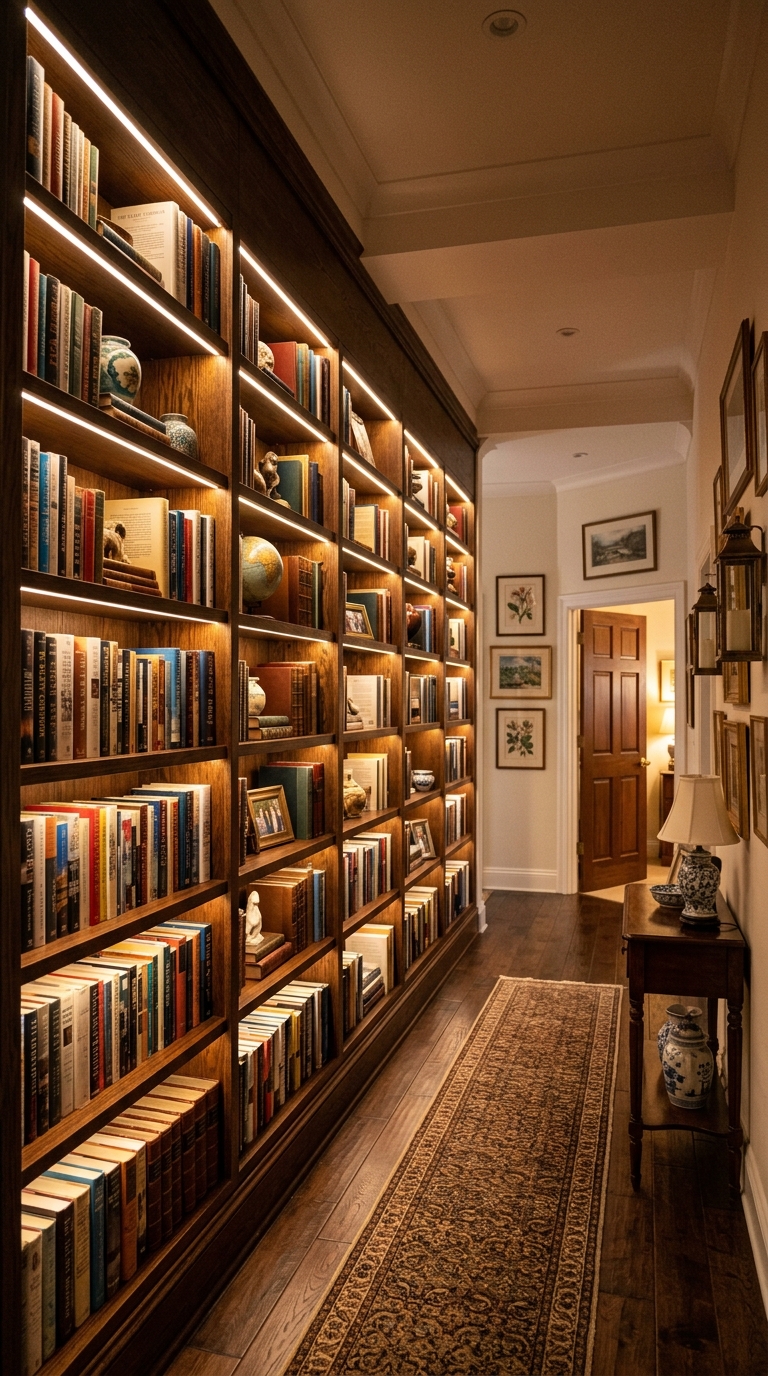
You install LED strip lights along the inside top edge of each shelf bay, pointing downward. This floods each shelf with warm, even light and turns your hallway built-ins into a glowing display case. Books, plants, objects, family mementos — everything looks intentional and beautiful rather than just stored.
For the best results:
- Use warm white strips at 2700K to 3000K — cooler temperatures make shelf contents look clinical
- Choose warm-toned LED profiles with an opal diffuser cover so the strip itself is not visible, only the glow
- Add a dimmer so the shelf lighting can be turned down to a soft glow in the evenings
- Layer this with a ceiling fixture above for general hallway illumination — the shelf lights handle accent and mood
This works particularly well in hallways that double as mini home libraries or display corridors in craftsman and traditional style homes.
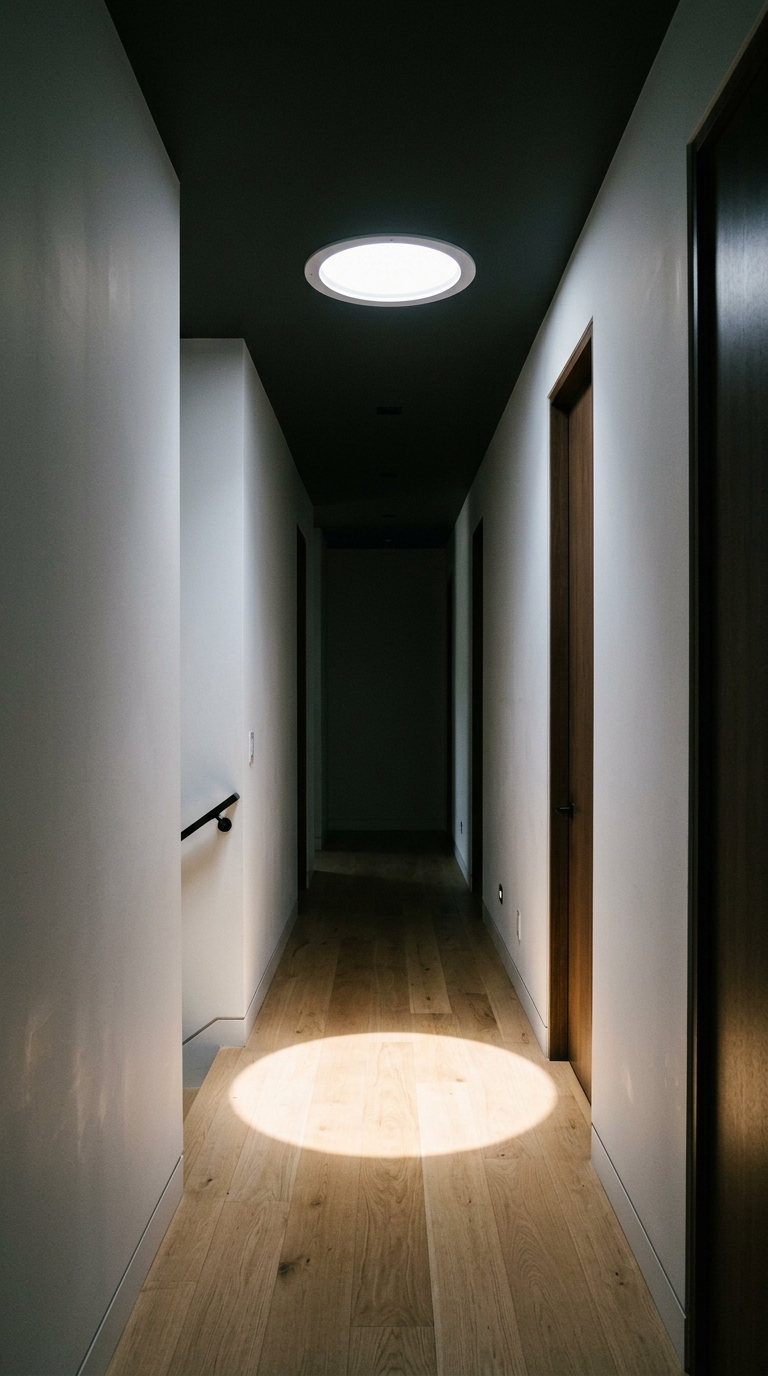
Skylight Tube With a Daylight Diffuser Panel — Bringing Real Sunshine Into a Dark Hallway
Every idea on this list so far involves artificial light. This last one is different — and arguably the most impactful of all. If your hallway is one of those perpetually dark corridors with zero natural light, a tubular skylight (also called a solar tube or light tube) is a genuine game-changer.
A solar tube is a reflective metal tube — typically 10 to 14 inches in diameter — that runs from a dome on your roof, through attic space, and down through the ceiling into your hallway below. The dome collects sunlight, the tube bounces it downward, and a diffuser lens at the ceiling end spreads it into the hallway as soft, natural daylight.
The benefits are extraordinary compared to any artificial fixture:
- Natural daylight makes hallways feel genuinely alive in a way that LEDs simply cannot replicate
- Installation is typically one day’s work and does not require major structural changes
- Modern solar tubes include optional nighttime LED kits that activate automatically after dark
- The daylight diffuser panel looks like a simple frosted ceiling light — completely unobtrusive
- Energy cost during daytime hours drops to zero for hallway illumination
This works best in single-story homes or where the hallway sits directly beneath attic space. Two-story installations are possible but require longer tube runs. For a dark, windowless corridor — the ones that always feel like a different, dimmer world — this idea transforms the entire experience of moving through your home.
How to Layer These Ideas for a Complete Hallway Lighting System
You do not have to pick just one of these ideas and stop there. The best hallway lighting setups use multiple light sources working together at different heights. Here is a simple layering formula that works in almost any hallway:
Start with one ambient source — a ceiling fixture, recessed lighting, or the solar tube from Idea 14 — that handles general brightness and safe navigation. Add one accent layer — perforated sconces, picture rail spotlights, or niche lighting — that creates visual interest at mid-wall height. Then finish with a low-level or indirect source — floor uplights, handrail strips, or staircase riser LEDs — that adds depth and a nighttime navigation function.
Three layers. Three different heights. One hallway that works beautifully in every situation from bright morning light to quiet midnight navigation.
Final Thoughts: Your Hallway Deserves Better Than an Afterthought
Every single person who enters your home walks through your hallway first. Every single time. It is arguably the most experienced space in your house — more than any living room or kitchen.
The ideas in this list are not just aesthetically pleasing. They are practical, layered, and genuinely useful for how people actually live. Whether you start with the backlit mirror and a weekend’s work, or commit to a solar tube installation that will pay dividends for the next twenty years — your hallway is worth the investment.
Start with one idea. See what it does to the feel of your home. We promise you will not stop there.