16 Dark Green Bedroom Ideas for a Cozy, Luxurious Retreat
Have you ever walked into a bedroom and felt your whole body exhale? That is exactly what a well-designed dark green bedroom does to you. It pulls you in, wraps around you like a cashmere throw on a rainy Sunday, and says, “You are home.” Dark green has this rare ability to feel both bold and deeply calming at the same time — and right now, it is having the design moment it fully deserves.
If you have been scrolling through the same recycled “paint an accent wall forest green” advice and rolling your eyes, you are in the right place. We are going deeper, getting more specific, and giving you 16 genuinely fresh ideas that will make your bedroom look like it belongs in an architectural magazine. No fluff, no filler — just ideas that actually work.
Let Start..
Dark Green Limewash Walls With Exposed Plaster Patches
Forget perfectly smooth paint. The biggest shift happening in high-end bedroom design right now is the move toward textured, imperfect wall finishes — and dark green limewash is absolutely electric when it is done right.
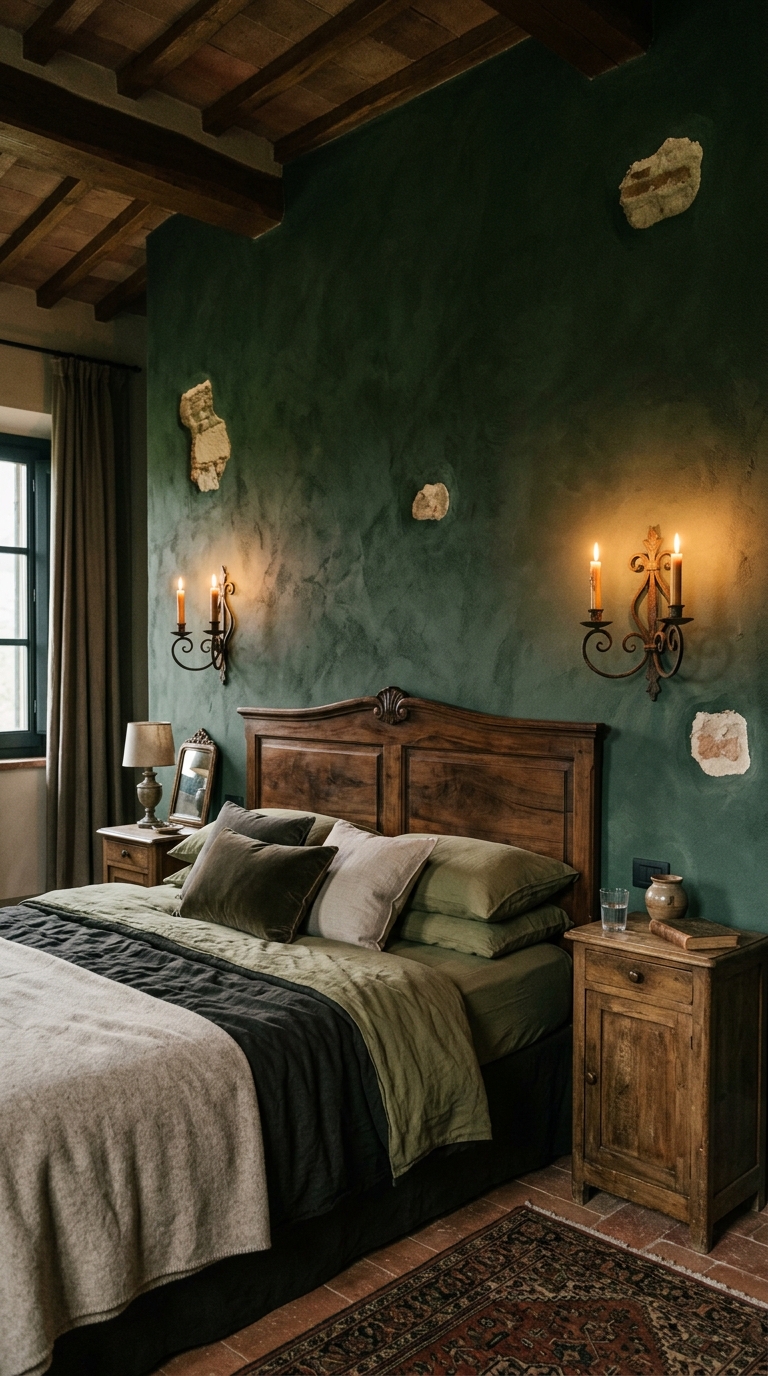
Limewash paint in a deep bottle green or hunter green shade creates this layered, almost watercolor effect on your walls. Each section looks slightly different depending on the light, the time of day, and the angle you are standing. It breathes. It shifts. It looks like something you found in a centuries-old Italian villa — not something you picked up at a big-box store on a Saturday afternoon.
Here is what makes this idea special: you can intentionally leave small patches of exposed plaster or aged texture showing through. That raw contrast between the dark pigment and the pale, chalky plaster underneath adds a layer of authenticity that no roller-applied paint can replicate. Interior designers in New York and Los Angeles have been charging serious money to create this exact look for their clients.
To pull this off well, you want:
- A deep, muted green with warm undertones — think Farrow and Ball’s Viridian or a custom mix in the hunter-olive family
- Limewash applied with a wide sea sponge rather than a brush for the most organic result
- Exposed patch areas kept small and strategic — near corners, along the ceiling line, or around architectural details
- Warm amber or candlelight bulbs in your fixtures to make the green absolutely glow
Dark Green Japandi Bedroom With Wabi-Sabi Accents
Here is a combination that competitors have barely touched — and honestly, it makes perfect sense once you see it. Japandi design (the Japanese-Scandinavian crossover that prioritizes calm minimalism and natural materials) pairs with dark green in a way that feels grounded, intentional, and quietly stunning.
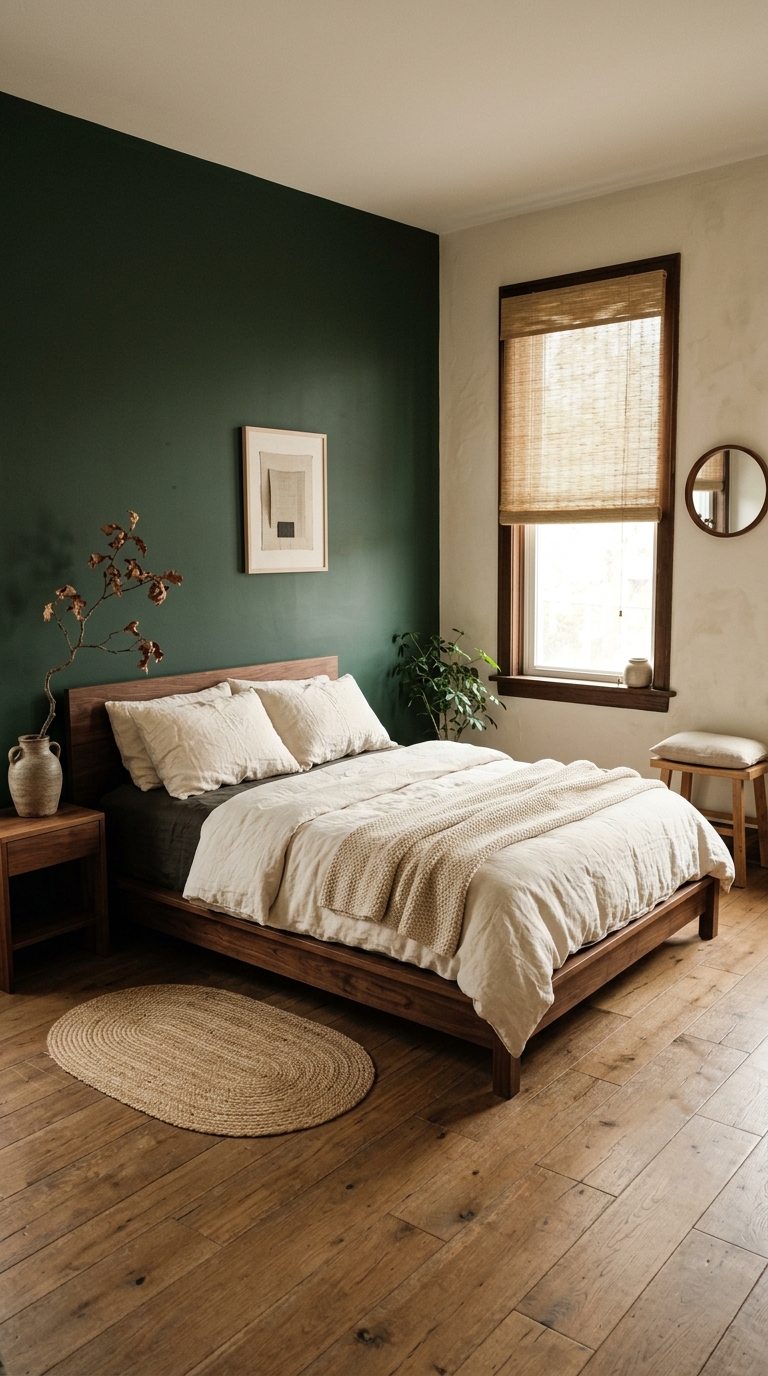
The key difference between a regular dark green bedroom and a dark green Japandi bedroom is restraint. You are not filling the room with dark green. You are using it in a very deliberate, almost meditative way. One deep forest-green wall behind the bed. A low-profile platform bed in raw, unfinished walnut or white oak. Organic linen bedding in undyed cream. Nothing shiny. Nothing loud.
The wabi-sabi philosophy — finding beauty in imperfection and impermanence — lives beautifully in this space through:
- Handmade ceramic nightstand objects in earthy, slightly uneven shapes
- A single dried pampas stem or branch in a tall, unglazed vase
- A hand-stitched linen throw with visible fraying at the edges (intentionally so)
- Woven grass shades on the windows instead of heavy curtains
- A low wooden bench at the foot of the bed in natural, unsanded timber
The contrast between the deep, rich green and the spare, quiet furniture keeps your eye moving gently around the room without ever feeling overstimulated.
Dark Green Bedroom With a Tadelakt Plaster Bathing Nook Alcove
This idea is genuinely next-level and something almost nobody in the US design blog world is talking about — bringing a recessed bathing or reading alcove into the bedroom and finishing it entirely in dark green tadelakt plaster.
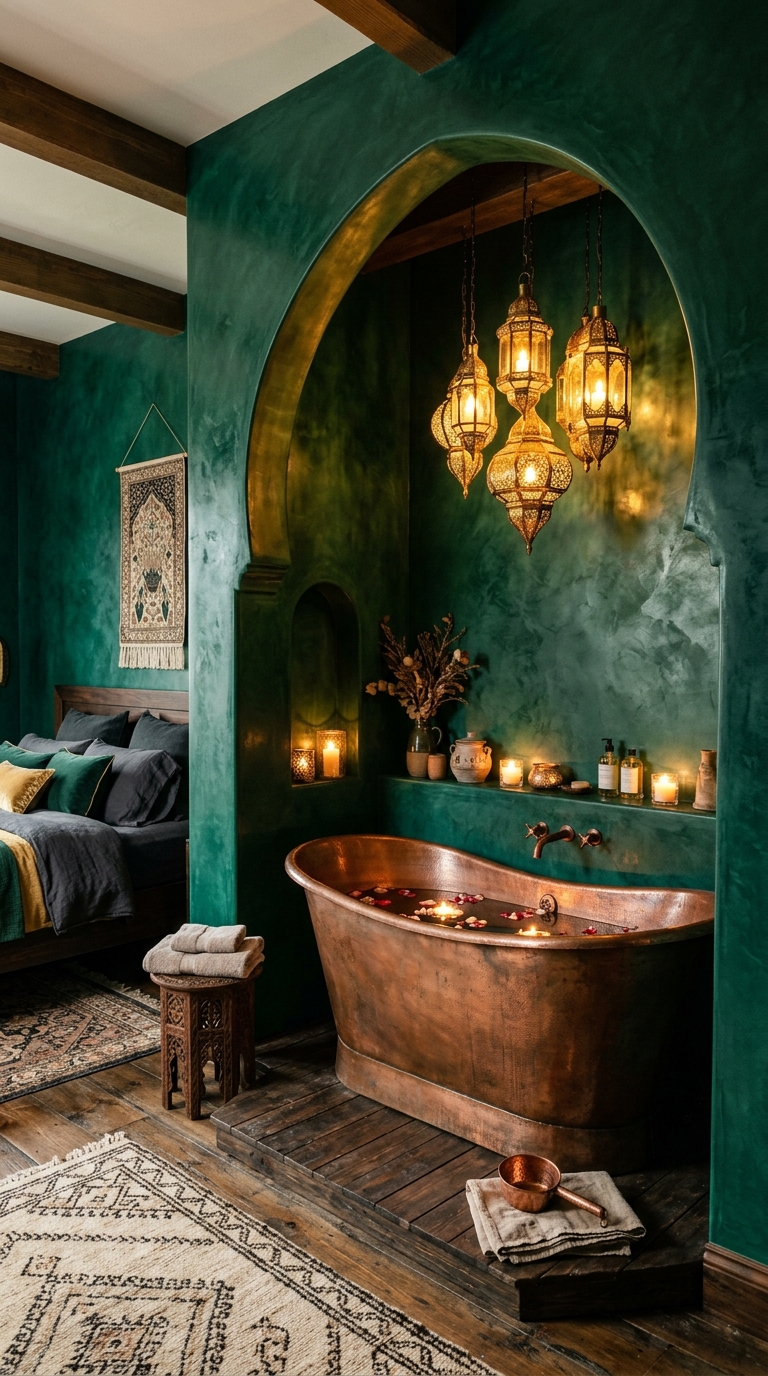
Tadelakt is a traditional Moroccan waterproof lime plaster that gets polished with olive oil soap to create this gorgeous, slightly luminous, almost wax-like finish. It is completely smooth, totally waterproof, and visually unlike anything else in the world.
Imagine an arched or rectangular recess carved out of the bedroom wall — big enough for a freestanding copper soaking tub or a built-in upholstered reading bench — and the entire interior of that alcove finished in deep green tadelakt. The texture catches light differently than paint, differently than tile, differently than wallpaper. It feels ancient and luxurious at the same time.
This works especially well in:
- Primary bedrooms with larger square footage
- Rooms with high ceilings where the architectural alcove can have real presence
- Homes in the Southwest or California with adobe or stucco construction that suits Moroccan-adjacent finishes
If a full alcove is not in your budget or your floor plan, you can fake a similar effect by applying dark green venetian plaster to a single recessed area — even a small window seat nook — and polishing it to that same luminous finish.
Dark Green Ceiling With a White Coffered Grid
Most people only think about what color to paint their walls. But the fifth wall — your ceiling — is one of the most underused design opportunities in any bedroom.
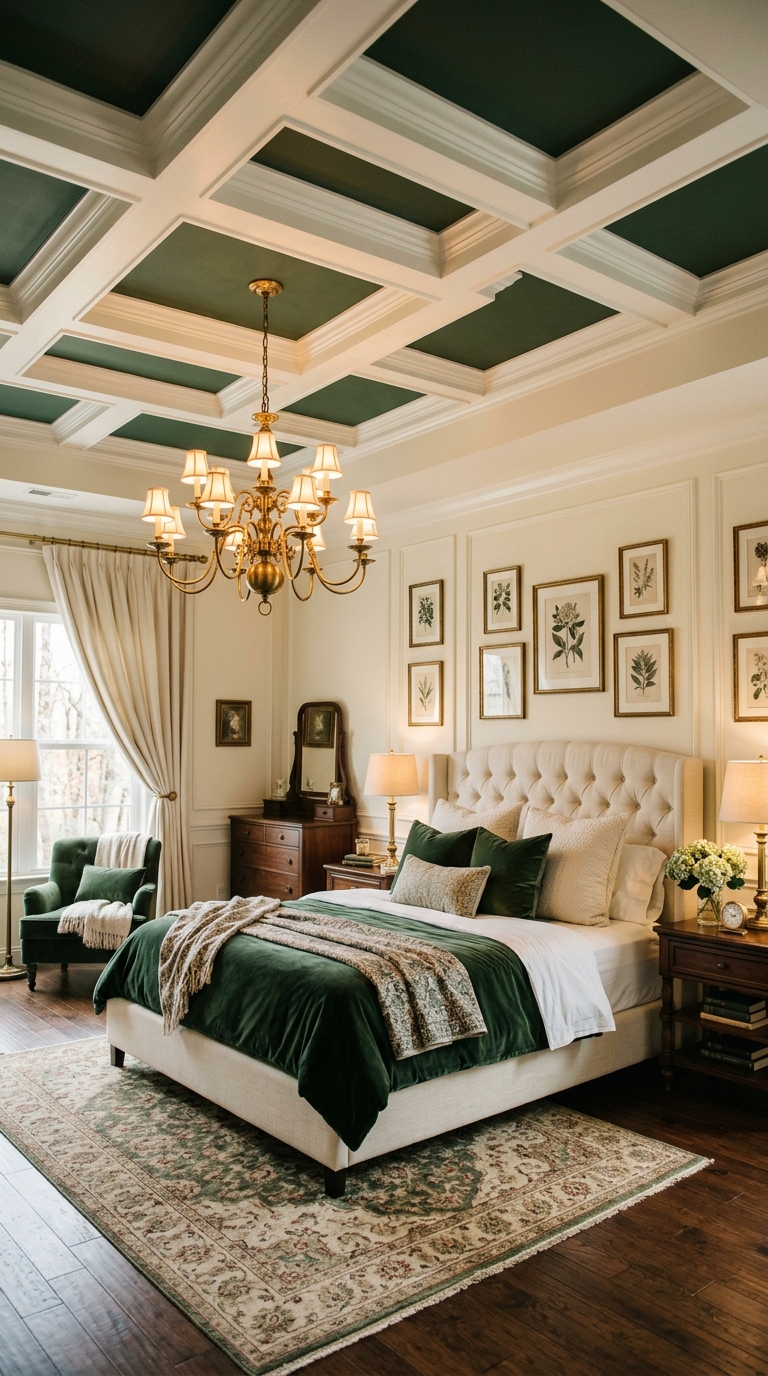
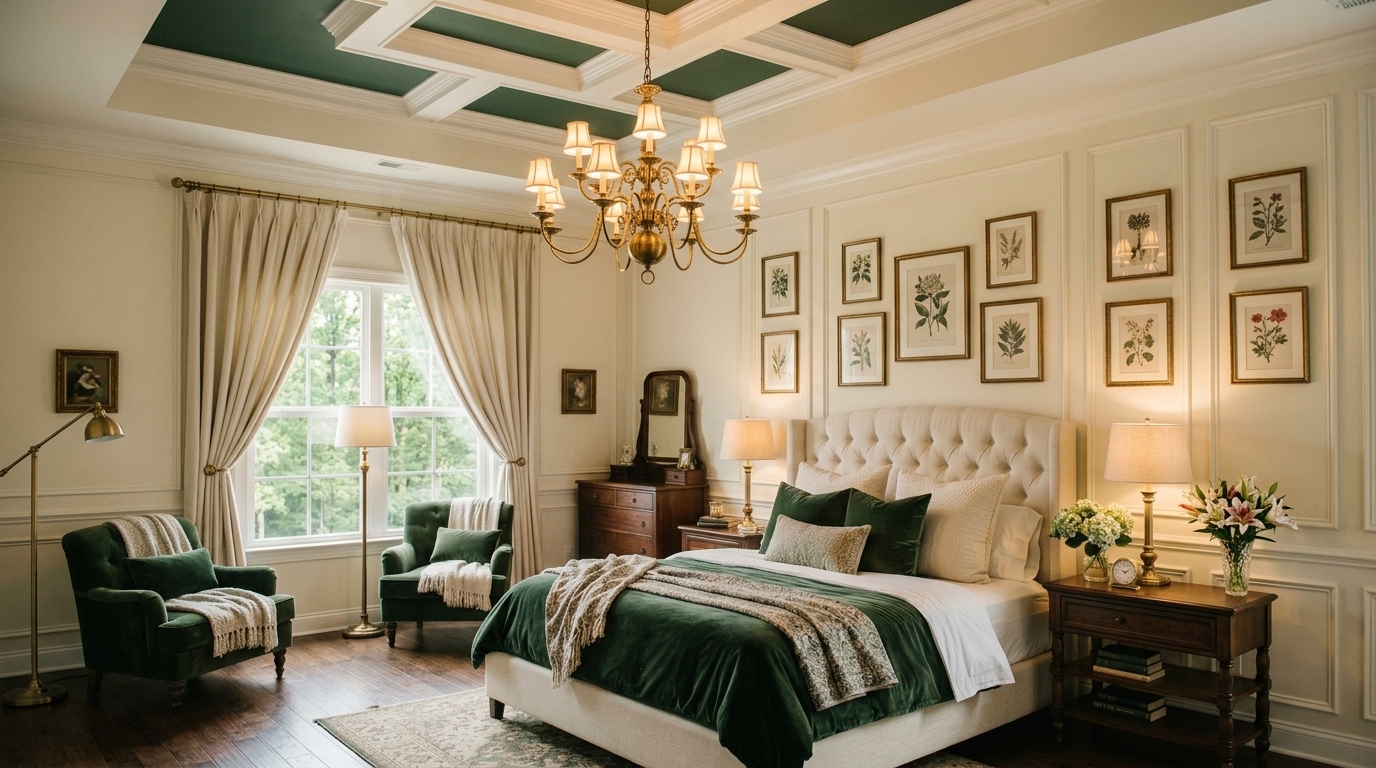
Dark green coffered ceilings are having a moment, and they deserve all the attention they are getting. Here is the thing about a coffered ceiling: those architectural grid panels give you the perfect built-in structure to work with color drama. When you paint the flat field of each coffer in deep forest green and keep the raised beams and trim in crisp white or warm ivory, the effect is unexpected and deeply sophisticated.
This idea works even if your room is modest in size, because the visual weight of the coffered ceiling draws the eye upward and actually makes the room feel taller, not smaller. The green ceiling reflects softly downward and adds this warmth and depth to everything below it — your bedding glows a little more warmly, your wood furniture looks richer, and the whole room feels like it has good bones.
Pair this with:
- Walls in soft white, warm greige, or even a pale sage that bridges the ceiling color downward
- A linen or velvet upholstered bed in cream or biscuit tones
- A pendant light or chandelier in aged brass that anchors the center of the coffered grid
- Deep green velvet throw pillows that echo the ceiling color
Dark Green Bedroom With a Rattan Four-Poster Canopy and Botanical Batik Curtains
This idea mixes materials and cultures in a way that feels genuinely fresh — not trend-chasing, but deeply considered and full of personality.
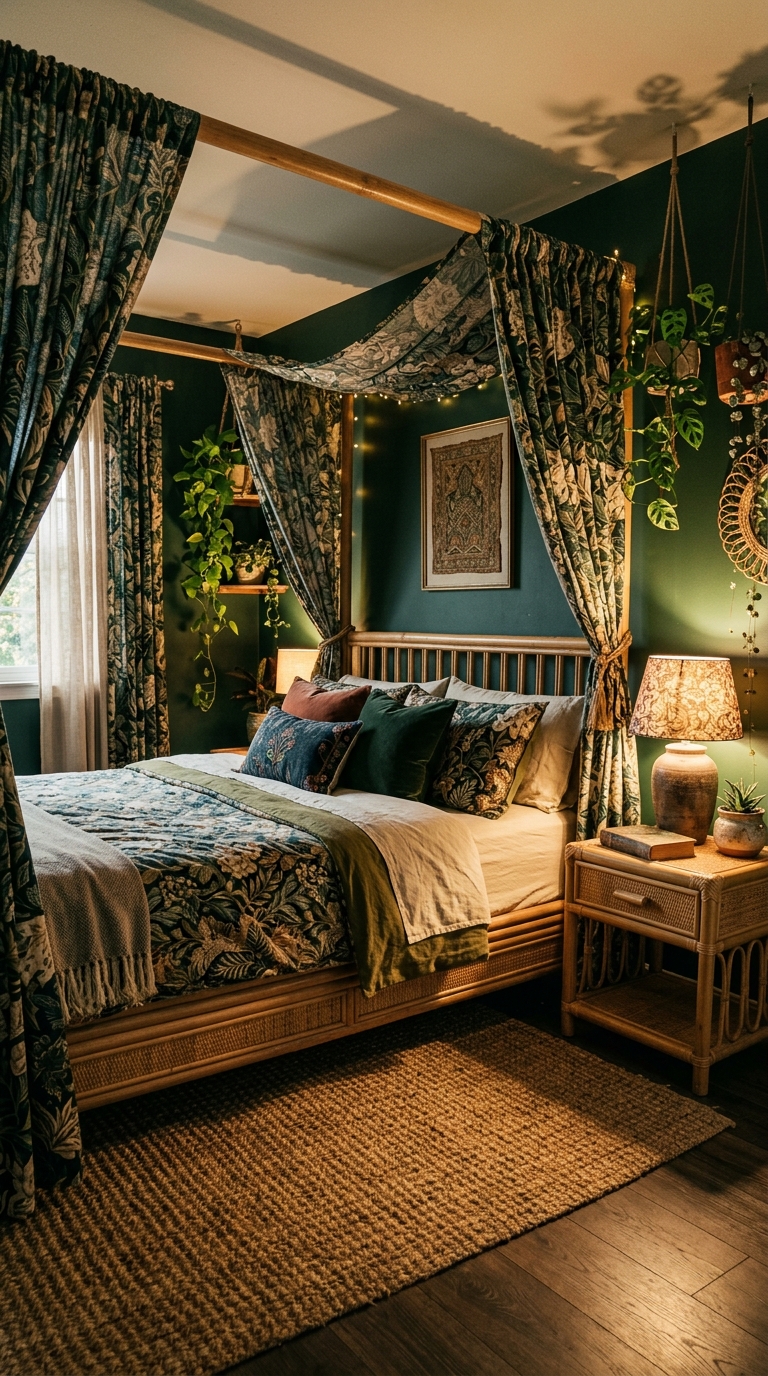
The starting point is a rattan or cane four-poster bed frame. Not the flimsy kind you find in budget catalogs — a real, chunky-rattan or wicker-wrapped frame with presence and weight. The canopy posts give you a structure to hang fabric from, and this is where it gets interesting.
Batik fabric — the hand-dyed, wax-resist textile tradition from Indonesia and West Africa — comes in incredibly beautiful dark green botanical patterns. Rich, inky greens, tropical leaf shapes, deep indigo-blue vine patterns, all woven into fabric that has genuine handmade soul. When you drape these textiles from the top of a rattan four-poster as loose, flowing canopy curtains, the effect is unlike anything you will find on a mood board.
The rest of the room stays intentionally relaxed:
- Walls in deep hunter or bottle green with a matte finish
- Natural coir or sisal rug on the floor
- A rattan nightstand with a hand-thrown ceramic lamp base
- Trailing pothos plants on floating shelves in one corner
- Wicker storage baskets that double as decor
This is a bedroom for someone who has traveled, who collects things with meaning, who finds beauty in the handmade over the mass-produced.
Dark Green Fluted Wood Paneling as a Full Headboard Wall
Fluted and reeded wood paneling is one of the most tactile, visually interesting wall treatments available right now — and when you paint it dark green, the depth created by those vertical grooves is extraordinary.
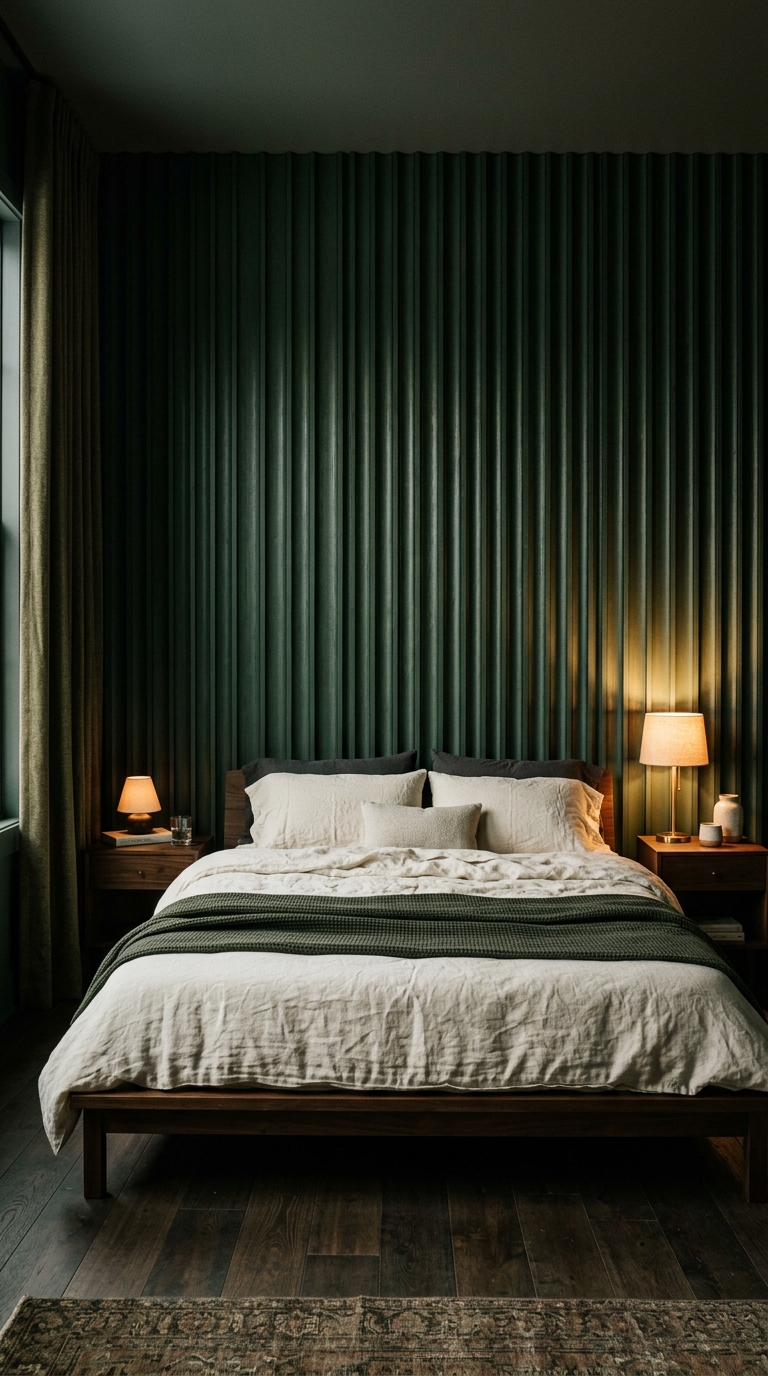
Here is why this works so beautifully: fluted paneling creates shadow. Every groove runs vertically from floor to ceiling (or floor to dado height), and the light plays in and out of each channel differently depending on where your lamps are positioned. In dark green, the shadows inside the grooves go almost black, while the raised ridges pick up light and glow in that rich, moody green. The entire wall becomes a three-dimensional texture piece.
This works best as the wall directly behind your bed — your headboard wall — running the full width of the room from floor to ceiling. No artwork needed. No shelves breaking it up. Just that gorgeous, rippled, dark green surface with your bed placed against it like a jewel in a setting.
Keep everything else:
- Warm and neutral: ivory or warm white bedding, no busy patterns
- Low to the ground: a platform or storage bed so the tall paneling has maximum visual impact
- Lit from below: use bedside table lamps that throw light upward against the panels to maximize the shadowing effect
- Accessorized minimally: one sculptural object on each nightstand, that is it
Dark Green Bedroom With a Vintage Industrial Skylight and Botanical Print Wallpaper
This one requires a little architectural luck — or a skylight installation if you are serious — but the effect is genuinely unmatched.
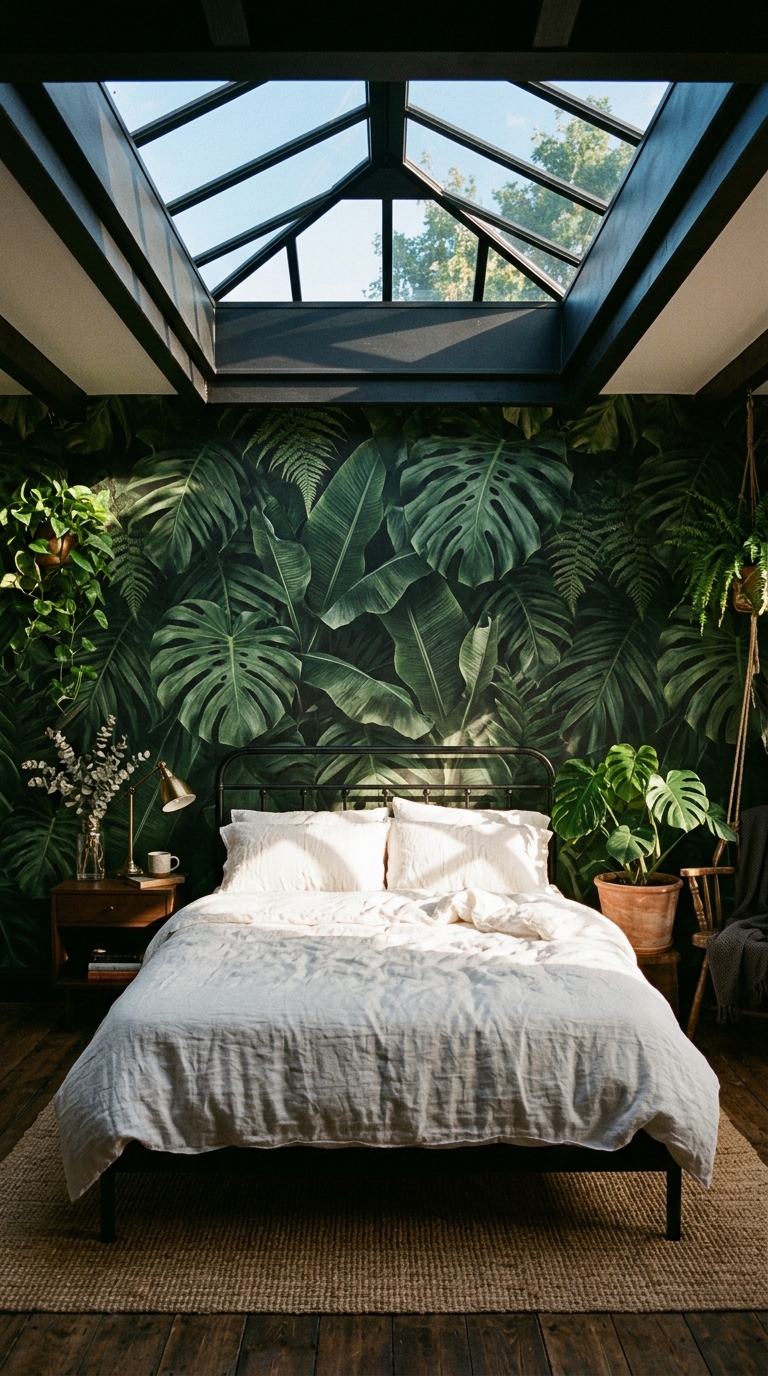
Picture a bedroom where dark green botanical wallpaper (think oversized palm leaves, monstera, or banana plant prints in deep, almost black-green tones) covers three walls. The fourth wall, behind the bed, is painted a complementary deep olive or racing green. And overhead, a steel-framed vintage industrial skylight brings in a column of natural light that falls directly onto the bed.
The magic of a skylight in a dark green bedroom is the way natural light interacts with the green pigments around it. In the morning, the room feels like waking up inside a rainforest canopy. At night, with the skylight dark and your bedside lamps glowing, the room becomes this incredible cocoon — deep, rich, and quiet in the best possible way.
The industrial skylight frame (matte black steel is the ideal finish) adds a sharp, graphic element that prevents the botanical wallpaper from getting too soft or romantic. It is that combination of raw and lush that makes this room feel like it belongs in a converted warehouse in Brooklyn that somehow became the most beautiful home on the planet.
Dark Green Bedroom With a Micro-Mosaic Tile Niche and Hammered Brass Fixtures
This idea takes a detail most people reserve for bathrooms and brings it into the bedroom — and it is absolutely stunning when executed well.
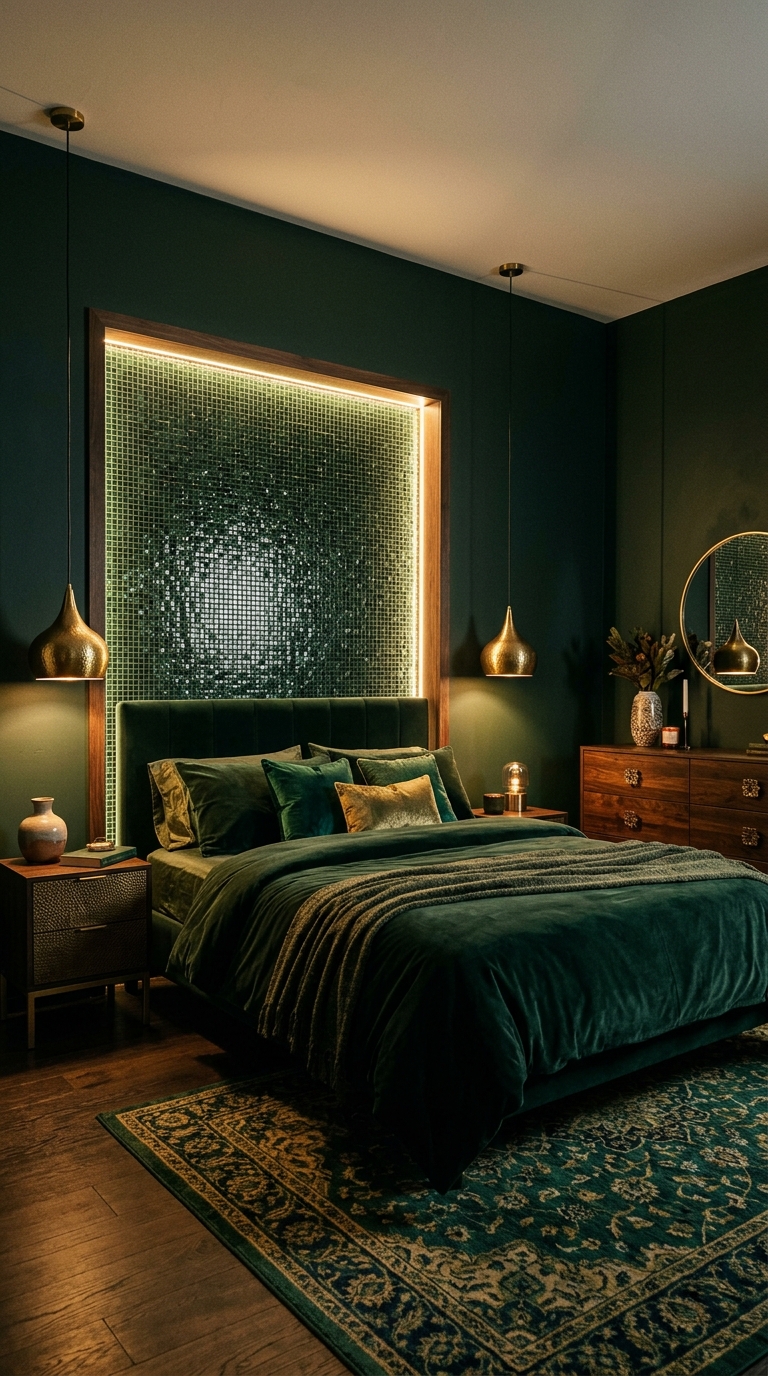
A micro-mosaic tile niche — recessed into the wall and framed in natural plaster or stone — can serve as an illuminated display shelf behind or beside the bed. Fill that niche with tiny, iridescent green glass mosaic tiles in a deep, jewel-toned shade. The tiles catch every sliver of light and scatter it in tiny points across the dark green walls.
The niche itself gets lit from within: a small LED strip along the top edge with a warm-white or amber color temperature, just enough to make the tiles shimmer without being harsh.
Hammered brass fixtures throughout the room — bedside pendant lights, drawer pulls on a dark wood dresser, a mirror frame above a low chest — complete the sensory richness of this room. Hammered brass has a beautiful irregularity to its surface that mirrors the imperfect quality of handmade tile work.
This is a design strategy that rewards slowing down. Every surface in this bedroom gives you something to look at — not in a cluttered or overwhelming way, but in the way that a really beautiful hotel suite does, where every detail was thought through.
Dark Green Bedroom With a Floor-to-Ceiling Library Wall
Books and dark green walls belong together the way coffee belongs with a slow Sunday morning. There is something about the combination that just makes your whole nervous system settle.
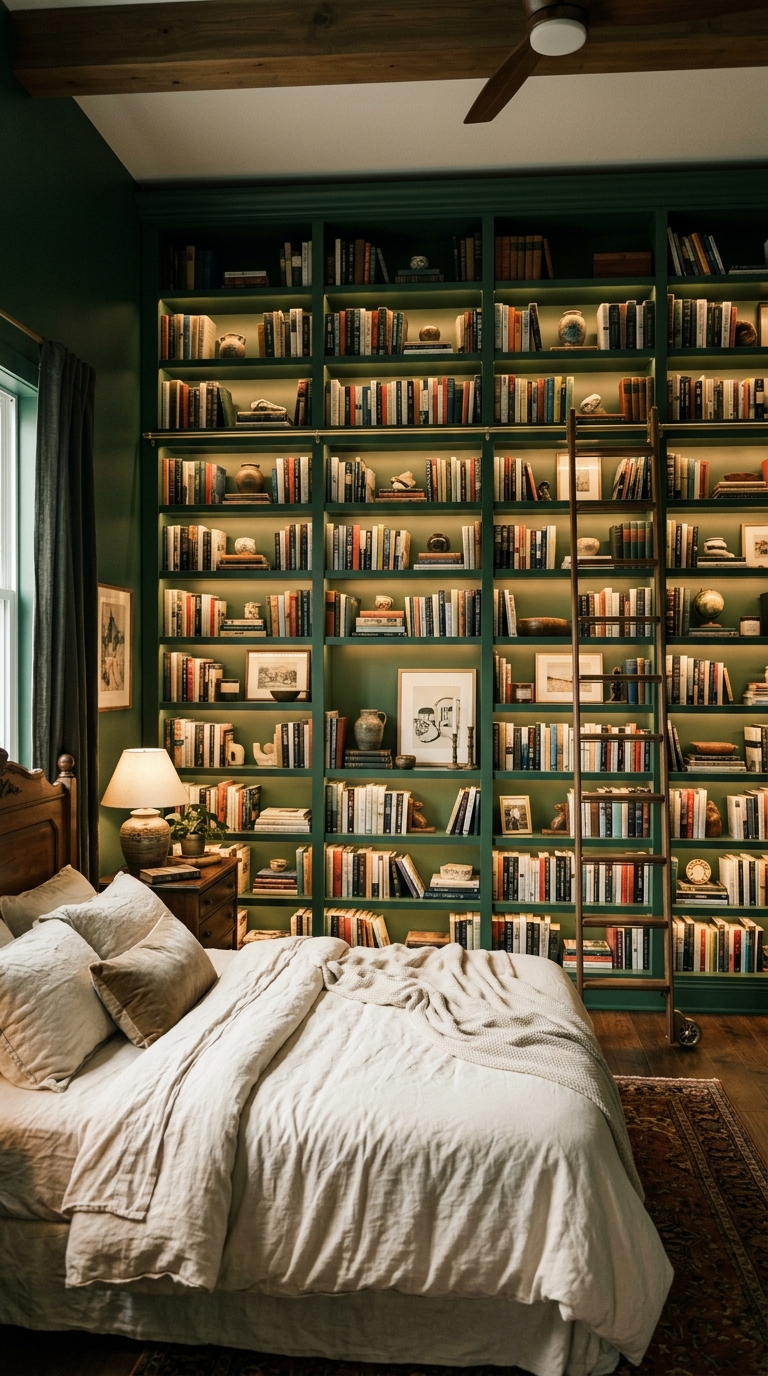
A floor-to-ceiling built-in bookshelf painted the same dark green as your walls (or one shade deeper, for dimension) creates an immersive, enveloping effect that no standalone bookcase can replicate. When the shelving disappears into the wall color, your eye stops registering it as furniture and starts reading the whole wall as a single rich, layered surface — punctuated by the spines of books in every color, framed photos, small sculptures, and candles.
The key decisions that make this work:
- Paint the shelves the exact same green as the wall, or go one shade darker to create shadow-like depth
- Use the shelves for a mix of books and objects — not just books, which can look austere
- Add warm lighting inside the shelves: small puck lights or LED strips tucked under each shelf lip
- Keep the bedding simple and pale — cream or warm white — so the book wall is the undisputed star
- Add a rolling library ladder in dark walnut or matte black if the shelves are tall enough
This idea works especially well in primary bedrooms, guest rooms that double as a private sitting room, or any bedroom where reading is a genuine part of daily life rather than just an aspiration.
Dark Green Bedroom With Dip-Dyed Ombre Linen Curtains
Window treatments are one of the most overlooked design decisions in a bedroom — and they are also one of the highest-impact changes you can make for the money.
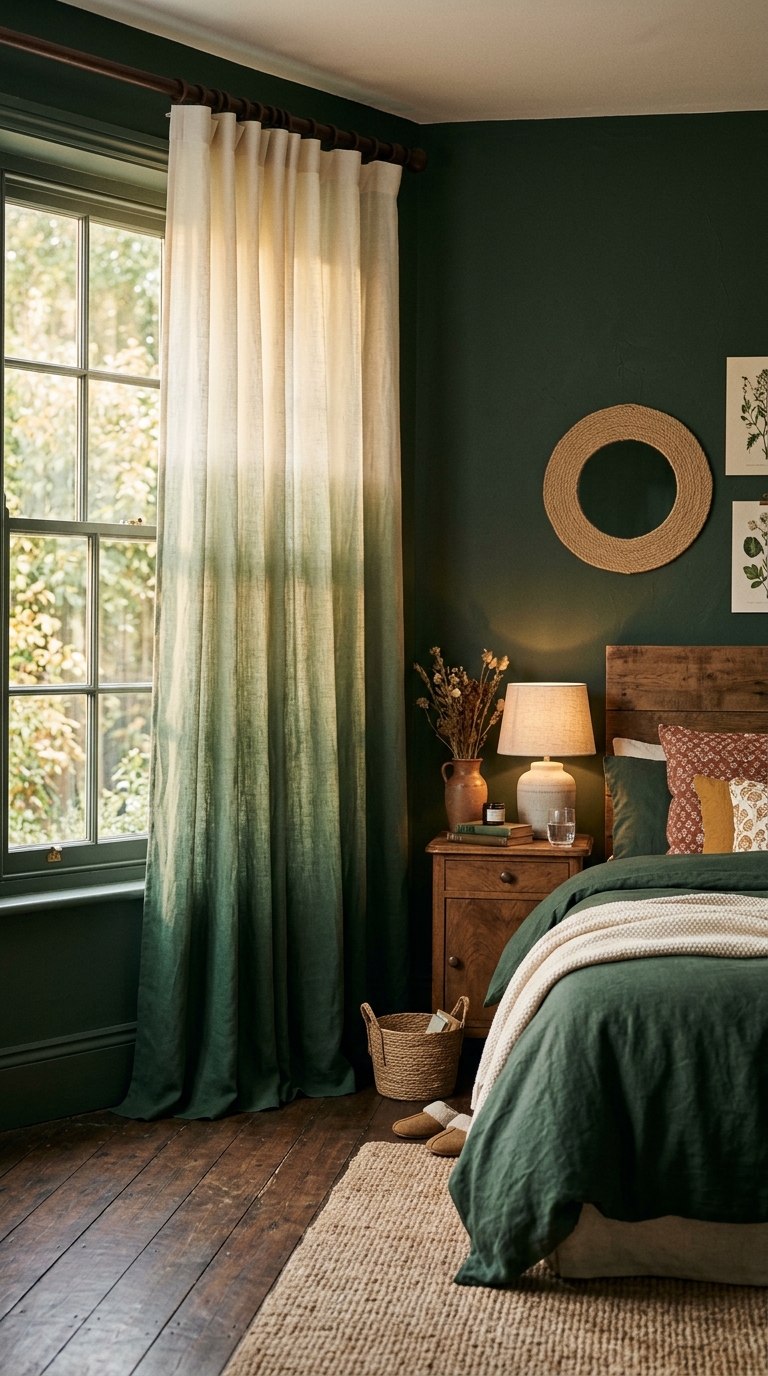
Ombre dip-dyed linen curtains in a dark-green-to-cream gradient bring so much visual movement and artisan texture to a room. The curtains start pale and neutral at the top, where they hang from their rod, and deepen gradually to a rich dark green at the hem that pools softly on the floor.
What makes this idea powerful in a dark green bedroom:
- The gradient curtains create a sense of vertical movement — your eye travels upward from the darkest green at the floor toward the pale cream at the ceiling, which makes the room feel taller
- The linen fabric diffuses incoming light beautifully, turning any window into a soft glowing source of warmth
- The ombre effect means the curtains pick up and echo both the dark green of the walls AND the lighter tones of your bedding without being matchy-matchy about it
- Handmade dip-dyed curtains feel utterly unique in a way that printed or block-color curtains simply do not
You can commission ombre-dyed linen curtains from independent textile makers on Etsy (look for natural plant-dye options using indigo and weld for a particularly beautiful green) or DIY your own with a fiber-reactive dye kit and an afternoon of patience.
Dark Green Bedroom With a Blackened Steel Canopy Frame and Organic Cotton Gauze Drape
Here is the kind of bedroom that stops you mid-scroll and makes you save the image three times before you even realize what you are looking at.
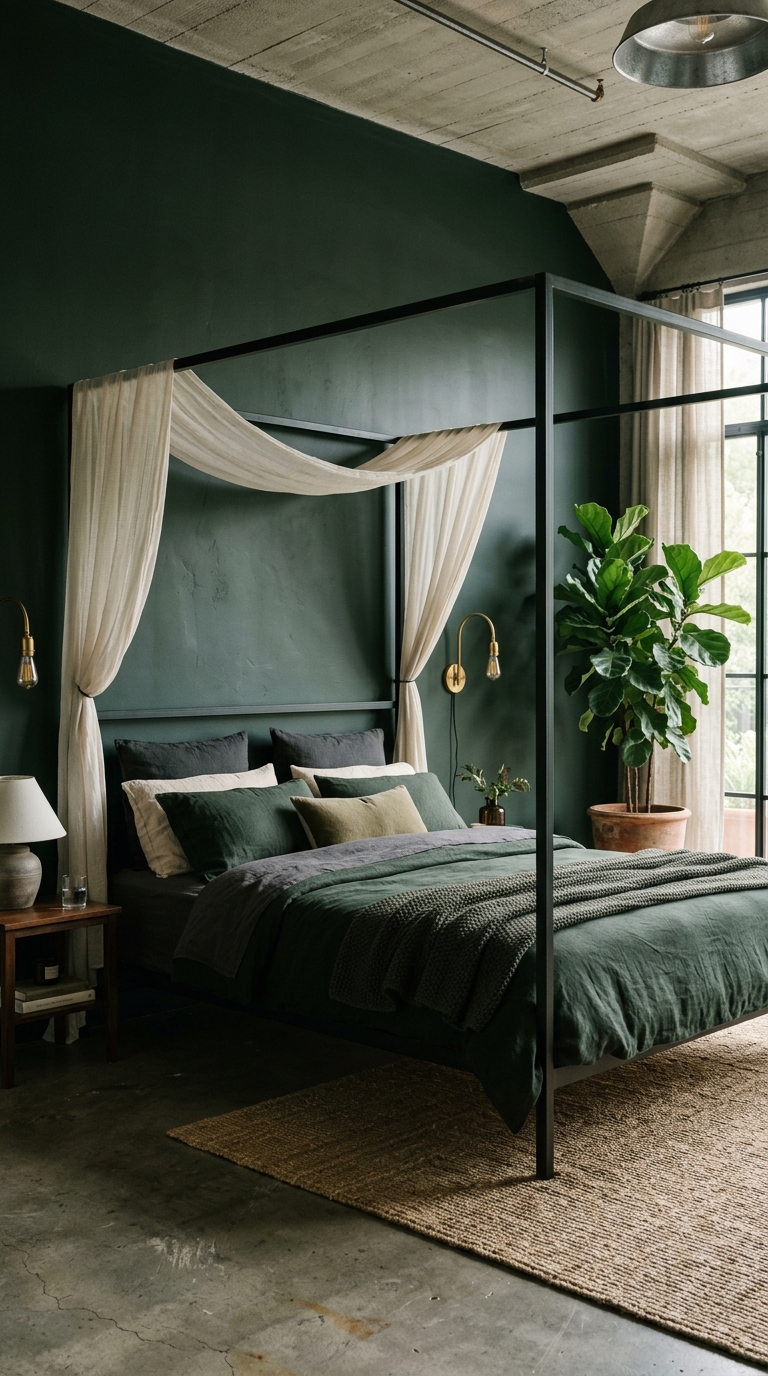
The centerpiece is a blackened steel canopy frame — raw, geometric, completely unadorned — positioned around and above the bed. This is not the elaborate carved-wood or fabric-topped four-poster of a traditional canopy bed. This is architectural. Clean lines. Visible welded joints. Industrial but refined.
From that matte-black steel frame, you drape panels of organic cotton gauze — the kind of fabric that is nearly transparent, almost white, impossibly light. The gauze falls from the frame in soft, unstructured cascades that contrast against the darkness of the steel and the richness of the dark green walls behind.
The green walls (deep bottle green or dark teal-green in a matte or eggshell finish) make the white gauze almost luminous by comparison. The black steel frame is the graphic punctuation mark that keeps everything from going too soft or dreamy.
Pair with:
- Stone or concrete flooring — polished or honed, not glossy
- A low-profile mattress directly on a blackened steel frame (no box spring)
- A single large potted fiddle-leaf fig or olive tree in one corner
- Unlacquered brass wall sconces on either side of the bed
Dark Green Bedroom With a Painted Geometric Mural Behind the Bed
This one requires either a steady hand or a hired muralist — and it is absolutely worth every penny if you can stretch to it.
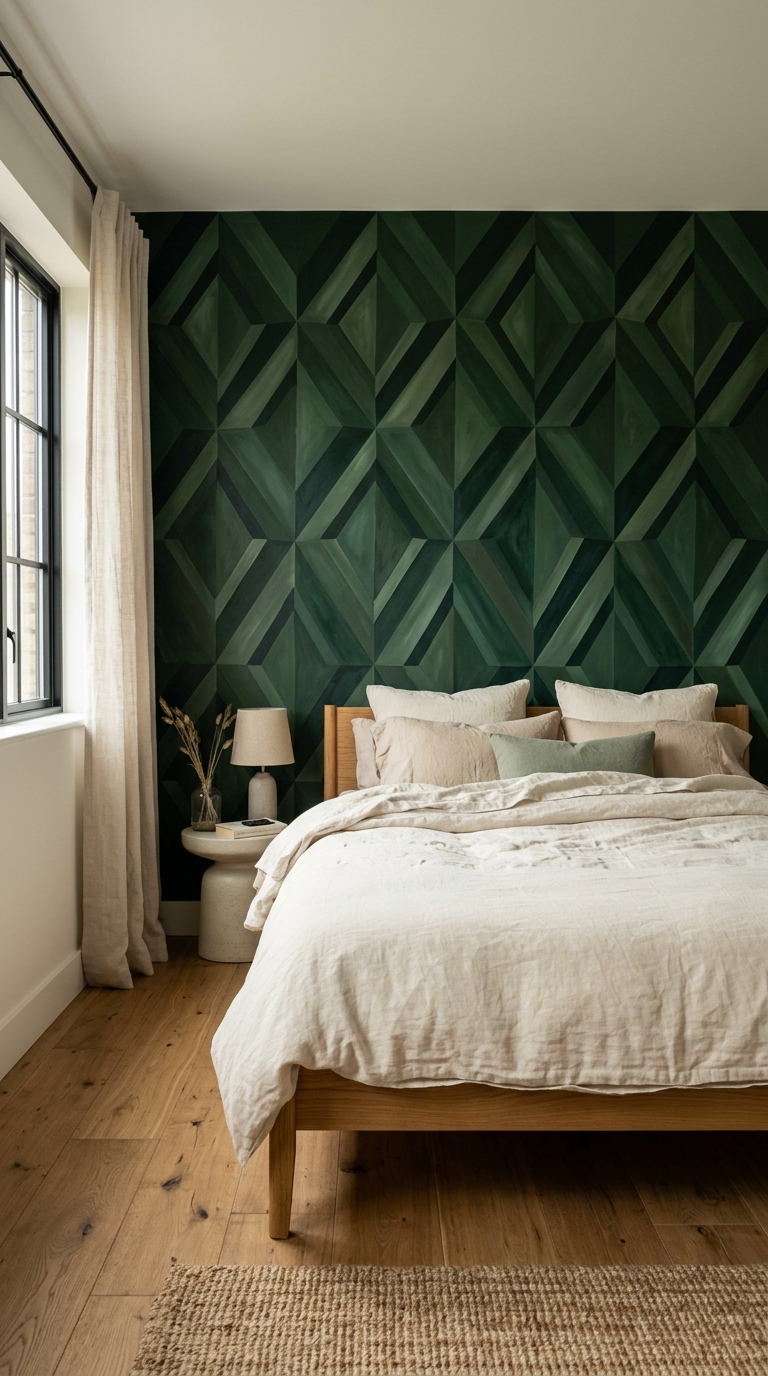
A hand-painted geometric mural in varying shades of dark green directly behind the bed creates a one-of-a-kind feature wall that no wallpaper, no art print, and no accent color can replicate. We are not talking about a simple triangle pattern or basic chevron. Think large-scale interlocking rhombuses, overlapping hexagons, or an abstract architectural grid — all executed in a carefully graduated palette of greens.
The palette within the mural might include:
- Deep forest green as the base tone
- Emerald green one shade lighter as a midtone
- Olive or moss green for the highlighted, forward-facing planes
- Near-black green for the deepest shadow areas
The three-dimensional trompe-l’oeil effect created by this shading makes your flat wall look like a faceted gemstone or a carved bas-relief. It is bold, but it is controlled. It is artistic without being chaotic.
Keep everything else in the room neutral and grounded: natural oak floors, cream bedding, blackened steel light fixtures, and no other pattern anywhere. The mural earns its place as the sole visual focus.
Dark Green Bedroom With Aged Copper Pipes as Architectural Detail
Plumbing pipes as decor sounds industrial. But aged copper — with its patinated blues and greens already alive on the surface — is one of the most beautifully organic materials you can introduce into a dark green bedroom.
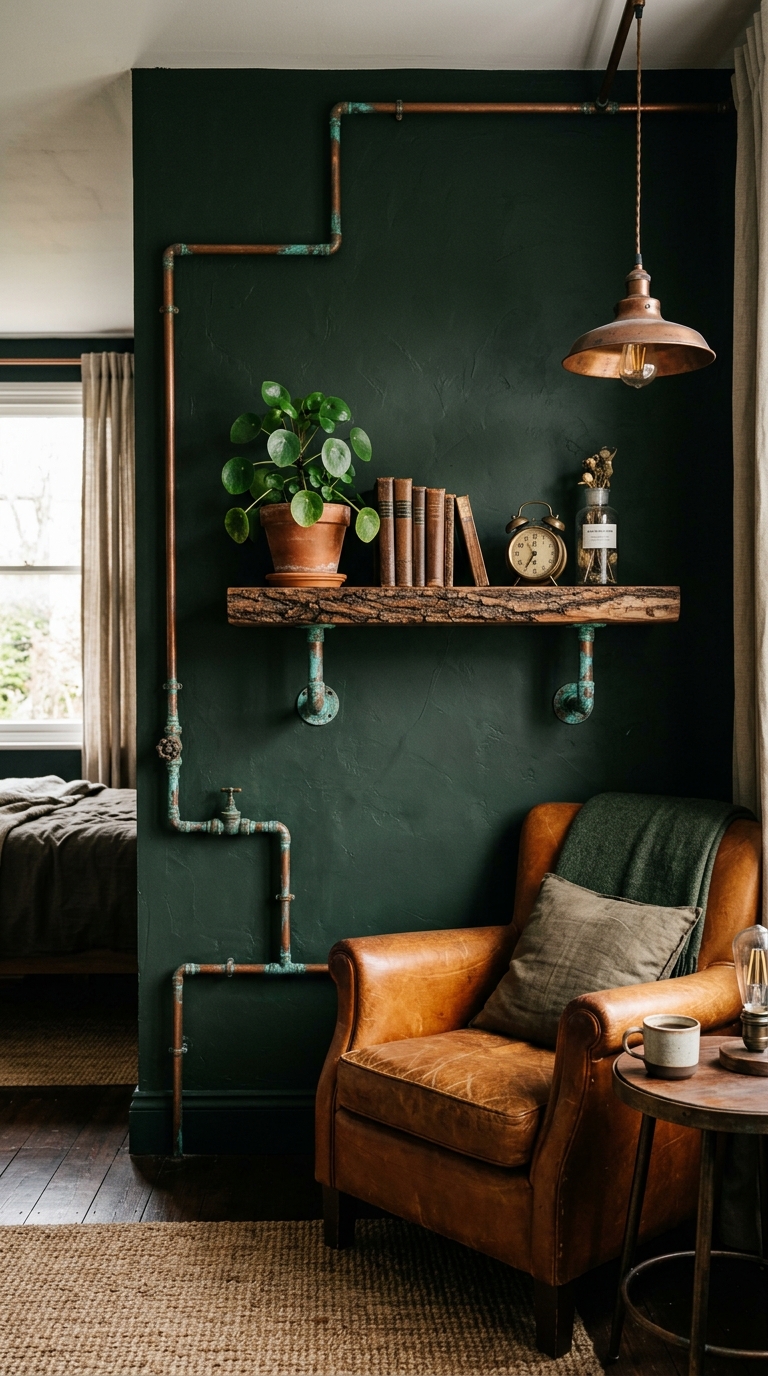
The idea here is simple in concept, remarkable in execution: use genuine aged copper pipes (or new copper pipes allowed to patinate naturally over weeks using a chemical aging solution) as architectural accent elements. These might be:
- Exposed copper pipe runs along the ceiling edge as a decorative trim line
- A custom copper pipe bedside hanging rail for books, a reading lamp, and a small trailing plant
- Copper pipe supports for a floating wooden shelf beside the bed
- A sculptural copper pipe coat-and-hook wall piece near the bedroom door
The green tones in aged copper patina — verdigris is the technical name for that blue-green oxidation — create a genuinely beautiful conversation between the copper surface and the dark green walls. Your room starts to feel like something grown rather than designed.
Natural wood elements (a live-edge shelf, a slab-wood nightstand) and aged leather accessories (a small leather-bound journal on the nightstand, a leather chair in the corner) complete this aesthetic beautifully.
Dark Green Bedroom With a Sunken Lounge Floor Area and Conversation Pit Seating
If you are lucky enough to have a larger bedroom, or if you are in a new build or renovation where architectural changes are on the table, this idea will completely change the way you think about your bedroom.
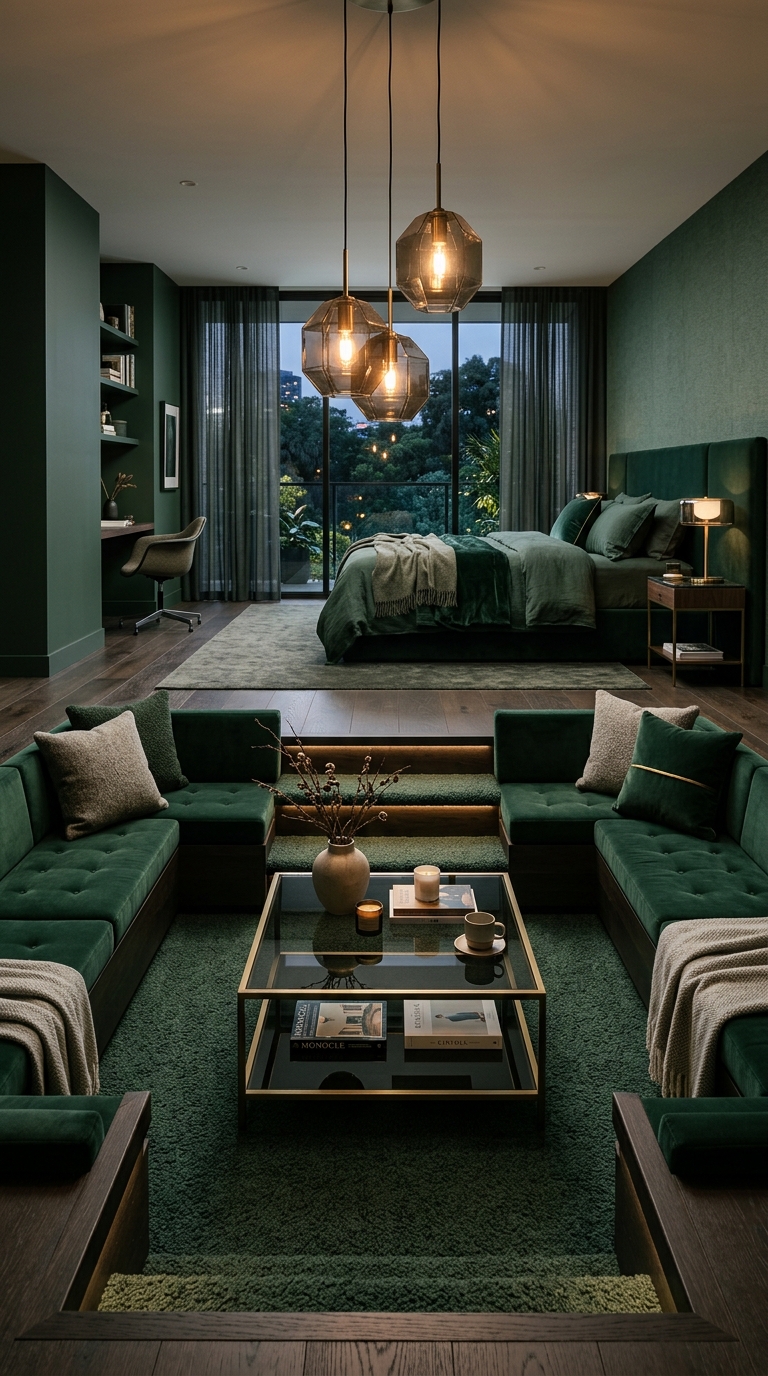
A sunken lounge area — a conversation pit — set at one end of the bedroom creates a distinct “zone” within the room that feels luxurious and completely separate from the sleeping space. Step down two or three inches into a carpeted or cushioned lower floor area surrounded by built-in upholstered seating on three sides.
In a dark green bedroom, this sunken pit gets finished in deep green velvet upholstery on the built-in bench seating, dark green boucle or wool carpet on the sunken floor, and a small low coffee table in smoked glass or dark marble at the center. The walls of the bedroom — including those surrounding the conversation pit — stay in the same deep green tone so the entire space feels enveloping and continuous.
A pair of low-hanging pendant lights above the pit at a dimmer level separate from the main bedroom lighting lets you use this area independently — for reading, for morning coffee, for quiet conversation with a partner — without disturbing the sleeping half of the room.
Dark Green Bedroom With Hand-Block-Printed Wallpaper in a Botanical Repeat
This idea celebrates craftsmanship — real, human craftsmanship — in a way that mass-produced design rarely can.
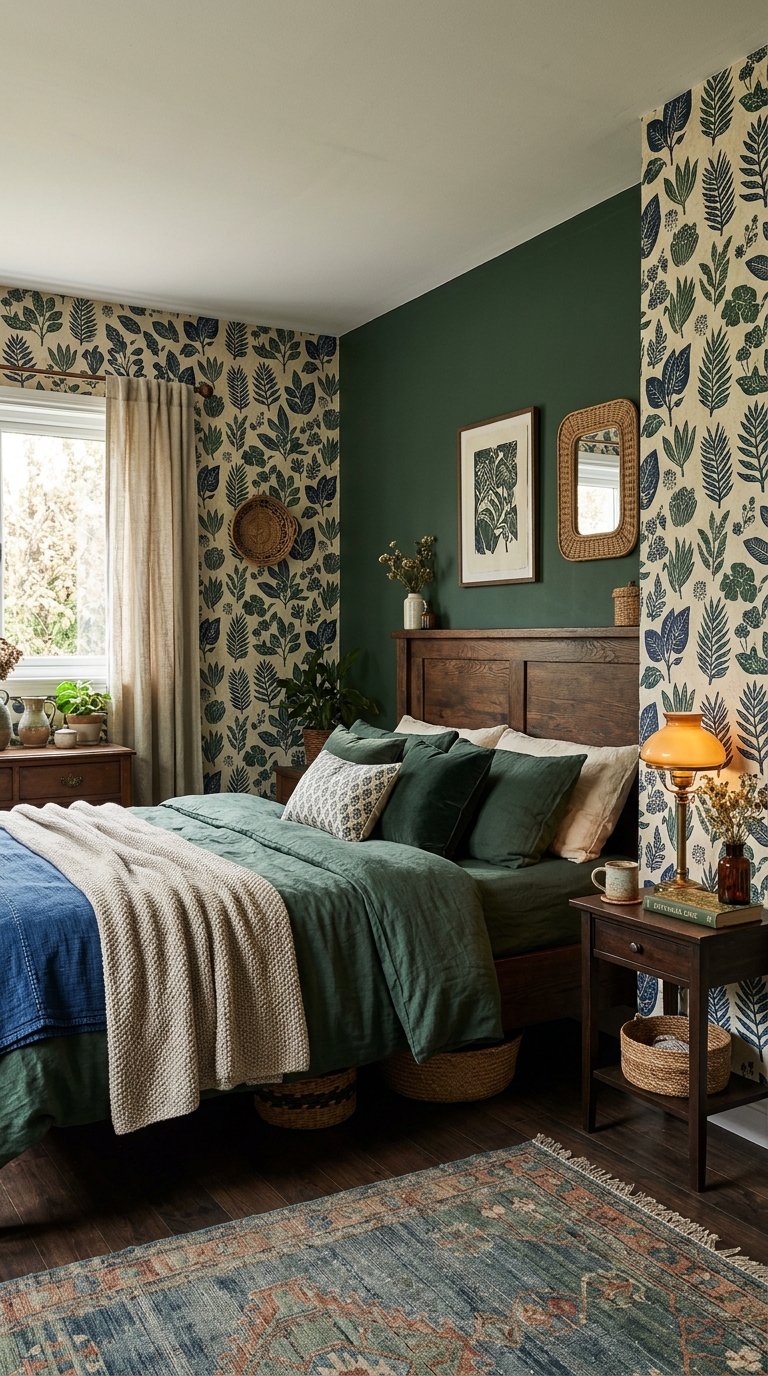
Hand-block-printed wallpaper in a botanical pattern is the kind of thing your great-grandmother might have had in her most beautiful room, and it is also precisely the kind of thing that feels completely fresh and interesting in 2025. The irregularities in block-printed patterns — the slight misalignment, the variation in ink pressure, the places where the block lifted a fraction early and left a ghost impression — give the surface a warmth and authenticity that digital prints on vinyl simply cannot manufacture.
For a dark green bedroom, you want a hand-block-printed design in:
- Deep navy, hunter green, and forest green tones on a warm ivory or aged linen base
- Large-scale botanical subjects — magnolia branches, fig leaves, fern fronds, or tropical palm patterns
- Printed in an irregular, naturalistic repeat rather than a perfectly mechanical grid
This wallpaper goes on three walls. The fourth wall — your headboard wall — gets a deep, matching dark green paint in matte finish. The contrast between the pattern and the solid creates exactly the right visual balance: rich and layered, but never busy.
Source hand-block-printed wallpapers from independent makers in India (Jaipur in particular has extraordinary block-printing heritage) or from specialist wallpaper studios in the UK. Many ship internationally and the price point, considering what you are getting, is genuinely reasonable.
Dark Green Bedroom With a Floating Moss Wall Art Installation
We are saving the most genuinely unexpected idea for last — and this one you will not find on any competitor’s blog.
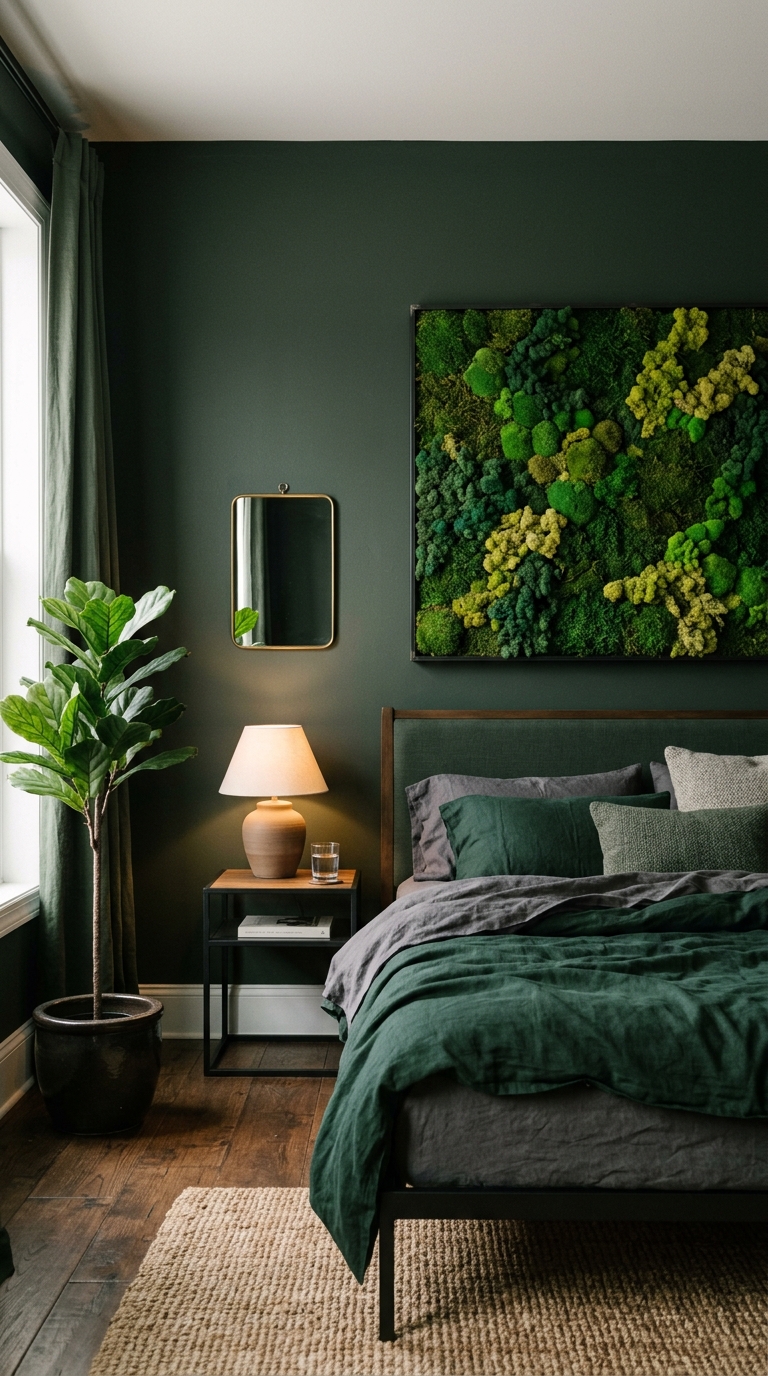
A preserved moss wall art installation — not a plant, not wallpaper, but actual preserved natural moss arranged in a framed panel or a free-form organic shape — on the bedroom wall is one of the most extraordinary and genuinely nature-connected things you can bring into your home.
Preserved moss requires no water, no sunlight, no maintenance. It stays a rich, deep green indefinitely. It absorbs sound beautifully, making your room noticeably quieter. And against dark green walls, it creates this incredible tonal layering — two greens side by side, but one flat and painted and one dimensional, living-textured, organically complex.
Here is how to design around it:
- Hang a large custom moss panel (or an arrangement of three smaller panels in an asymmetric grouping) on the wall beside the bed rather than behind it — so you can see it from lying down
- Frame the moss in raw wood, blackened steel, or leave it unframed with the moss running edge to edge for a more sculptural look
- Mix different moss varieties within the panel — flat sheet moss, reindeer moss (which has a beautiful branching texture), and cushion moss for dimension
- Keep the rest of the room’s decor spare and earth-toned so the moss panel is clearly the centerpiece
This is a bedroom that wakes you up feeling like you slept in an ancient forest. And honestly, that is exactly what more of us need.
What Color Pairs Best With Dark Green in a Bedroom?
Now that you have 16 genuinely fresh directions to explore, let us talk briefly about color pairing — because even the best idea falls flat if the supporting palette is off.
Dark green works beautifully with a surprisingly wide range of companions:
- Warm neutrals (cream, beeswax, warm greige) soften the intensity and keep the room from feeling heavy
- Aged brass and unlacquered copper add warmth and organic chemistry with green’s natural associations
- Matte black and charcoal sharpen the room and add a graphic, contemporary edge
- Deep burgundy or wine red create a jewel-box, maximalist richness that feels theatrical in the best way
- Raw natural wood (walnut, white oak, teak) grounds the room in nature and prevents it from feeling artificial
- Dusty blush or terracotta bring unexpected warmth that most people do not see coming — and absolutely works
The one combination to use with caution: dark green and pure bright white. It can veer toward clinical or kitschy if you are not careful. Opt for warm ivory, aged linen, or warm cream over a stark, cool white and you will thank yourself every morning.
Do Dark Green Bedrooms Work in Small Rooms?
Yes — and here is the truth that most people get wrong about dark colors in small spaces. Dark green does not shrink a room. It removes the walls. When your bedroom is painted a deep, saturated green, you stop seeing the walls as boundaries and start experiencing the room as an atmosphere. The space actually feels more expansive because your brain is no longer registering where the room ends.
The trick in a small dark green bedroom is:
- Keep your ceiling light (pale cream or soft white) to maintain a sense of height
- Use mirrors strategically to borrow light and reflect it back through the room
- Choose furniture with legs rather than floor-length pieces so the floor stays visible and the room feels airier
- Layer your lighting: do not rely on a single overhead fixture — use bedside lamps, wall sconces, and floor lamps to create warmth at multiple levels
A small dark green bedroom done well feels like the coziest, most intentional room in the house. People always want to stay in it longer than they planned to.
Final Thought
Dark green is not just a trend. It is a response to something deeper — a collective desire for spaces that feel rooted, calm, and genuinely meaningful. We are all a little tired of beige. We are all looking for a bedroom that makes us feel something real when we walk in.
Whether you start with a single moss wall panel, a painted coffered ceiling, or a full limewash treatment on every surface, you are making a statement that this room is taken seriously. That rest is taken seriously. That beauty matters — not just in the things you can buy, but in the space you come home to every single day.
Pick the idea that made you feel something. Start there. The rest will follow.