Can These 15 Small Apartment Decorating Ideas Make Your Home Look Bigger?
Be honest — have you ever walked into your small apartment after a long day and felt like the walls were closing in? Like no matter what you do, it still feels cramped, cluttered, or just… blah? You are not alone. Millions of people live in compact apartments across the US, and most of us are Googling the same thing late at night: how do I make this tiny space feel like home?
Here’s the good news — you don’t need a renovation budget or a design degree. You just need the right ideas. And not the same recycled tips you’ve already read a hundred times. We’re skipping the generic “use mirrors” and “declutter more” advice and going straight to 15 fresh, creative, tested decorating ideas that genuinely transform small apartments into spaces you’ll love coming home to.
Let’s dive in.
Why Small Apartment Decorating Is Actually a Creative Superpower
Living small forces you to be intentional. Every inch matters, and that constraint? It pushes you toward designs that are smarter, more personal, and honestly more beautiful than sprawling spaces that get filled with stuff nobody needs.
The key isn’t to make your apartment look bigger at all costs — it’s to make it feel rich with personality, function, and warmth. When you nail that, square footage stops mattering.
Here’s what we’re covering today:
- Ideas that work for renters and owners alike
- Approaches that blend style with function
- Tips organized clearly so you can pick what fits your space
Build a “Scent Zone” That Anchors Each Room
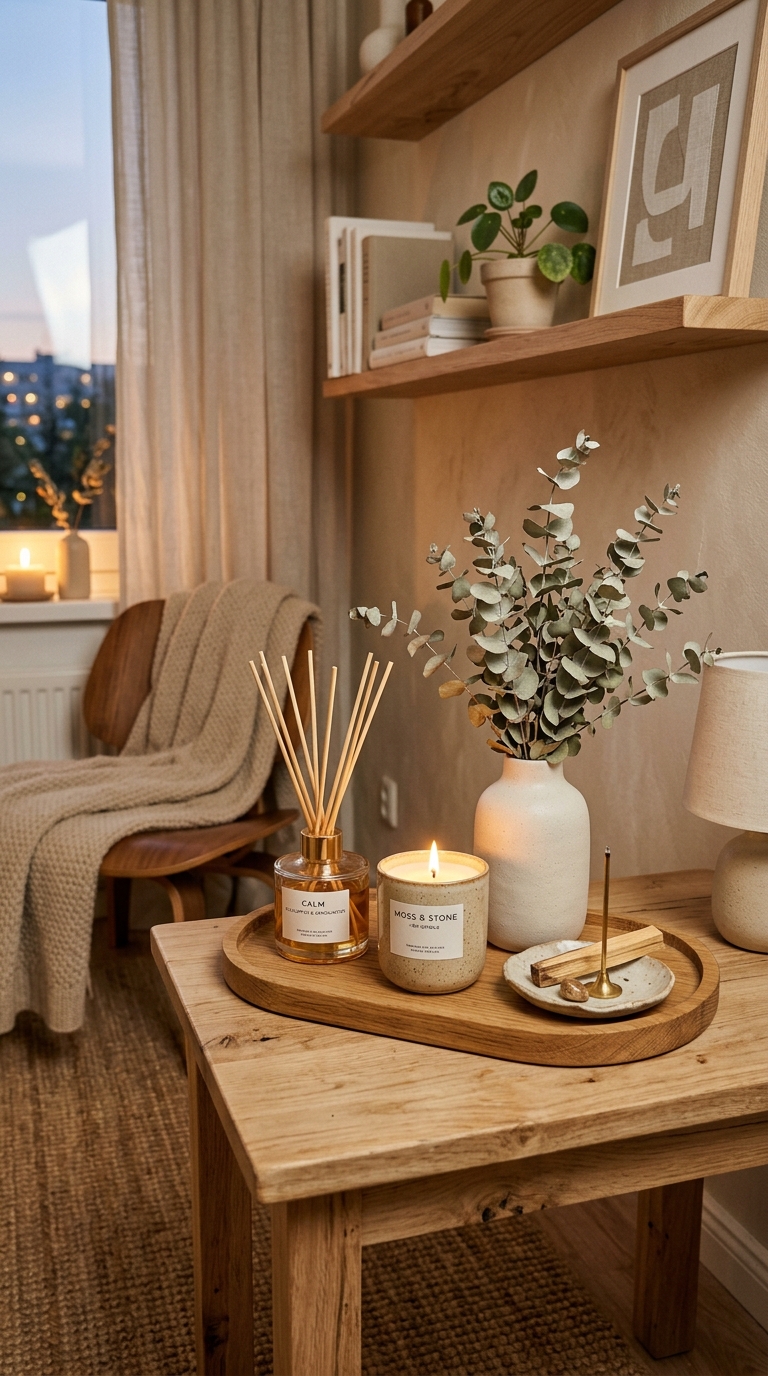
This one surprises people every time, but it works brilliantly. Most small apartment decorating focuses entirely on what you see. But what you smell shapes how spacious and inviting a space feels just as powerfully.
Create a dedicated scent zone — a small tray or corner in each area of your apartment with a reed diffuser, a candle, and one natural element like dried lavender or eucalyptus. This does two things: it adds a purposeful styled vignette that looks designed, and it psychologically signals that each area of your apartment has its own identity.
In a studio apartment especially, scent zoning is a game-changer. Your sleep corner can smell like lavender and cedar. Your work desk area can have a citrus-based diffuser. Your reading nook gets something warm like sandalwood. Your brain starts to register these zones as distinct spaces even when they’re only feet apart. Interior psychologists call this “sensory zoning,” and it genuinely changes how comfortable and expansive a small space feels.
Practical tips:
- Use a wooden or marble tray to keep everything contained and intentional-looking
- Rotate scents seasonally to keep your space feeling fresh
- Avoid mixing more than two scents in one open room — they’ll compete
Install a Pegboard Lifestyle Wall in Your Entryway
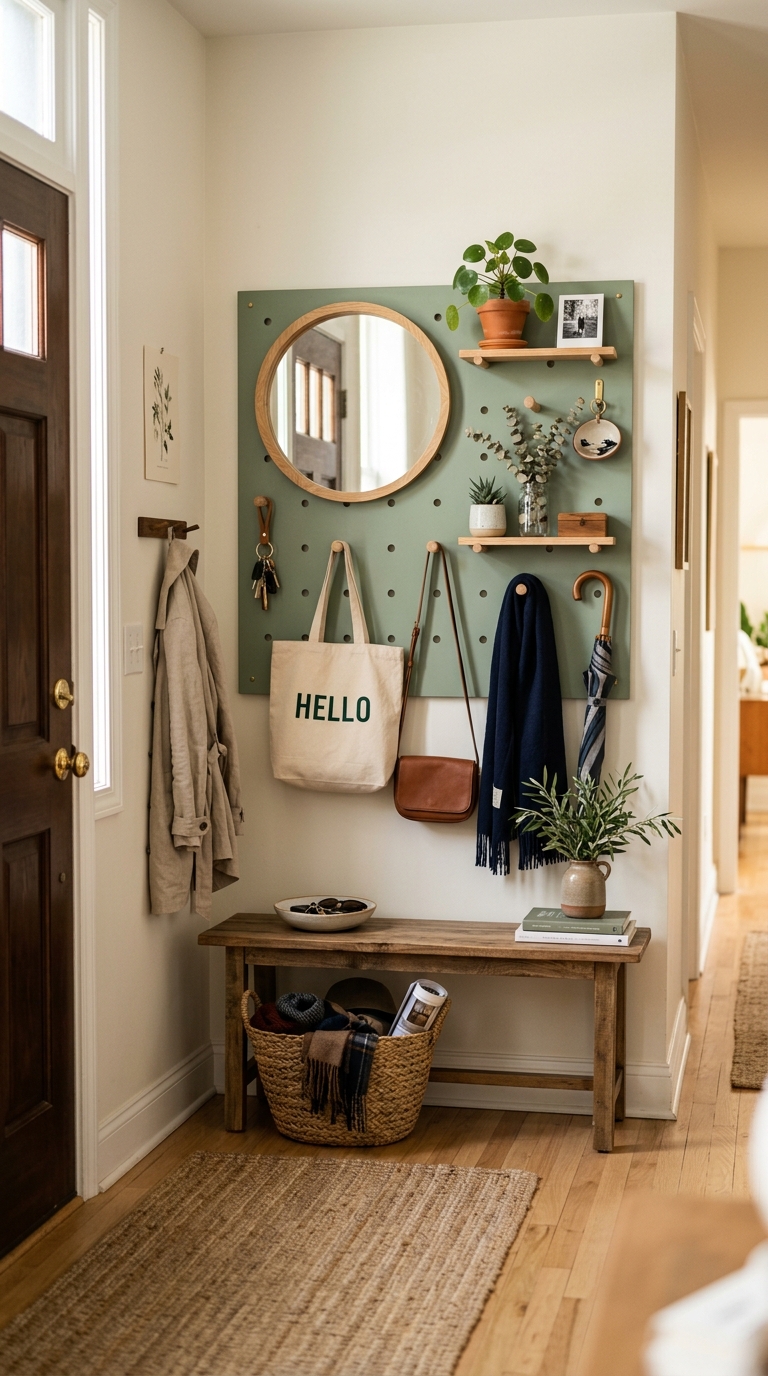
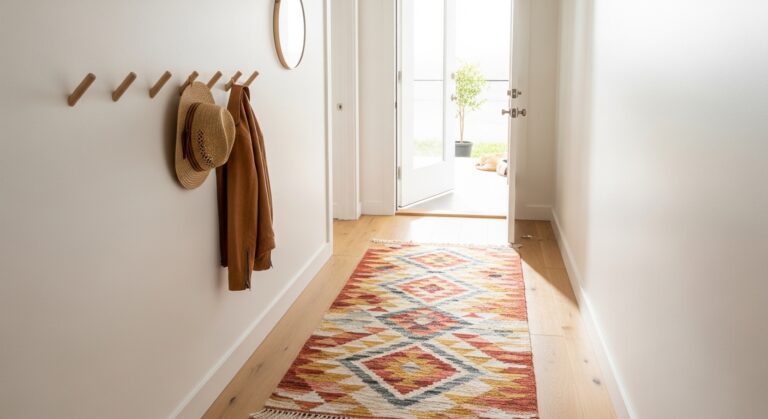
Your entryway sets the tone for everything. In small apartments, it’s usually just a blank wall where things pile up — shoes, bags, mail, and the general chaos of daily life. Here’s the fix: turn that wall into a pegboard lifestyle wall.
A pegboard (painted in a color that matches your apartment’s palette) can hold hooks for keys and bags, small shelves for plants or a candle, a compact mirror, and even a tiny chalkboard for notes. It takes dead wall space and turns it into a functioning, beautiful system.
This works especially well because it gets items off countertops and floors — which immediately makes your apartment feel bigger — while giving you something genuinely decorative to look at when you walk in.
What makes this fresh is the execution. Skip the raw wood pegboard look. Paint yours in a muted sage green, terracotta, or navy. Add brass hooks. Tuck in a trailing pothos plant. Suddenly it’s a design feature, not just storage.
Practical tips:
- IKEA’s SKÅDIS pegboard series is affordable and highly customizable
- Mount at eye level so it functions as decor, not just utility
- Use one consistent hook finish throughout — mixed metals make it look messy
Use a Statement Daybed as Your Living Room Anchor
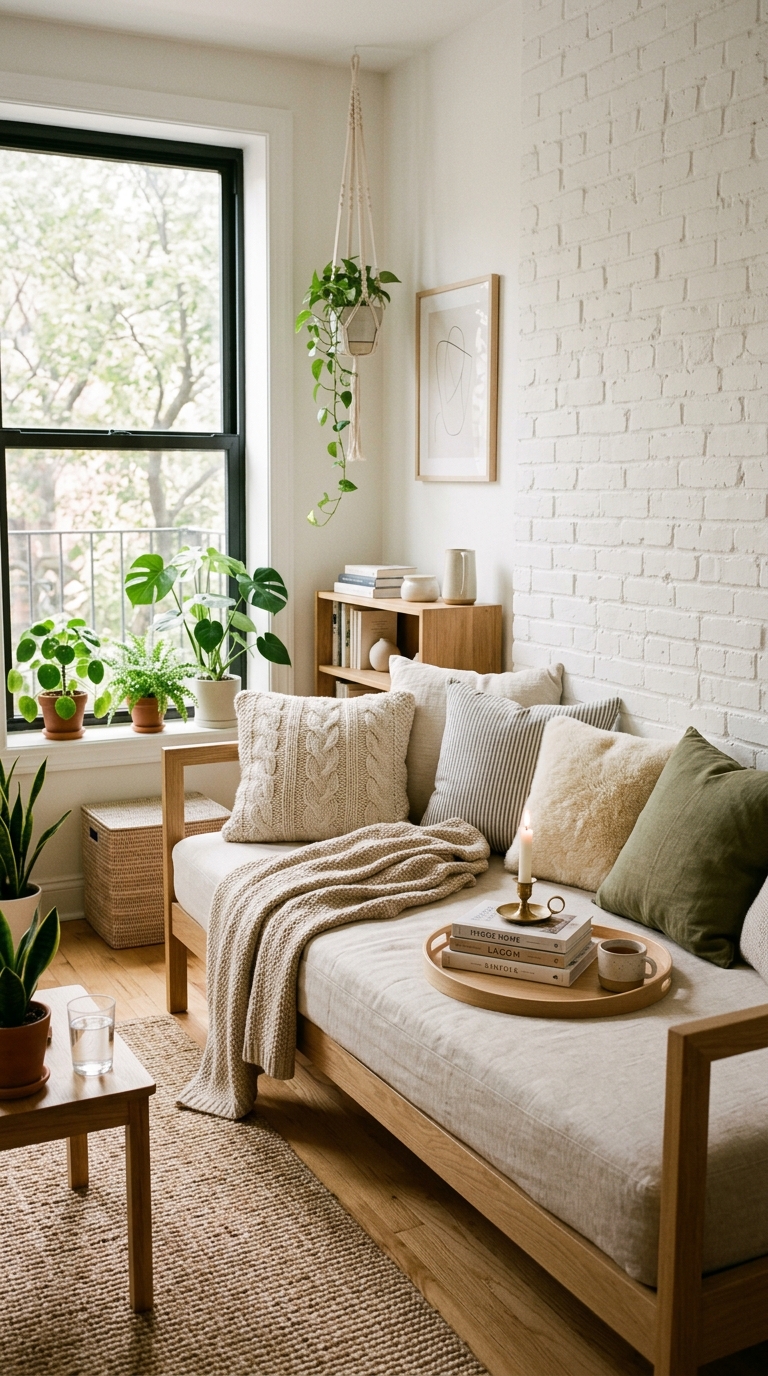
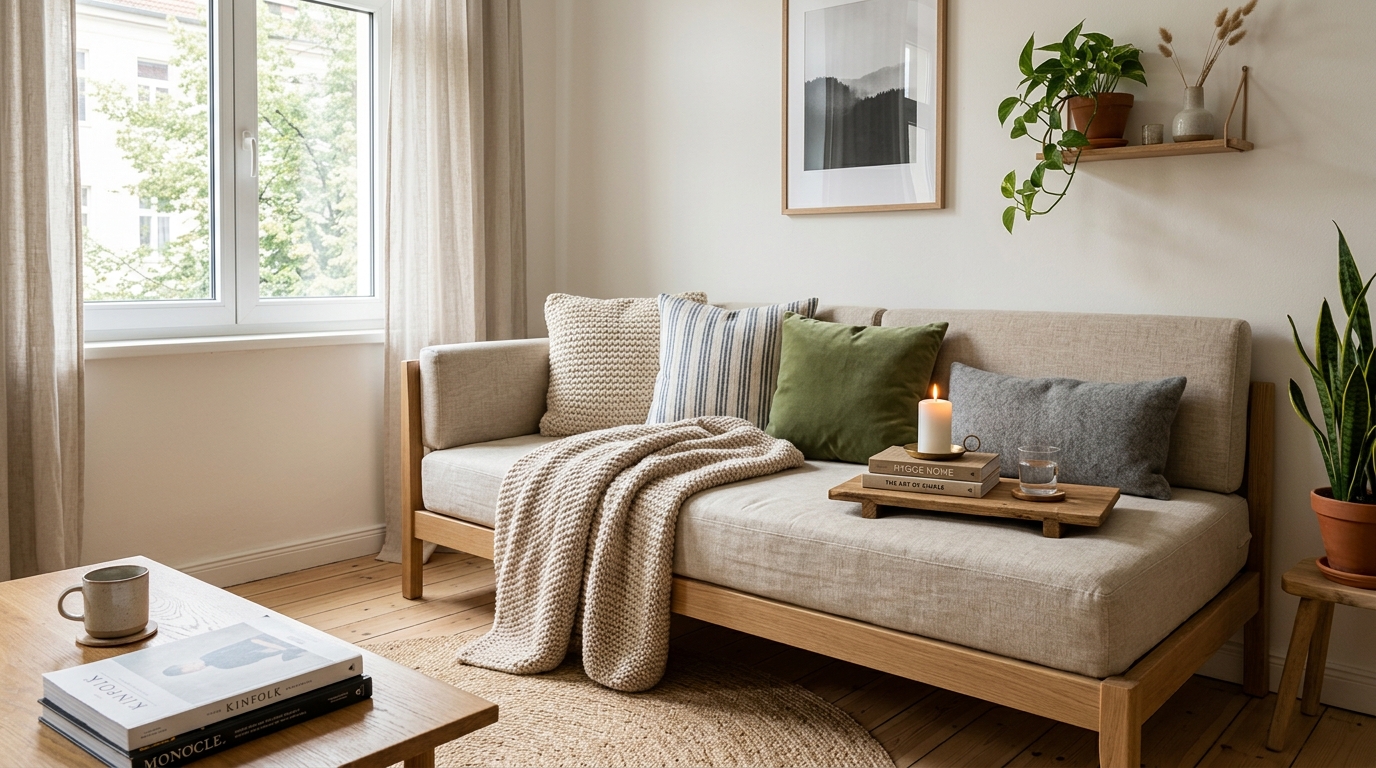
Most small apartment dwellers default to a sofa, but a daybed changes the entire energy of your space. A daybed serves as a sofa, a reading perch, a guest bed, and a nap spot — all in one piece. But beyond its function, it brings a softer, more editorial quality to a small room that traditional sofas simply don’t.
A linen or velvet daybed against a wall reads like a design choice, not a compromise. Style it with layered pillows in varying textures — a chunky knit, a linen case, a velvet lumbar — and a folded throw at the foot. Add a low tray with a book stack and a small plant beside it, and you’ve created a vignette that looks intentional and magazine-worthy.
The practical win here is massive. When guests come over, you’re not scrambling for a pull-out sofa. When you want to read, you have a proper reclining surface. When you need a nap, you’ve got it. That triple function in one piece is exactly the kind of thinking that makes small apartments work.
Practical tips:
- Look for daybeds with a trundle drawer underneath for hidden storage
- Keep the bedding and throw in a cohesive two-tone palette
- Place a narrow console behind it if the daybed sits away from the wall — it doubles as a sofa table
Paint Your Ceiling a Deeper Tone Than Your Walls
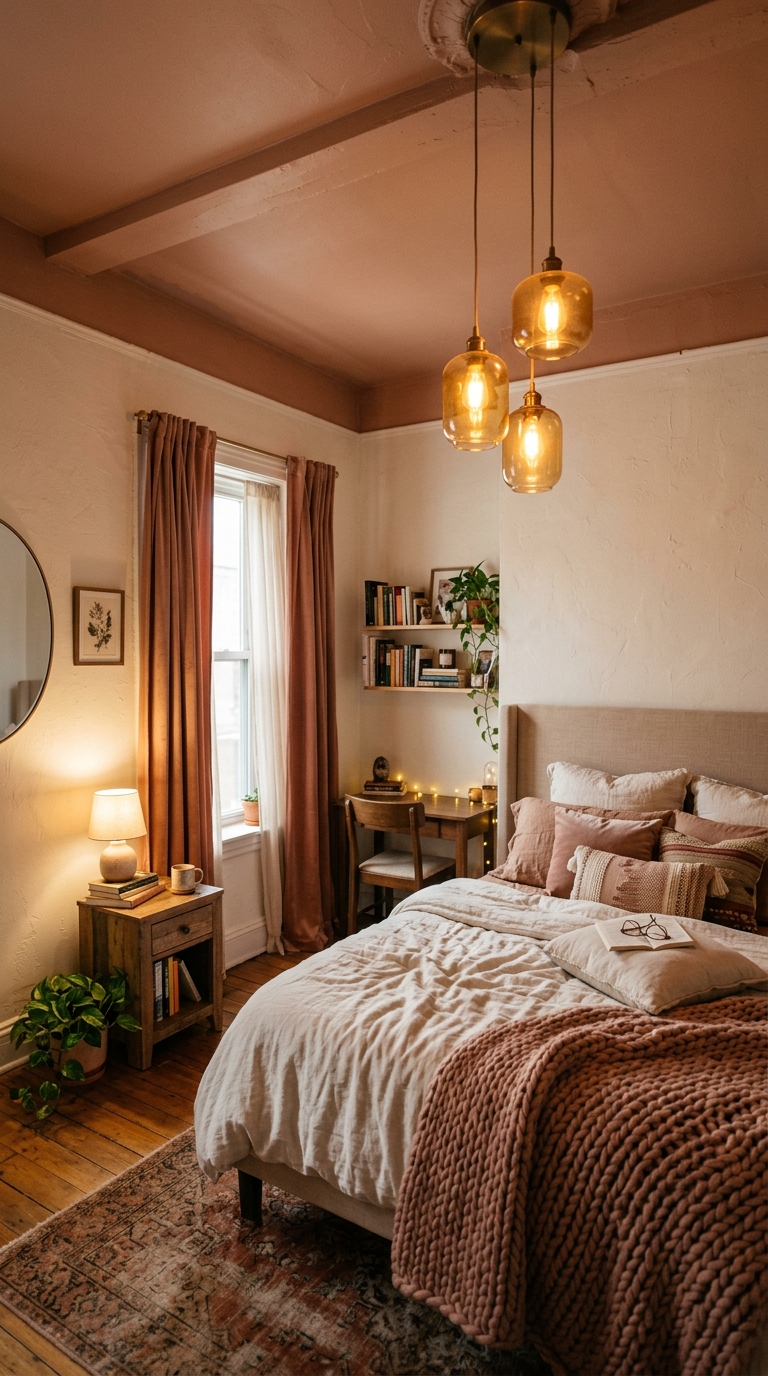
Here’s one that designers use constantly but renters almost never try because it sounds counterintuitive. A darker or richer ceiling actually makes a small room feel cozier and more intentional — not smaller and closed in, as you might fear.
When your ceiling is painted a warm, enveloping tone like dusty clay, soft blush, or muted sage, it draws the eye upward and creates a “canopy” effect. The room feels designed and layered rather than just a white box with furniture stuffed in it.
The key is to keep walls lighter and let the ceiling be the moment. This works beautifully in bedrooms and dining areas. Pair it with pendant lighting (low-hanging lights emphasize the ceiling color) and the effect is genuinely stunning.
For renters worried about landlords — if you go light enough, returning a ceiling to white is a one-coat job. Choose soft, muted tones rather than dark bold colors, and you’ll have no problem restoring it before you move.
Practical tips:
- Benjamin Moore’s “Rose Bisque” and Sherwin-Williams “Moth Wing” are perfect ceiling tones for small spaces
- Always test a large swatch before committing — ceiling colors look very different once up
- Don’t paint both walls and ceiling the same color in a small room; the contrast is what creates depth
Create a Micro Library Nook in a Dead Corner
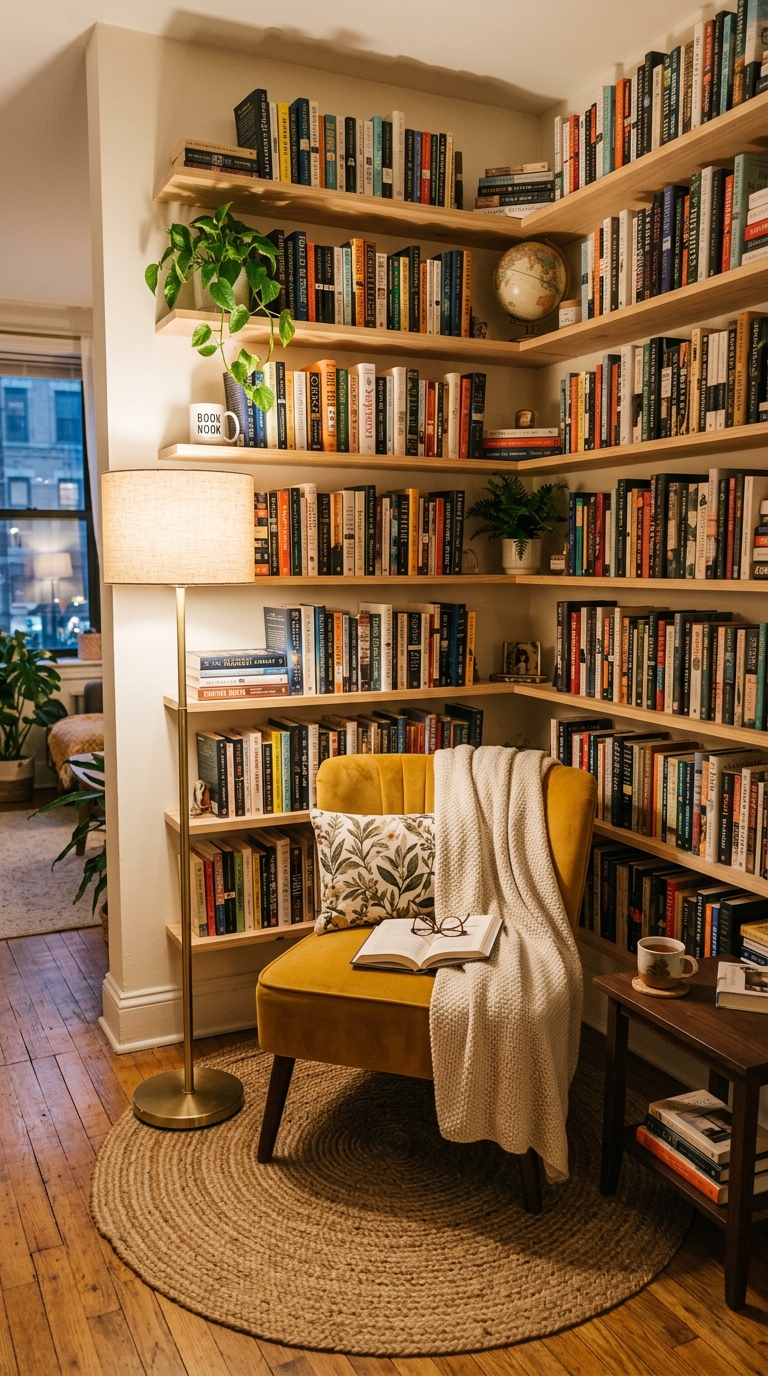
Every small apartment has at least one dead corner — that awkward space where nothing quite fits and stuff just accumulates. Most people shove a floor plant there and call it done. Here’s something better: transform it into a micro library nook.
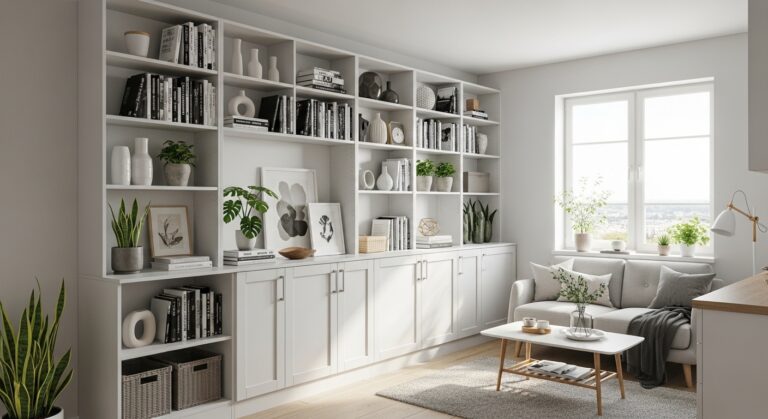
Mount floating shelves floor to ceiling in that corner. Fill them with books, a few plants, small framed photos, and one or two decorative objects. Pull in a slim accent chair — something with a narrow footprint like a slipper chair or a scoop chair — and add a thin floor lamp beside it.
That dead corner just became the most personal and charming spot in your apartment. It’s functional (actual reading happens there), decorative (books are one of the best visual textures you can add to a room), and it gives your space a storytelling quality that bare walls never will.
The psychological benefit is real too. Having a dedicated “purpose zone” in a small apartment makes the entire space feel more organized and intentional.
Practical tips:
- Organize books by color for a visually clean look, or by genre for practical use — pick one
- Use picture-ledge shelves for the bottom two rows so you can display covers face-out
- A clip-on reading light on the shelf saves you from adding another surface lamp
Introduce a “Living Wall” with Mounted Planters
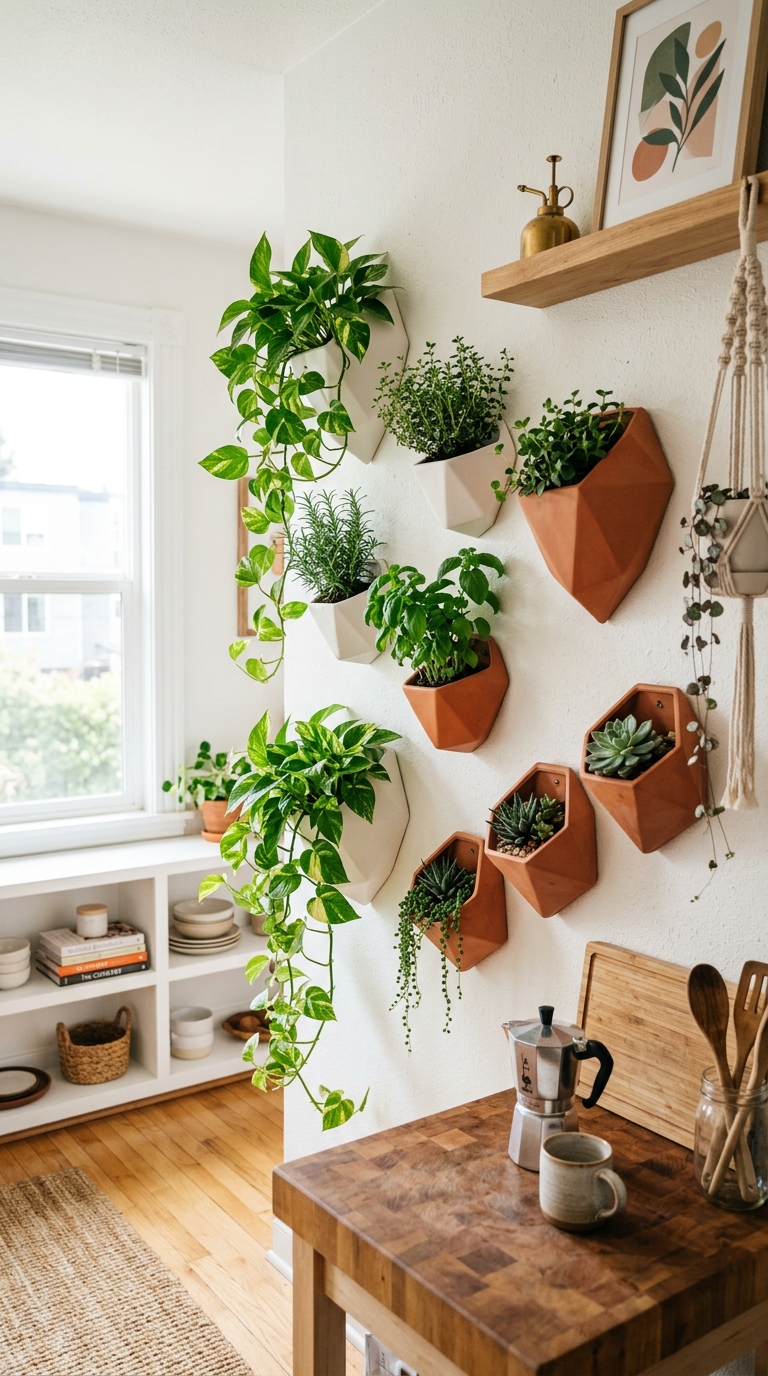
Plants in pots on the floor take up floor space you simply don’t have. The solution? Go vertical. A living wall — even a small one — uses your wall surface as a garden, brings nature into your space without sacrificing any square footage, and doubles as a genuine art installation.
You don’t need a fancy hydroponic system. Start with four to six wall-mounted planters in a geometric arrangement. Mix trailing plants like pothos and string of pearls with upright ones like a small snake plant or herb cluster. The mix of heights and textures creates visual movement that makes the wall feel dynamic.
In a kitchen, a mounted herb wall is both beautiful and practical. Fresh basil, mint, and rosemary within arm’s reach while you cook? That’s the kind of detail that makes a small apartment feel genuinely luxurious.
Practical tips:
- Use self-watering wall planters to avoid forgetting — they have a small reservoir that keeps soil moist
- IKEA’s BONDIS and Amazon’s mid-range geometric planters work beautifully together
- Group planters in odd numbers — three or five look more organic than even rows
Layer Your Lighting in Three Tiers
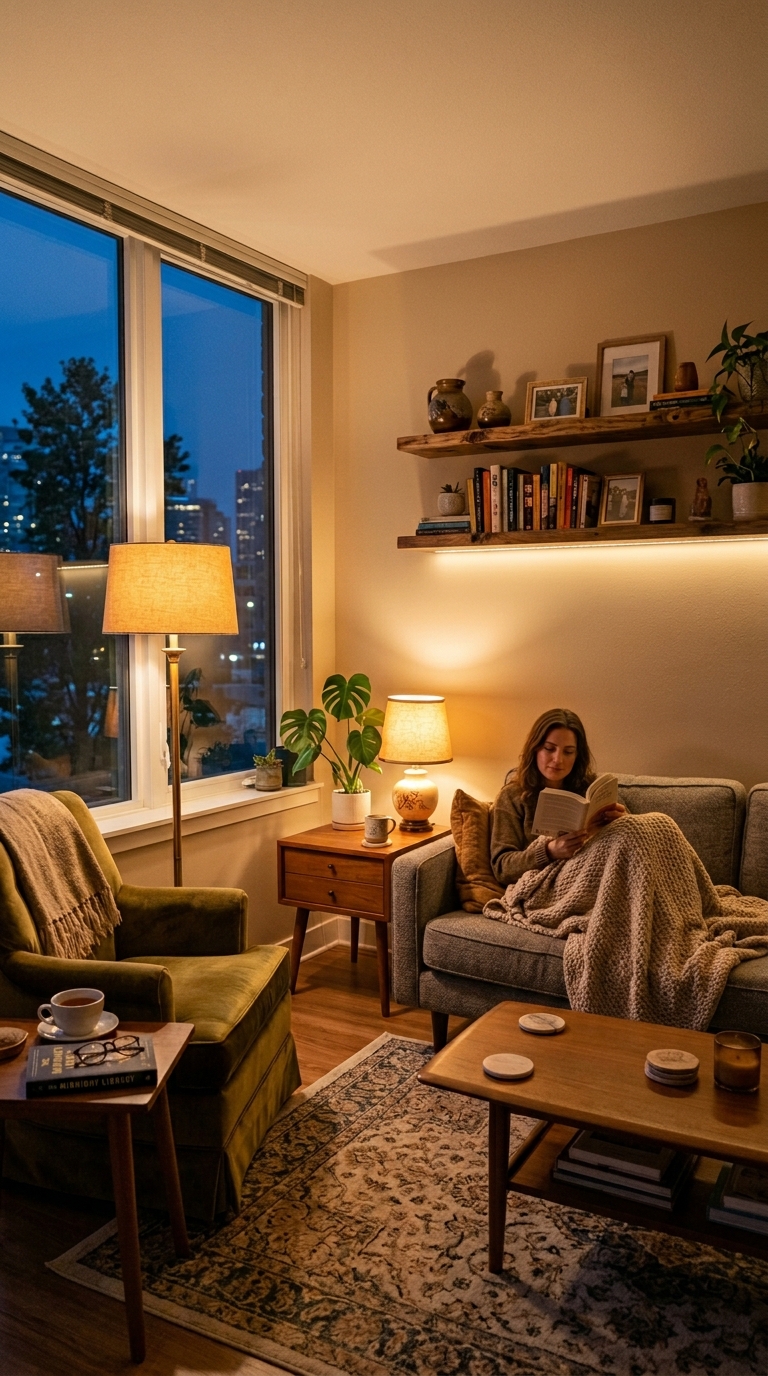
If your small apartment looks flat and lifeless in the evenings, your lighting is almost certainly the problem. Single overhead lights (the default in most rentals) are the enemy of a beautiful small space. They cast harsh, even light that flattens the room and makes it feel like a hospital corridor.
The fix is three-tier lighting: ambient, accent, and task. Ambient is your general light — a floor lamp or soft ceiling fixture. Accent is decorative — LED strip lights under a shelf, fairy lights in a glass jar, or a small table lamp behind your TV. Task is functional — the light at your desk or over your kitchen counter.
When all three tiers are on simultaneously at dusk, the effect is transformative. Your apartment goes from a flat, harsh box to a layered, intimate, warm-feeling space. It photographs beautifully too, which matters because we all have guests (and Instagram).
The beauty of this idea is that it costs almost nothing to start. A $25 LED strip from Amazon and a $40 floor lamp from Target can completely change how your apartment feels in the evenings.
Practical tips:
- Warm white bulbs (2700K) create the coziest atmosphere — avoid cool white or daylight bulbs at home
- Put your floor lamp and table lamps on a power strip with a single switch so you can turn all three on at once
- Position at least one light source low (below eye level) — it creates intimacy and makes ceilings feel higher
Use Architectural Molding Strips as a DIY Wall Feature
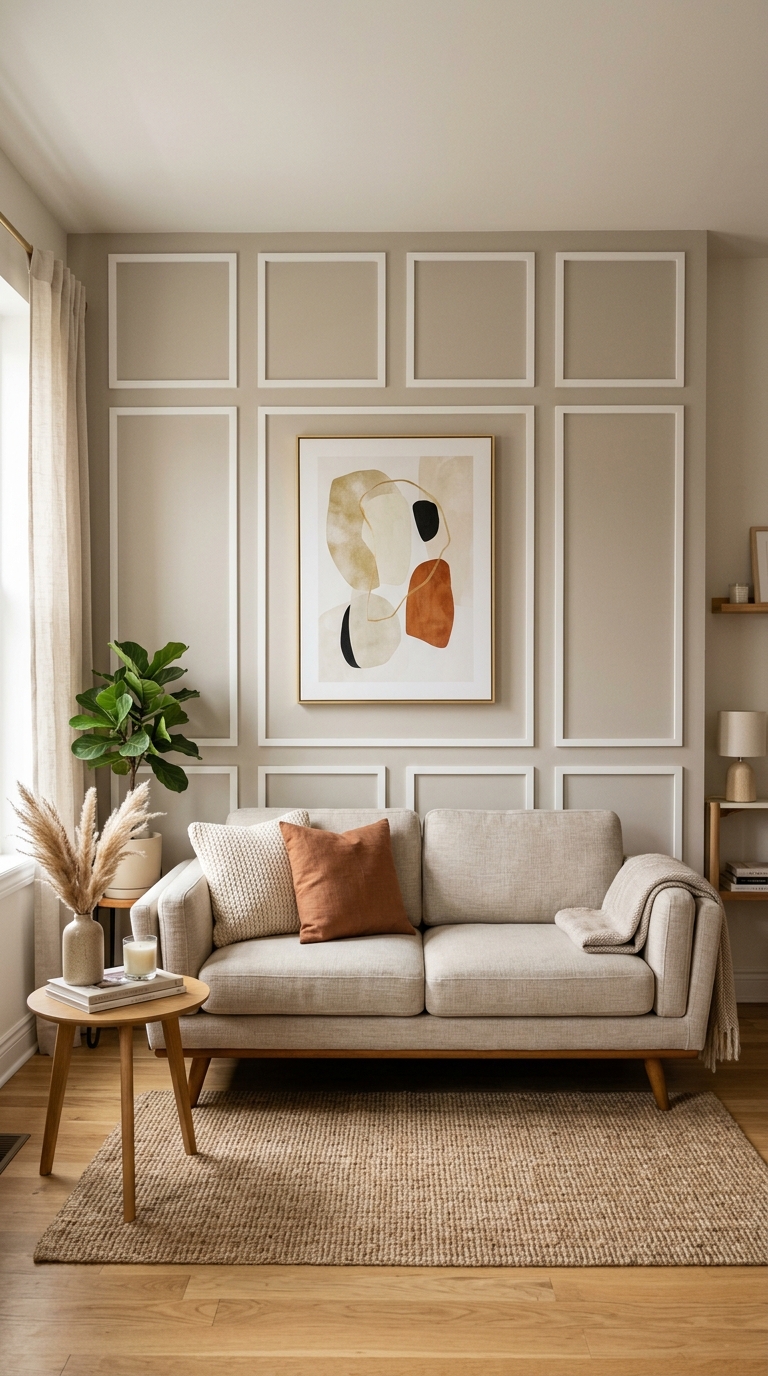
This is the most underused secret in apartment decorating, and once you try it you’ll wonder why it took you so long. Peel-and-stick architectural molding strips — available at Home Depot, Lowe’s, and Amazon — let you create beautiful wall paneling, picture frame molding grids, or wainscoting effects without any nails, drilling, or permanent commitment.
Choose one wall in your living room or bedroom. Paint it a warm, muted tone — think greige, dusty blue, or warm white. Then apply the molding strips in a classic grid or rectangle pattern. Paint over them in the same wall color so they read as raised detail rather than stuck-on trim. The result looks like a custom architectural feature that cost thousands. It costs under $100 and two weekend hours.
This idea works because it gives your small apartment a sense of craft and quality. It signals to every visitor that someone cared about this space — and that feeling of care is exactly what transforms a rental into a home.
Practical tips:
- Use a level and painter’s tape to map your pattern on the wall first before applying molding
- Always paint wall and molding the same color for a cohesive, architectural look
- This works best on a single feature wall — don’t do all four walls
Hang Curtains Dramatically High and Wide
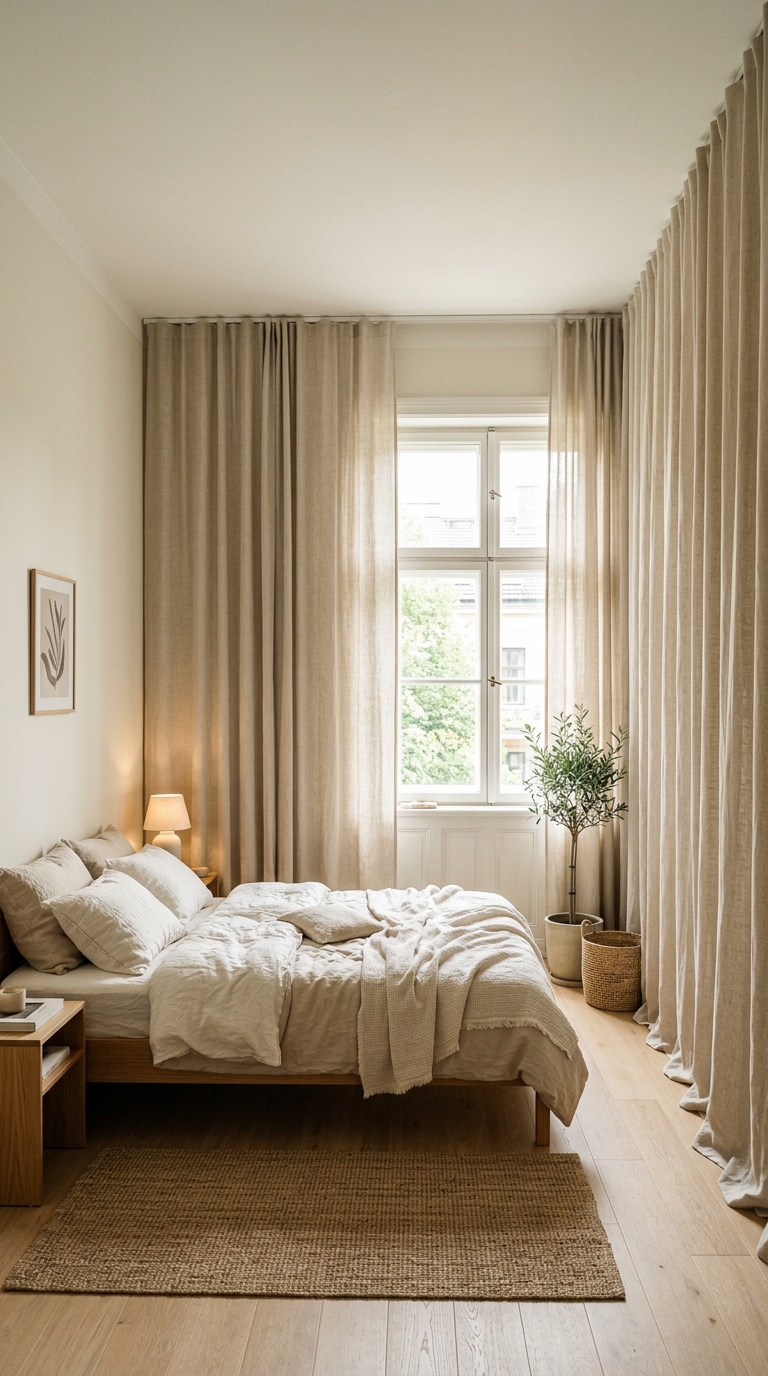
If your curtains are sitting exactly at the window frame, you’re losing one of the easiest optical illusions available to you. Hanging your curtains high (close to the ceiling) and wide (extending 12 to 18 inches beyond the window on each side) is the fastest way to make a small room feel dramatically more spacious and tall.
When the curtain rod is mounted near the ceiling and the curtains pool slightly on the floor, your eye follows that vertical line all the way up — and your brain interprets the room as taller than it is. The windows appear larger. The room breathes. It’s a simple change that genuinely shocks people with its impact.
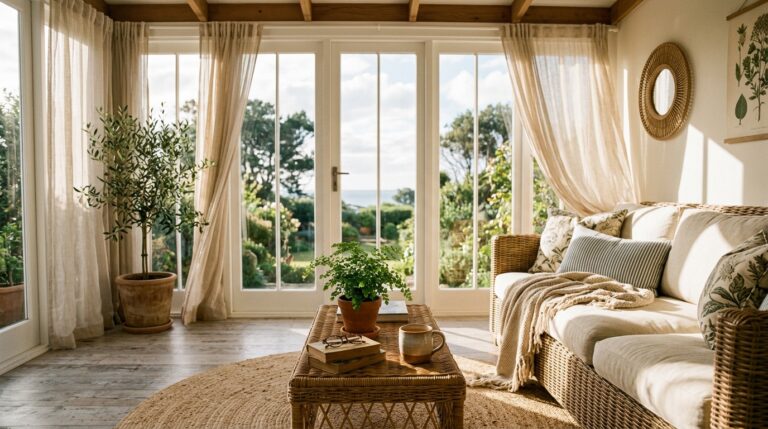
For small apartments, go with light, flowing fabrics in linen, cotton, or sheer voile. Avoid heavy drapes in dark colors — they absorb light and close a space in. Neutral tones like ivory, oat, dusty sage, or soft terracotta work beautifully and layer well with most color palettes.
Practical tips:
- Mount the rod 4 to 6 inches from the ceiling — or higher if you have the wall space
- Each curtain panel should be as wide as the full window (not half) so it pools generously when open
- IKEA’s DYTÅG and H&M Home linen curtains are affordable and fall beautifully
Style a Curated “Shelf Shelfie” with the Rule of Three
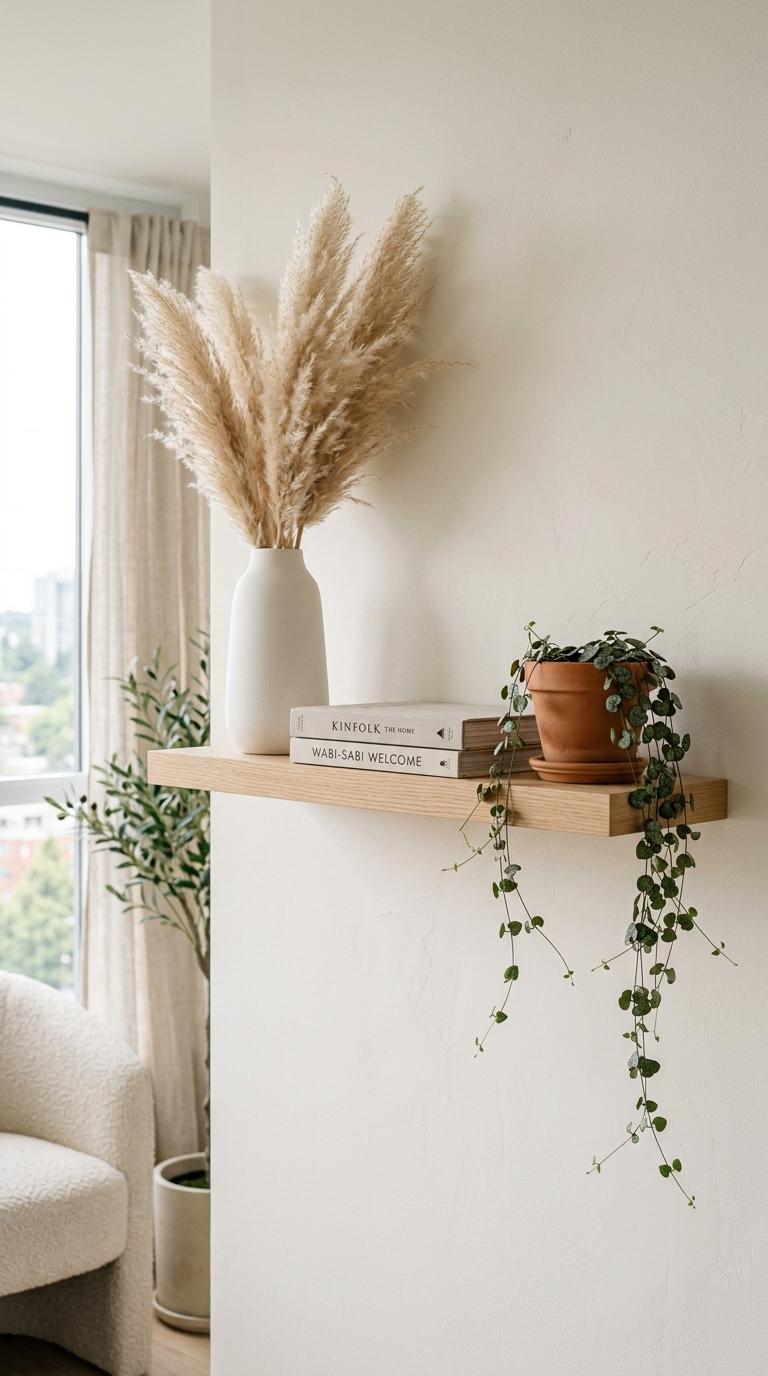
Floating shelves in small apartments often become a dumping ground for random objects that accumulate over time. The result is visual clutter that makes a small space feel chaotic. The fix isn’t minimalism — it’s curation using the Rule of Three.
Every shelf grouping should have exactly three elements: something tall, something medium, and something low. Vary the textures and materials — ceramic, wood, greenery, metal, paper. Leave space between groups. Let the shelf breathe.
For example: a tall dried pampas stem in a ceramic vase, a stack of two art books, and a small trailing succulent. Three elements. Three textures. Intentional space between them. That shelf now looks styled, not cluttered.
The Rule of Three works because it creates a visual rhythm that feels balanced and deliberate. It’s the same principle used by every store display you’ve ever found beautiful — and it works just as powerfully in a small apartment.
Practical tips:
- Edit ruthlessly — if something doesn’t fit the trio, it doesn’t belong on that shelf
- Rotate seasonal accents (a small pumpkin in fall, a pine cone cluster in winter) to keep shelves fresh without buying new things
- Art books are the best multi-function shelf element — they’re beautiful, meaningful, and serve as a riser for smaller objects
Create a Dedicated “Drop Zone” Near Your Door
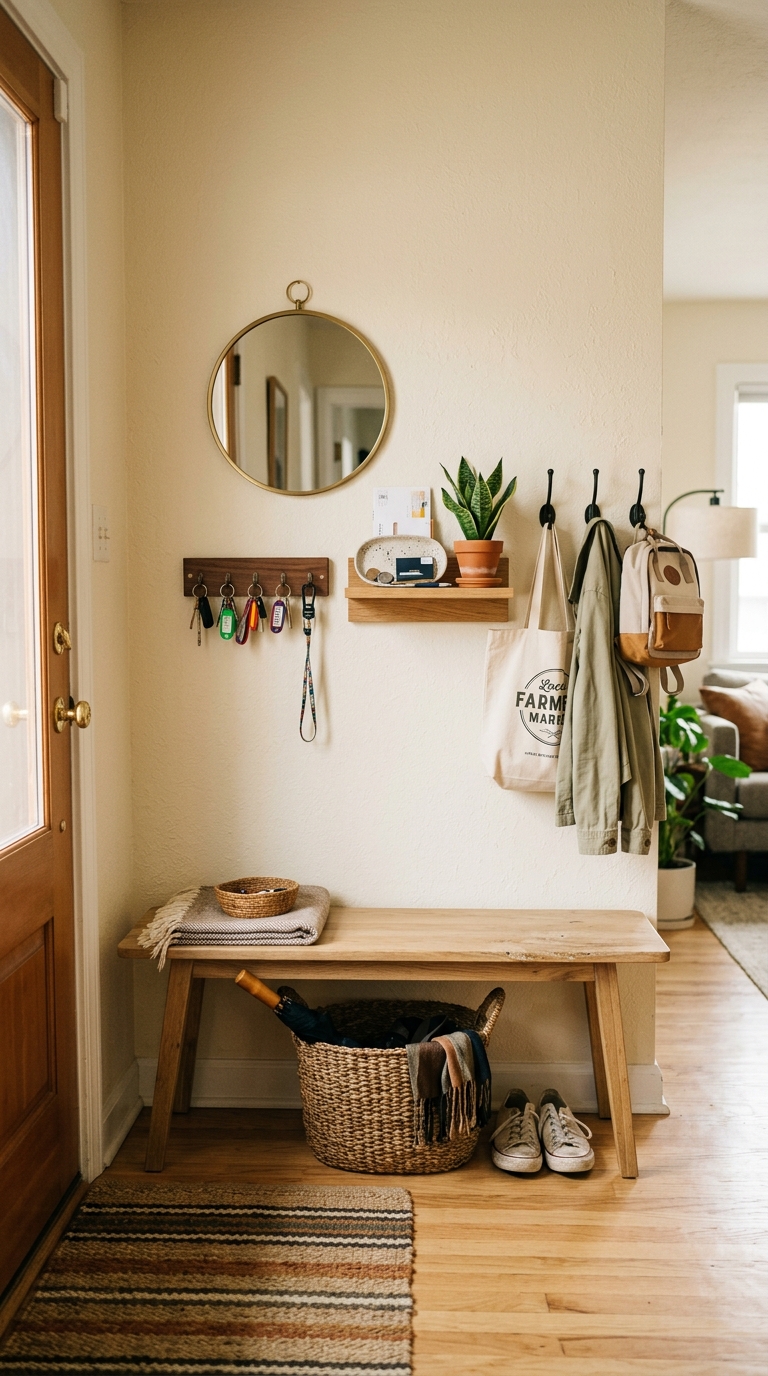
This might be the most functional idea on this entire list, and it has a direct impact on how your whole apartment feels — because if your entry is chaotic, you carry that chaos into every room.
A drop zone is a small, intentional system for everything that comes through your door: keys, bags, shoes, mail, and the random objects that accumulate in pockets and purses. It doesn’t need to be big — it just needs to be dedicated.
A slim bench with a basket underneath for shoes, a wall-mounted key hook, a small tray on a floating shelf for mail and everyday items, and two to three coat hooks above it. That’s it. The whole system can fit in a 24-inch stretch of wall.
When everything has a home the moment it enters your apartment, things stop migrating to countertops, beds, and chairs. Your space stays cleaner with almost zero effort. That’s the kind of organizing that actually holds because it works with your habits, not against them.
Practical tips:
- Use a tray — not a bowl — for keys and small items. Trays contain the visual clutter without hiding it
- A bench with open storage is better than a bench with a lid (you’ll actually use it)
- Keep a small clip or S-hook on the side of your drop zone for reusable grocery bags
Add Depth with a Two-Tone Arch
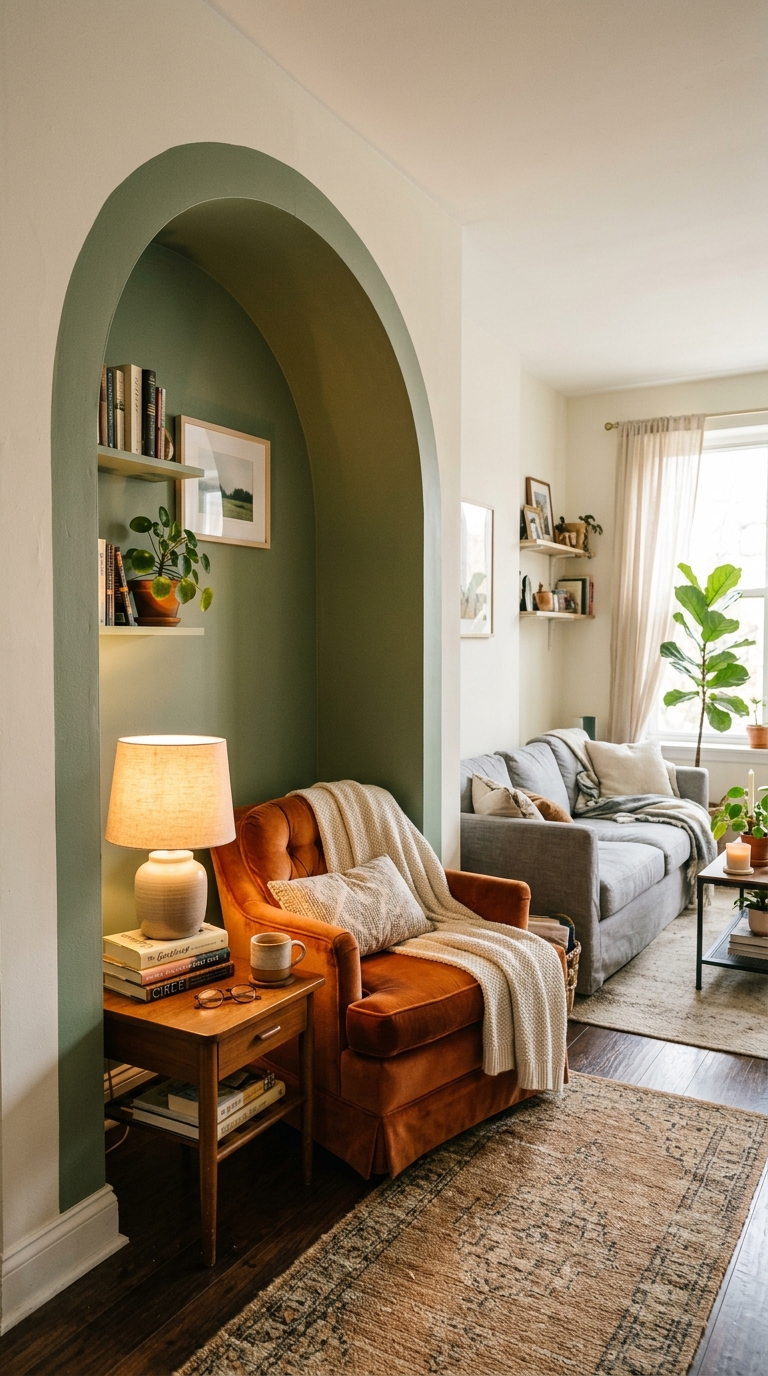
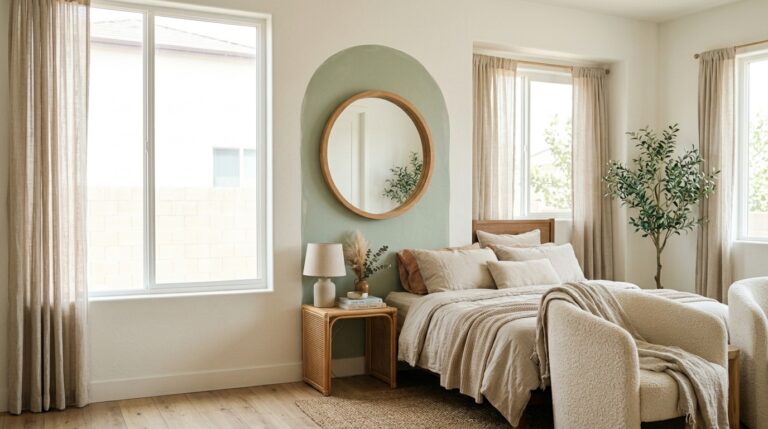
Here’s an idea that’s been quietly growing in the design community and is about to be everywhere: painting an arch on your wall to create a zone within a zone. It sounds dramatic but it’s just paint and painter’s tape — completely landlord-reversible.
Choose a corner or alcove in your apartment. Using painter’s tape and a piece of string as a compass, mark out a large arch shape on the wall. Paint the inside of the arch in a warm, complementary tone to your existing wall color. Place a small chair, a stack of books, or a tiny table inside it.
That arch creates a “room within a room” effect — a mini sanctuary that gives your apartment the feeling of having multiple distinct spaces even in a small square footage. It adds architectural interest, visual depth, and genuine personality that no piece of furniture can replicate.
Practical tips:
- Keep the arch color within the same warm or cool family as your existing wall — one tone lighter or darker reads best
- The arch should be large enough to feel intentional — at least 5 feet tall and 4 feet wide
- A simple floor lamp inside the arch completes the “nook” feeling beautifully
Use a Console Table Behind Your Sofa as a Room Divider
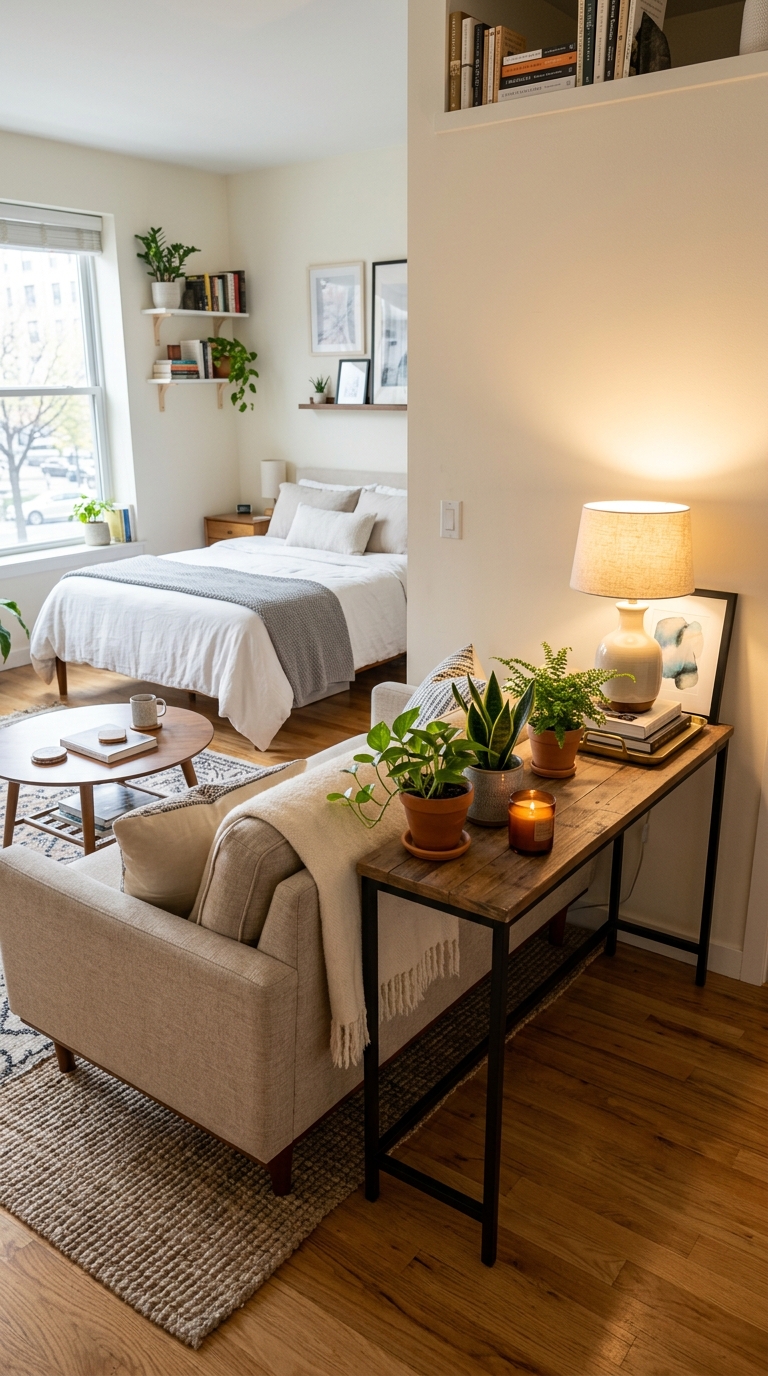
In studio apartments especially, the challenge is making one room feel like it contains multiple purposeful spaces. One of the cleverest ways to do this without building walls or buying room dividers is to place a slim console table directly behind your sofa.
This works for two reasons. First, it visually anchors the sofa as the edge of your “living room zone,” signaling where that area ends and another begins. Second, it gives you a surface for lamps, plants, and decorative objects that float above the sofa line — creating a layered visual backdrop rather than a sofa floating in empty space.
The console table should be roughly the same height as the sofa back — typically 28 to 32 inches. Keep it slim (10 to 14 inches deep) so it doesn’t eat into your floor space. Style it intentionally: one table lamp on one end, a plant or small vase on the other, and one framed piece leaning casually against the wall behind it.
Practical tips:
- This works even in non-studio apartments to give the living room a more polished, layered feel
- Avoid cluttering the console — three to four items maximum, styled with the Rule of Three
- Use the lamp on the console as part of your three-tier lighting system (Idea 7 above)
Bring in One Oversized Art Piece Instead of Many Small Ones
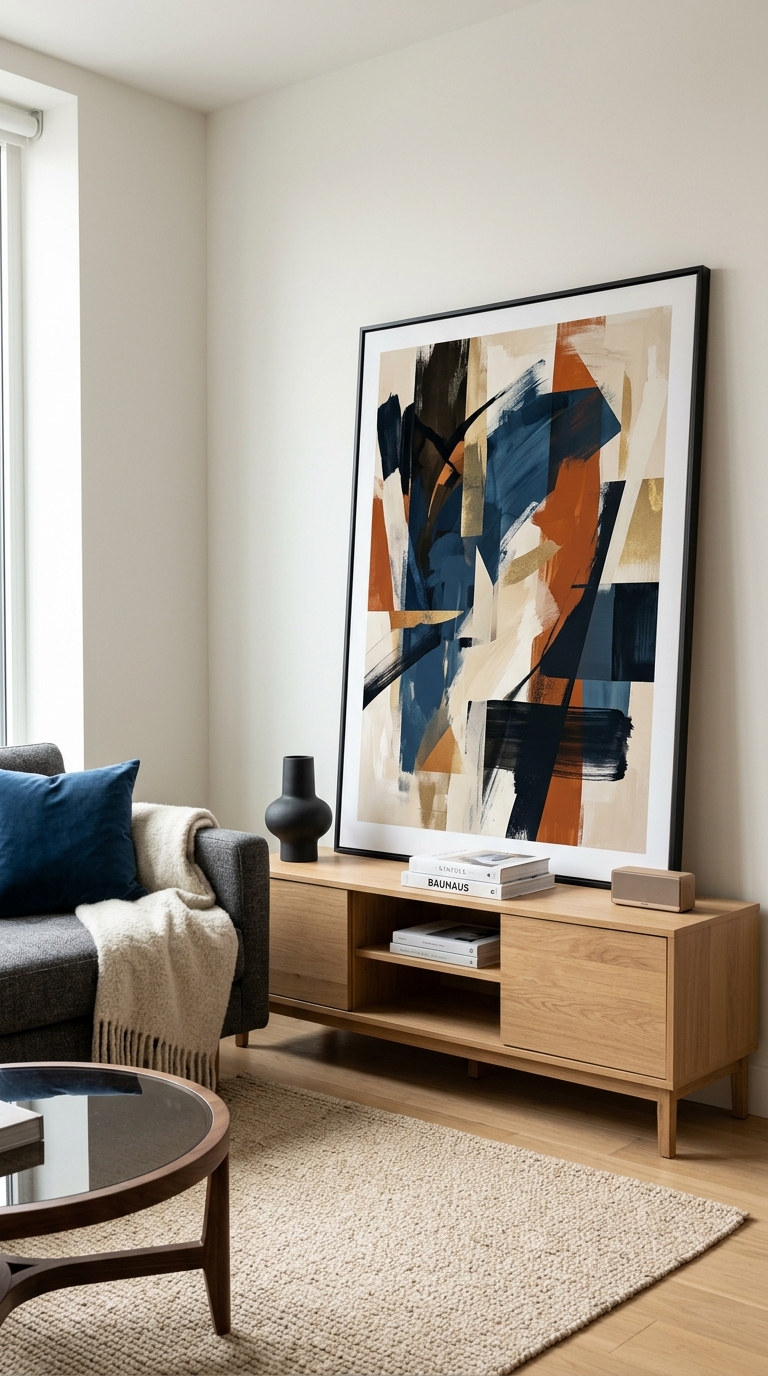
Here is a counterintuitive truth: one large piece of art makes a small apartment feel more expansive than three or four small pieces scattered around. Small clusters of tiny frames create visual busyness that fragments the eye and makes a small room feel choppy. One bold, oversized piece does the opposite — it gives the room a confident focal point and lets the eye rest.
The art doesn’t need to be expensive. An oversized digital print from Etsy (many sell for under $20 as a digital download you print yourself), a large canvas from local art students, or even a beautiful fabric piece stretched over a frame works brilliantly. Size matters far more than price here — aim for at least 36 by 48 inches, or larger.
Lean it against the wall rather than hanging it for a relaxed, intentional look that also eliminates nail holes in your rental walls.
Practical tips:
- Abstract or landscape art works best in small spaces — portraiture and busy patterns compete with the architecture
- Pick one dominant color from the art and repeat it in one small item elsewhere in the room (a throw pillow, a vase) to tie the space together
- If leaning art, place a small object (book stack, plant) in front of the base to ground it
Design a “Texture Wall” with Natural Materials
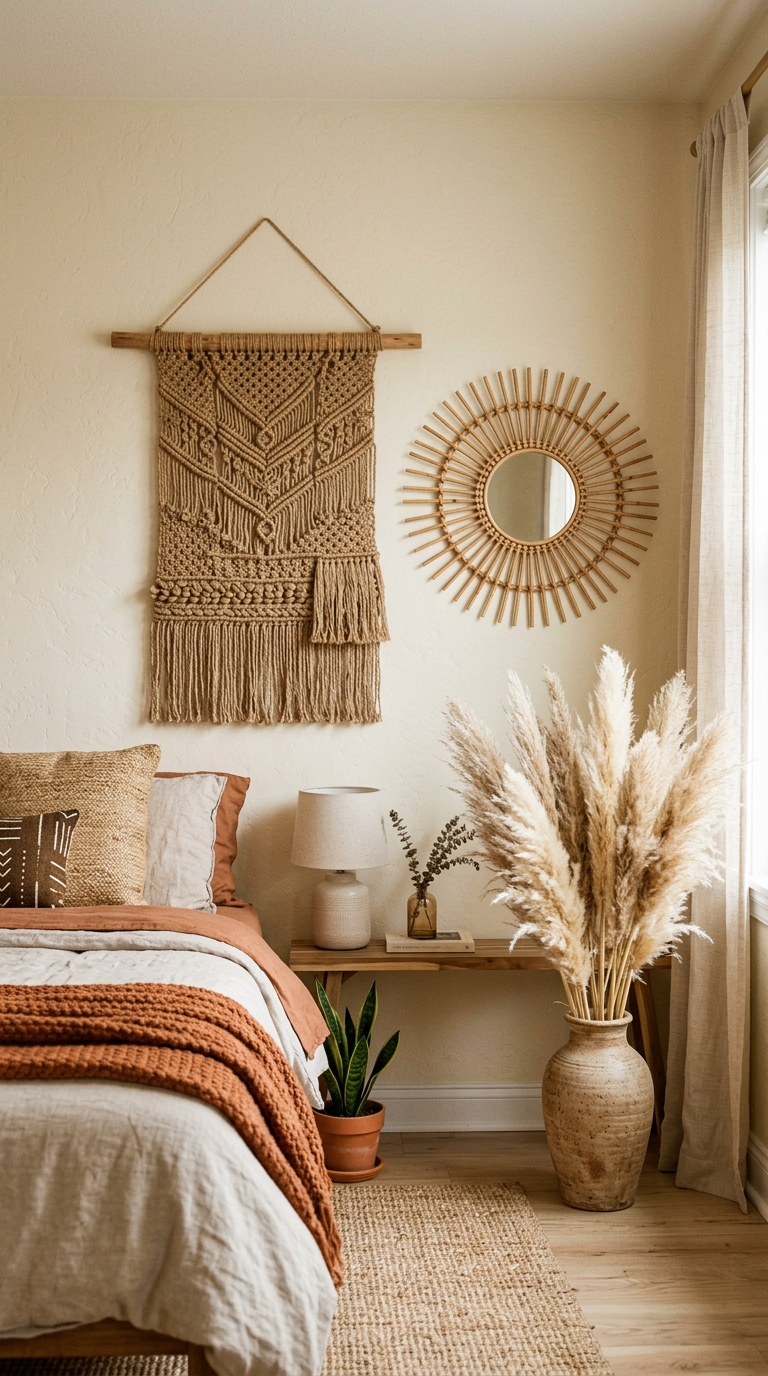
The final idea on this list might be the most impactful for transforming how a small apartment feels, because it addresses something most decorating advice completely ignores: tactile richness.
When a small apartment has only smooth surfaces — painted walls, glass, metal, synthetic fabrics — it feels cold and one-dimensional no matter how stylishly you decorate. The fix is a Texture Wall: one wall where you layer multiple natural materials in a composed, intentional arrangement.
Start with a large woven jute or macramé wall hanging as your anchor piece. Add a rattan or wicker mirror to one side. Bring in a tall dried pampas grass or dried botanicals arrangement in a floor vase nearby. Add a small mounted wooden shelf with a terracotta pot and a linen basket on the floor below.
The result is a wall that you can practically feel just by looking at it — and that sensory richness tricks the brain into reading the space as larger, warmer, and more complex than it is. Natural textures bring a level of depth that paint and furniture alone never achieve.
Practical tips:
- Stick to an earthy, natural palette for your texture wall — cream, jute, terracotta, dried grass, wood
- The wall hanging should be large enough to be the clear centerpiece — at least 24 inches wide
- Don’t add framed photos or art to this wall; the textures need space to read clearly
Bringing It All Together
Here’s something worth remembering: you don’t need to implement all 15 of these ideas at once. Pick two or three that speak to your space and your personality, execute them really well, and build from there.
The most beautiful small apartments we’ve ever seen aren’t perfectly styled in every corner — they’re spaces where a few deliberate decisions were made with intention and care. A great lighting layer here. A bold ceiling color there. A texture wall that stops you in your tracks.
Small doesn’t mean limited. It means focused. And focused, in design, almost always leads somewhere extraordinary.
Start with what excites you most. Your apartment will thank you for it.
Frequently Asked Questions
How do I make a small apartment feel luxurious on a budget?
Focus on lighting, texture, and one statement piece. These three elements deliver the highest visual return for the lowest investment. You can completely transform a small apartment for under $200 by layering your lighting, adding one oversized art piece, and introducing a texture wall with natural materials.
What colors make a small apartment feel bigger?
Warm neutrals like cream, warm white, and soft greige expand a space visually. Avoid cool whites and stark bright whites — they reflect light harshly and make small rooms feel clinical. Painting walls and ceilings in the same warm neutral family blurs the boundaries of the room and creates a sense of flow.
Can I decorate a rental apartment without damaging walls?
Absolutely. Command strips handle most lightweight hanging needs. Peel-and-stick molding, wallpaper, and tile stickers are all fully removable. Leaning art instead of hanging it eliminates nail holes entirely. Peel-and-stick ceiling hooks work for hanging lightweight curtain rods too.
What is the single most effective decorating change for a small apartment?
Without hesitation: your lighting. Switching from a single overhead fixture to a three-tier lighting system (floor lamp, accent light, task light) transforms how a small apartment looks and feels at almost no cost. It’s the change that makes everything else look better too.