20 Fire Pit Ideas Backyard Homeowners Will Love
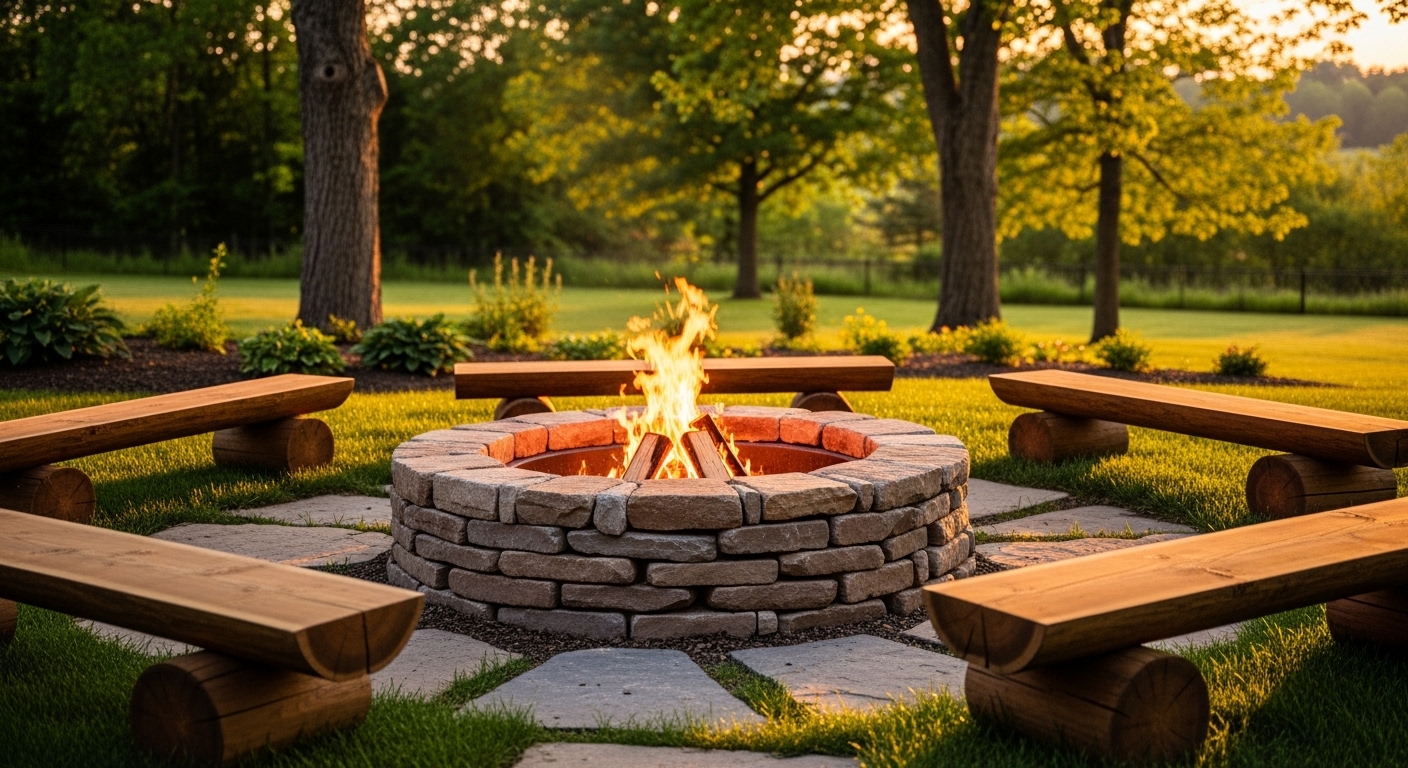
Picture this: it’s a cool Friday evening, you’ve got a glass of something good in hand, your favorite people are gathered around, and the warm glow of a crackling fire is casting the most magical light across your backyard. Nobody’s staring at a screen. Everyone’s actually talking. That’s the power of a fire pit — and it’s one of the best investments you can make in your outdoor living space.
Whether you’ve got a sprawling backyard or a cozy urban patio, there’s a fire pit idea out there that fits your space, your style, and your budget. We’ve rounded up 20 genuinely inspiring ideas — from budget-friendly DIY builds to stunning statement pieces — that real homeowners are using to transform their backyards into places they never want to leave.
Let’s get into it.
Classic Stone Ring Fire Pit
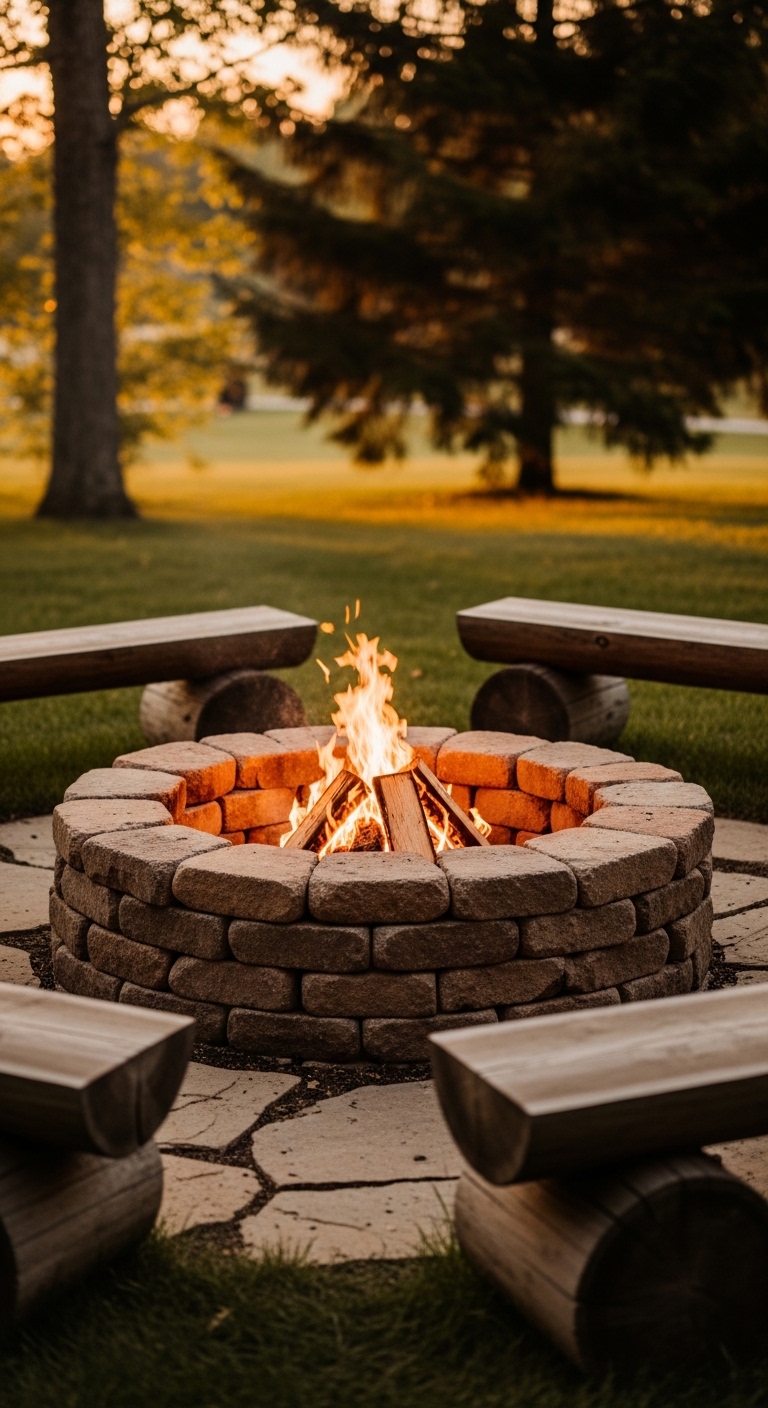
There’s a reason the stone ring fire pit never goes out of style. It’s honest, elemental, and works in practically every backyard setting — from rustic country properties to modern suburban yards. The design is simple: a circular ring of natural or stacked stone, set into the ground or sitting slightly above grade, with a gravel or sand base inside.
What makes this design so satisfying is how grounded it feels. You can source fieldstone, river rock, or reclaimed brick from your local landscape supply store, and build the whole thing in a weekend for under $100. Pack a layer of gravel at the base for drainage, and you’ve got a fire pit that’ll last for years.
Key tips to make yours look great:
- Stack your stones at least two to three layers high so the rim sits above ground level — this helps contain sparks
- Choose stones that are similar in size for a cleaner look, or go full rustic with wildly varied shapes
- Keep the interior diameter between 36 and 44 inches — big enough to build a good fire, small enough to feel intimate
- Line the interior base with a few inches of pea gravel or coarse sand to protect against heat buildup
The stone ring pit invites people to pull up logs, camp chairs, or Adirondack chairs and just settle in for the night. Add a cast iron grate and you’ve got an outdoor cooking setup too.
Sunken Fire Pit Lounge
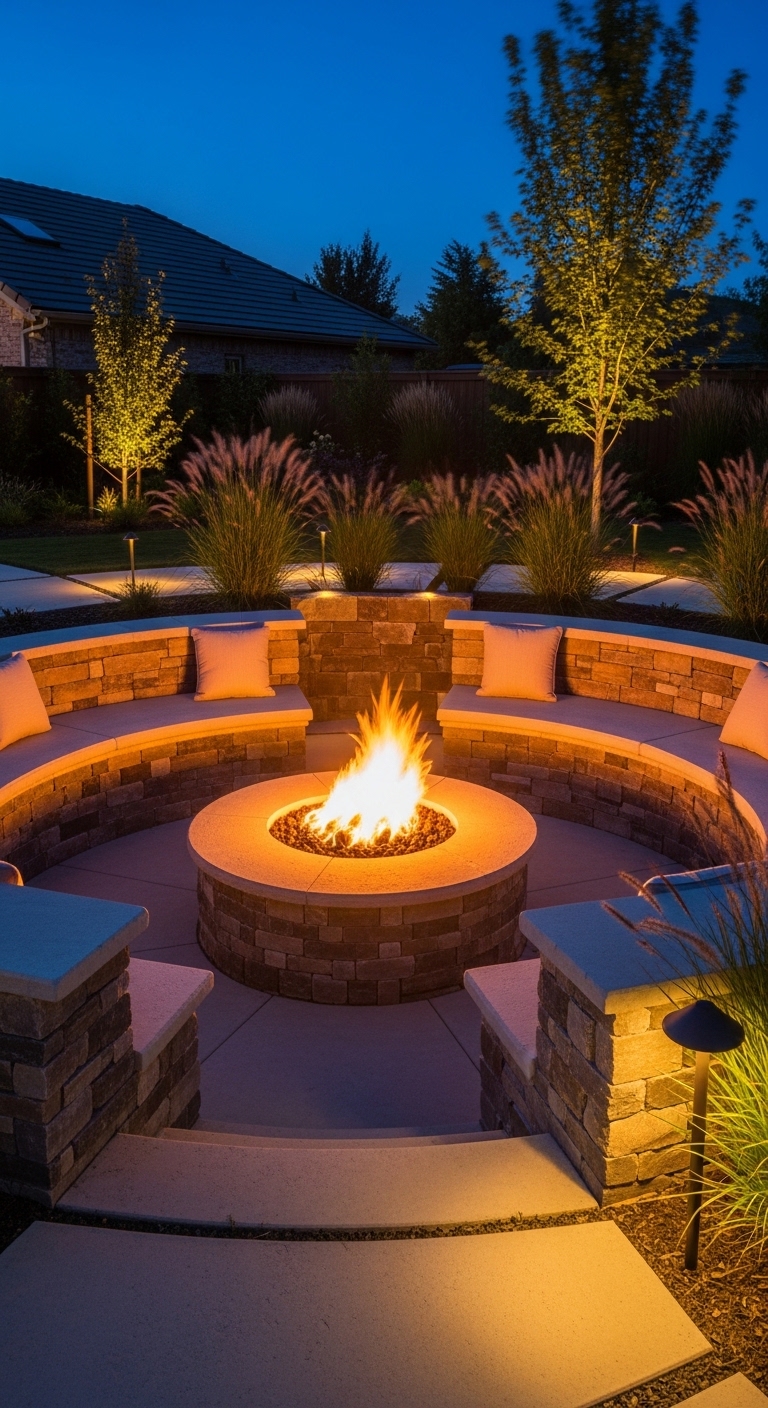
Here’s one that genuinely changes how people experience your backyard. A sunken fire pit lounge involves excavating a section of your yard — typically a circle or square, two to three feet deep — and building a fire pit at the center with built-in bench seating around the perimeter. The whole setup sits below grade, which creates an immediate sense of privacy and enclosure.
This design creates what designers call a “room within a room” — even in an open backyard, the sunken pit feels like its own contained world. The walls block wind, which means your fire burns steadier and you stay warmer. It also keeps conversations intimate — when you’re all seated at the same level around a glowing fire, there’s no hierarchy, no awkward standing versus sitting dynamic.
The build is more involved than a surface-level pit, but it doesn’t have to be expensive. If you do the excavation yourself (or hire a mini-excavator for half a day), you can keep costs very manageable. Line the inner walls with retaining wall blocks, cap them with smooth flagstone or bluestone for seating, and finish the floor with gravel or decomposed granite.
Things to think through before you dig:
- Check with your local municipality about permits for in-ground structures
- Make sure water drains away from the pit — a French drain or perforated pipe at the base solves this
- Leave at least one wide “step entry” into the pit so it’s easy to get in and out
- Built-in cushion storage under hinged bench seats is a thoughtful bonus
Modern Concrete Fire Pit
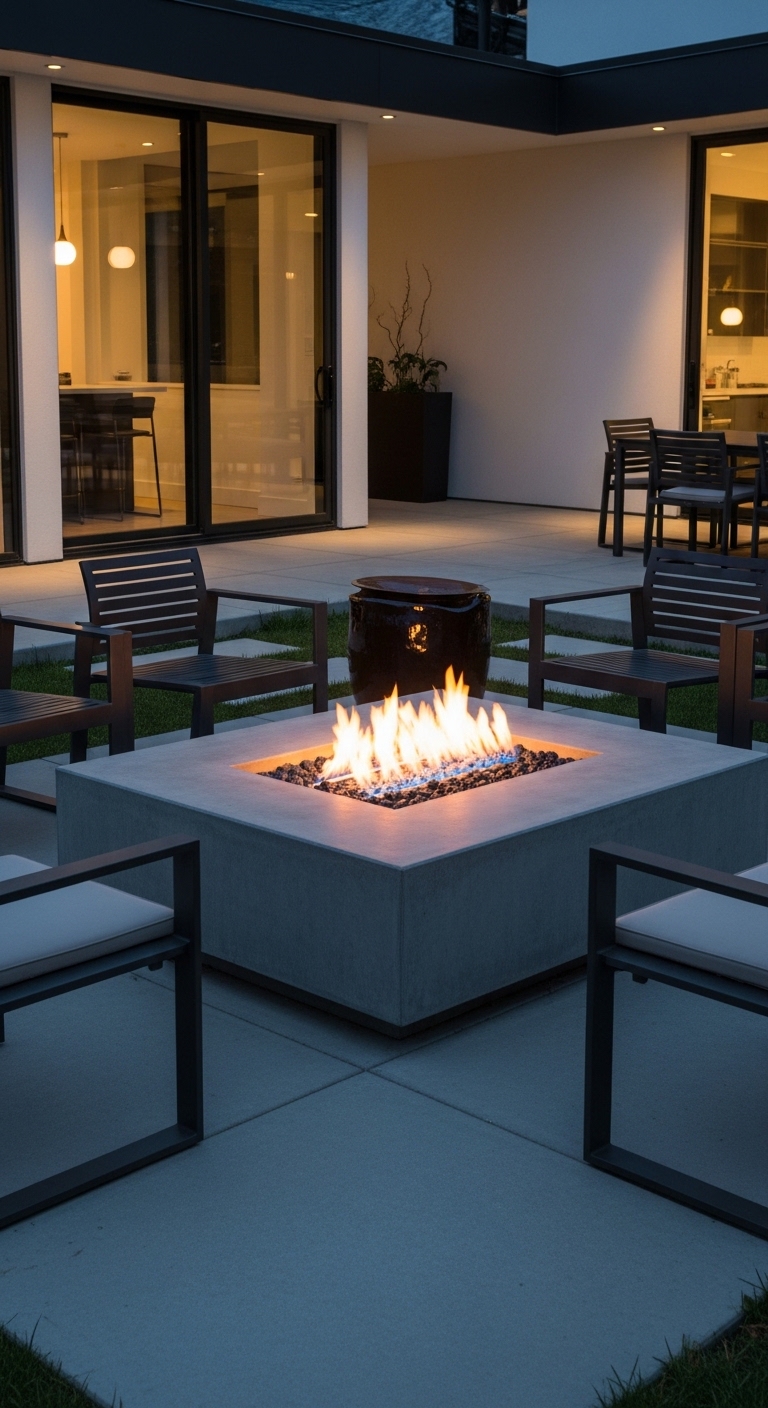
If your backyard aesthetic leans toward the clean, the minimal, and the architectural, a poured concrete fire pit is exactly what you need. These pits come in bold geometric shapes — squares, rectangles, and cylinders — and their matte gray texture feels right at home next to modern pavers, dark-stained wood decking, and steel-framed outdoor furniture.
You can pour your own concrete form if you’re comfortable with a bit of DIY, or buy a precast concrete fire pit bowl. The key is keeping the design intentional — straight lines, uniform surfaces, no ornamentation. Let the concrete itself be the statement.
One thing that makes concrete fire pits especially practical: they’re almost always designed for gas inserts, which give you precise flame control without the ash and smoke of a wood-burning fire. Perfect for backyards in neighborhoods with burn restrictions, or for homeowners who want the ambiance without the maintenance.
Modern concrete pits look incredible when paired with:
- Linear landscape lighting along adjacent pathways
- Ornamental grasses or architectural plants like agave or yucca nearby
- Dark-colored gravel or decomposed granite as ground cover
- Low, flat outdoor seating that keeps sightlines clean
Gas Fire Pit Table
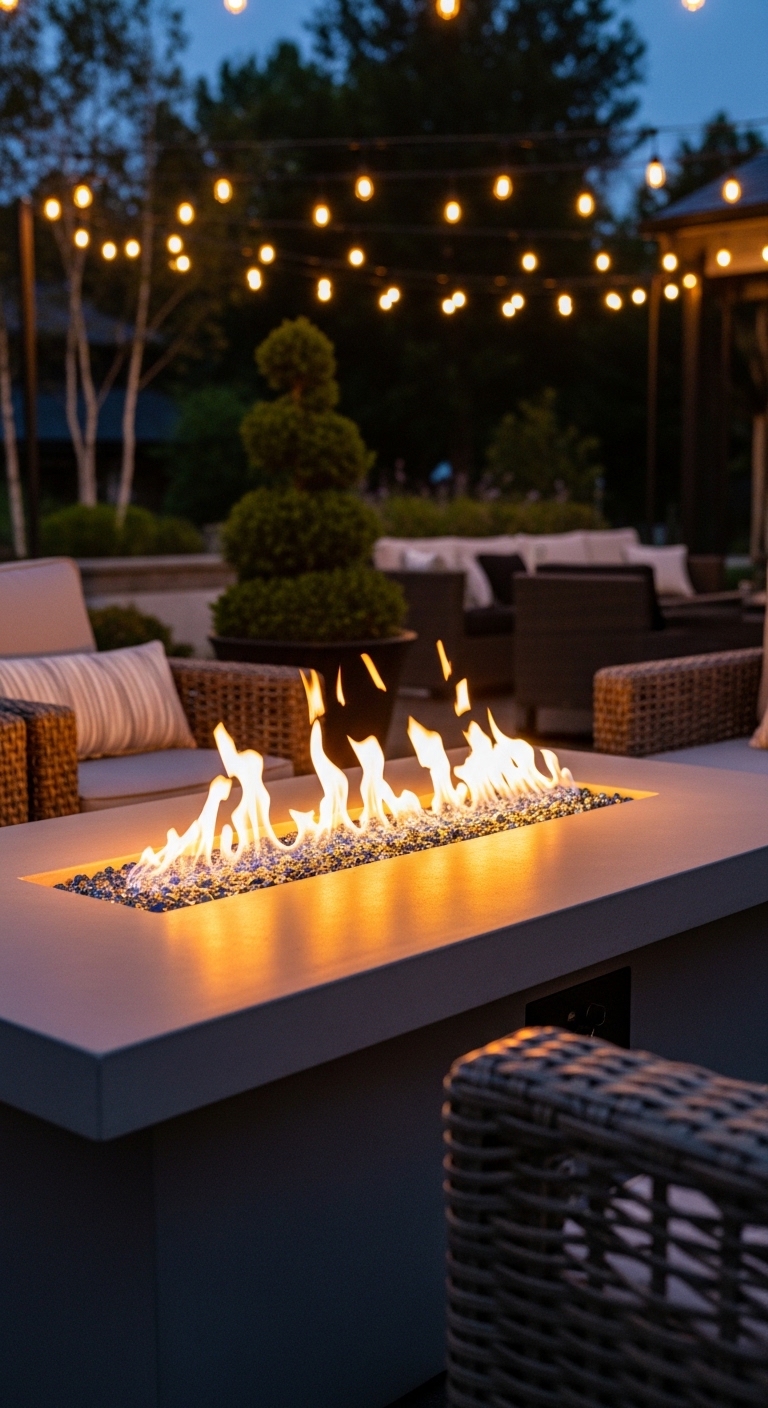
This is the fire pit that gets the most use in real-world backyards, and for good reason. A gas fire pit table combines a functional outdoor dining or coffee table with a built-in fire feature — so you get the warmth and atmosphere of a fire pit without dedicating a separate zone of your yard to it.
The fire runs through a bed of fire glass beads or lava rocks centered in the table, with seating around all four sides. You flip a switch or turn a valve, and you’ve got a clean, controllable flame in under a minute. No smoke, no sparks, no hauling wood.
Gas fire pit tables come in a massive range of styles now — round, rectangular, concrete, tile-topped, wicker-surround — so you can find one that fits your existing patio furniture. Budget models start around $400, while premium powder-coated steel or concrete options run $1,500 and above.
What homeowners love most about these:
- You can actually use the table surface when the fire is off
- Conversations flow naturally because everyone sits at the same table height
- The fire adjusts instantly — higher for chilly nights, lower for warmer evenings
- Propane tanks fit neatly inside most models, hiding all the hardware
Corten Steel Fire Pit Bowl

If you want a fire pit that looks like actual sculpture, corten steel is your material. Also called weathering steel, corten develops a rich, rust-orange patina over time as it weathers — and rather than deteriorating, this rust layer actually seals and protects the steel underneath. The result is a fire pit that gets more beautiful the longer it sits outside.
Corten steel fire pit bowls come in different forms — wide shallow dishes on tripod legs, deep cylindrical drums, or angular sculptural shapes. Their bold, earthy color looks striking against both lush green landscaping and minimalist desert gardens.
These are essentially zero-maintenance. You leave them outside year-round, the patina deepens with exposure to rain and sun, and the steel grows more characterful every season. The only thing to note is that during the initial weathering phase (the first year or two), the patina can leave orange streaks on concrete or pavers below — place yours on gravel, grass, or use a protective mat underneath.
Pair a corten bowl with:
- Natural wood seating (log rounds, live-edge benches) for a warm contrast
- Native plantings that echo the earthy orange tones
- A simple gravel gathering circle beneath the pit
- Overhead string lights for evening magic
DIY Brick Fire Pit
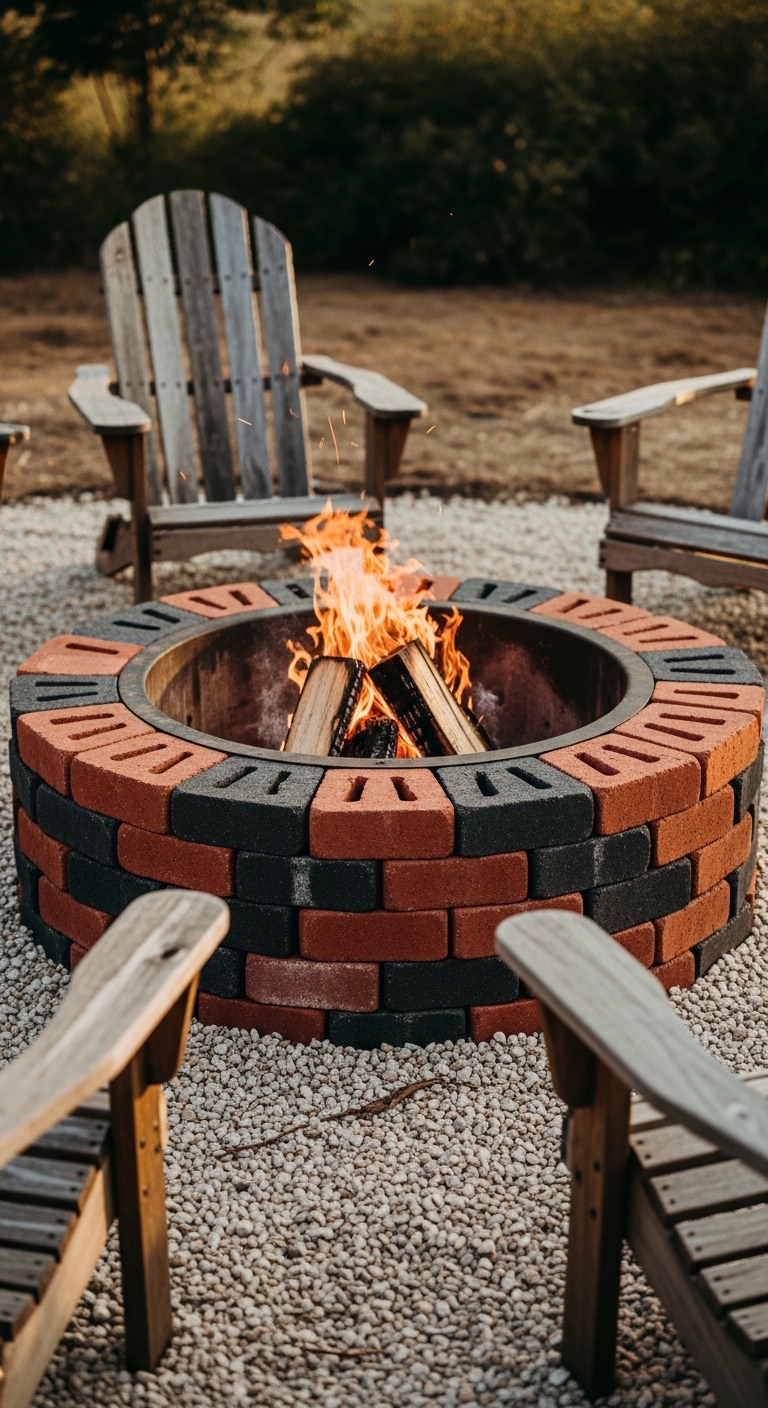
If you love a weekend project and want a fire pit that genuinely feels like you built it — because you did — a DIY brick fire pit is one of the most satisfying backyard upgrades you can do. The materials are inexpensive, the process is forgiving for beginners, and the finished result looks like something you’d pay a landscaper good money to install.
The key material choice here is using firebrick (also called refractory brick) for the interior ring — these withstand the repeated expansion and contraction from heat without cracking. Regular landscape brick works fine for the outer decorative ring. You don’t need mortar for the inner ring; a dry-stack approach actually works well because it allows for heat expansion.
A simple 36-inch interior diameter pit needs about 80 to 100 bricks and a Saturday afternoon. Here’s a quick breakdown of the process:
- Mark your circle using a string and stake at the center
- Excavate about 6 inches of soil, fill with compacted gravel
- Lay the firebrick in a tight circle, stacking 3 to 4 courses high
- Add a second outer ring of landscape brick for a finished look
- Fill the gap between rings with sand or gravel
Total material cost usually runs between $60 and $150 — remarkably affordable for something that becomes a true backyard centerpiece.
Fire Pit With Built-In Seating Wall
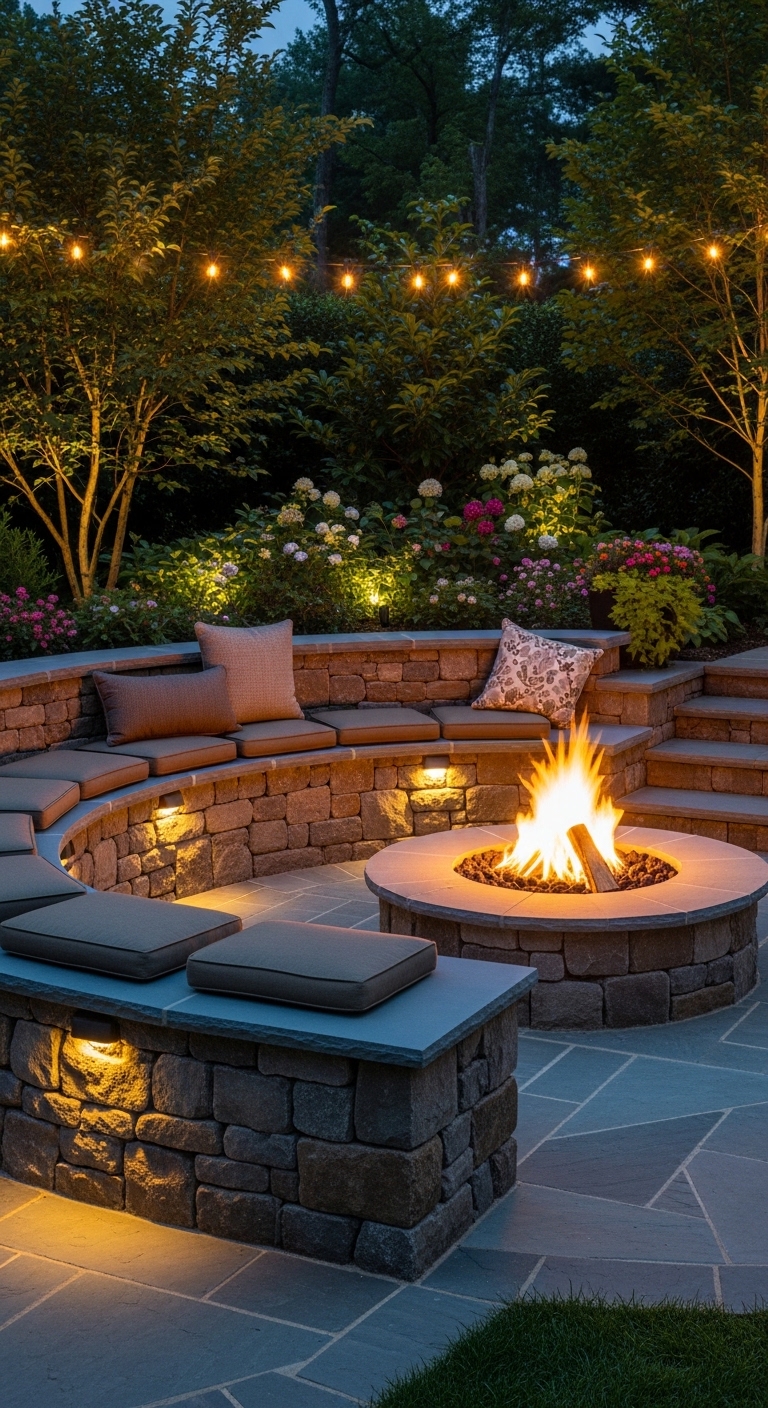
Take your fire pit zone to the next level by wrapping it in a low seating wall. Instead of pulling chairs up to the fire, you build curved or angular walls — typically 16 to 18 inches high — around the fire pit that serve as permanent seating. Top them with bluestone, flagstone, or timber cap boards and you’ve got a complete outdoor room that looks truly designed.
The seating wall approach solves one of the biggest practical challenges of a fire pit: furniture. Outdoor chairs get rained on, blown over, and dragged around constantly. A built-in seating wall eliminates all of that — it’s always there, always in the right position, and it actually increases your property’s appraised value.
Construction typically involves concrete block or stone veneer over a block core, then capped with a smooth stone or timber seat board. Budget about $40 to $60 per linear foot for a professional build, or significantly less if you tackle the block work yourself and hire out only the stone capping.
Design tips that make a real difference:
- Aim for a height of 17 to 18 inches — the same as a standard indoor chair seat
- A 16-inch depth on the wall cap gives comfortable seating without feeling precarious
- Incorporate planting pockets at the ends of the wall for greenery integration
- Install low-voltage lighting at the base of the wall for stunning evening ambiance
Fire Pit Pergola Combo
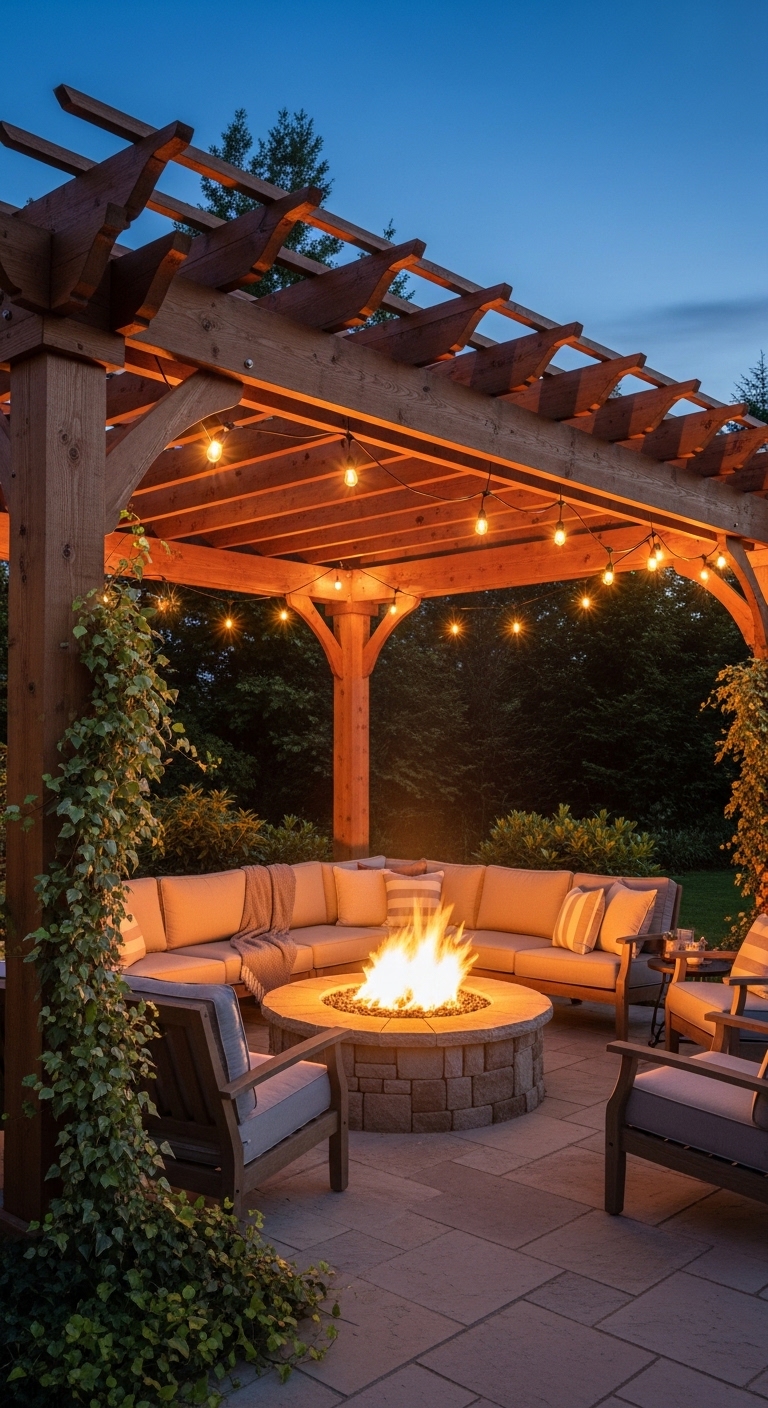
Why choose between shade and fire? The fire pit pergola combo gives you both — a permanent pergola structure directly over or adjacent to your fire pit, creating a dedicated outdoor room that’s usable in more weather conditions and feels like a real extension of your home.
Pergolas provide partial shade and wind protection, which makes the fire pit experience more comfortable in both summer and autumn. Add outdoor curtains or shade sails to the sides and you’ve got a space that works even during light rain.
The key structural consideration is clearance. Your pergola roof should sit at least 80 to 96 inches above the fire pit surface — fire needs upward draft to burn cleanly, and too-low overhead structures can trap smoke or present a fire hazard. Always use a fire pit rated for the fuel type you’re using (wood or gas), and keep a clear zone of at least 10 feet horizontally from any combustible structure.
What works beautifully in this setup:
- Weathered cedar or redwood pergola for a warm, natural look
- Edison string lights woven through the rafters
- A ceiling fan mounted on the pergola to manage smoke direction on calm nights
- Outdoor curtain panels on two sides for privacy and wind management
Portable Tabletop Fire Pit
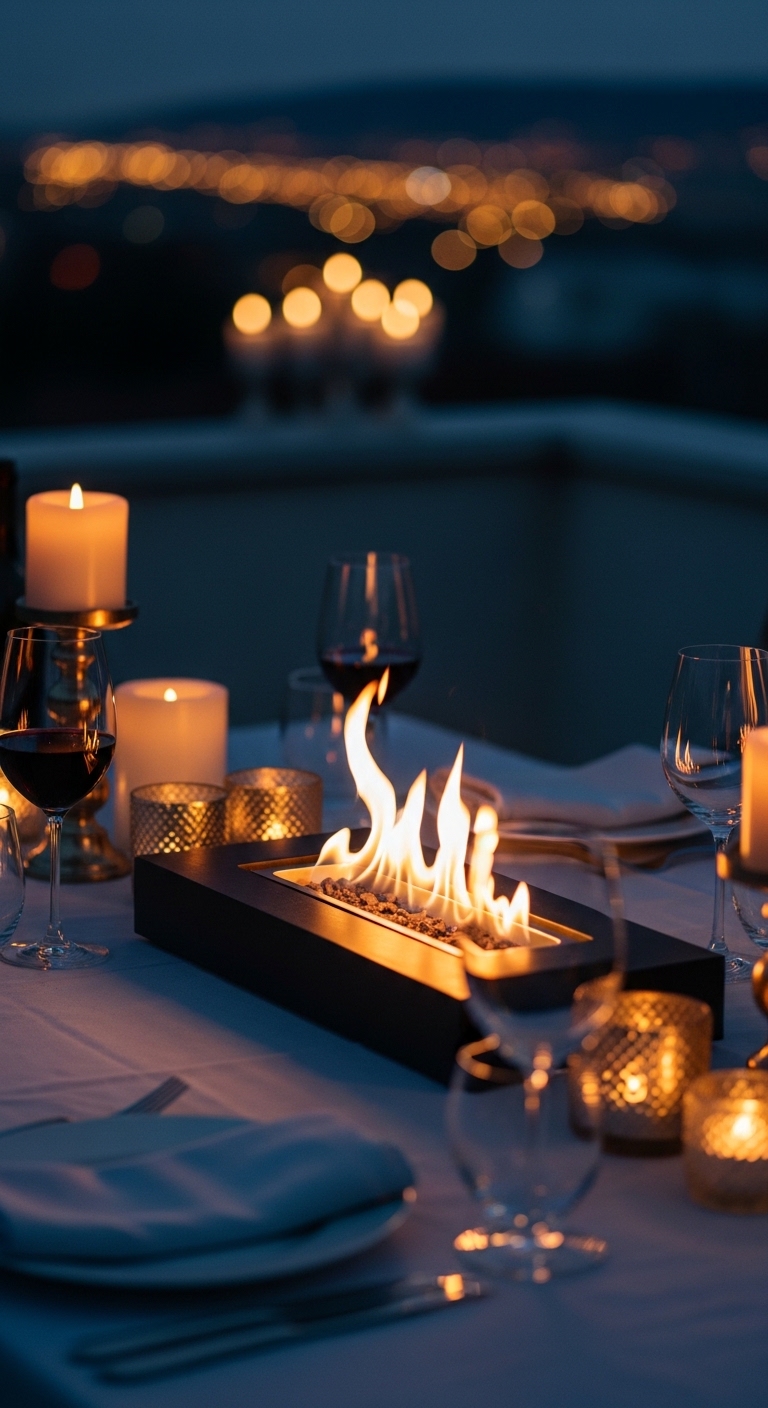
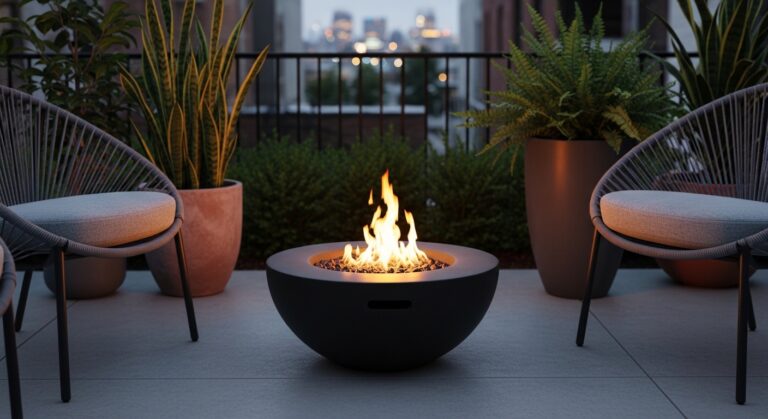
Not everyone has a sprawling backyard — and honestly, even people with large yards love having options. A portable tabletop fire pit is a small, elegant fire feature that sits on any outdoor surface: a patio table, a deck railing ledge, a side table next to a lounger. They run on gel fuel or small propane canisters, produce a real visible flame, and require zero installation.
These aren’t a replacement for a full-size fire pit, but they fill a different need entirely. Think apartment balconies, small patios, or those evenings when you want a little ambient fire without the full production. High-end versions look genuinely sophisticated — brushed stainless steel, concrete vessels, or handcrafted clay.
The best tabletop fire pits to look for:
- Bioethanol burners produce no smoke and no ash — genuinely clean burning
- Gel fuel versions are the most portable since the canisters are self-contained
- Look for models with a snuffer tool included for safe, instant flame extinction
- Windshields (glass panels on three sides) make these far more practical on breezy evenings
River Rock Fire Pit
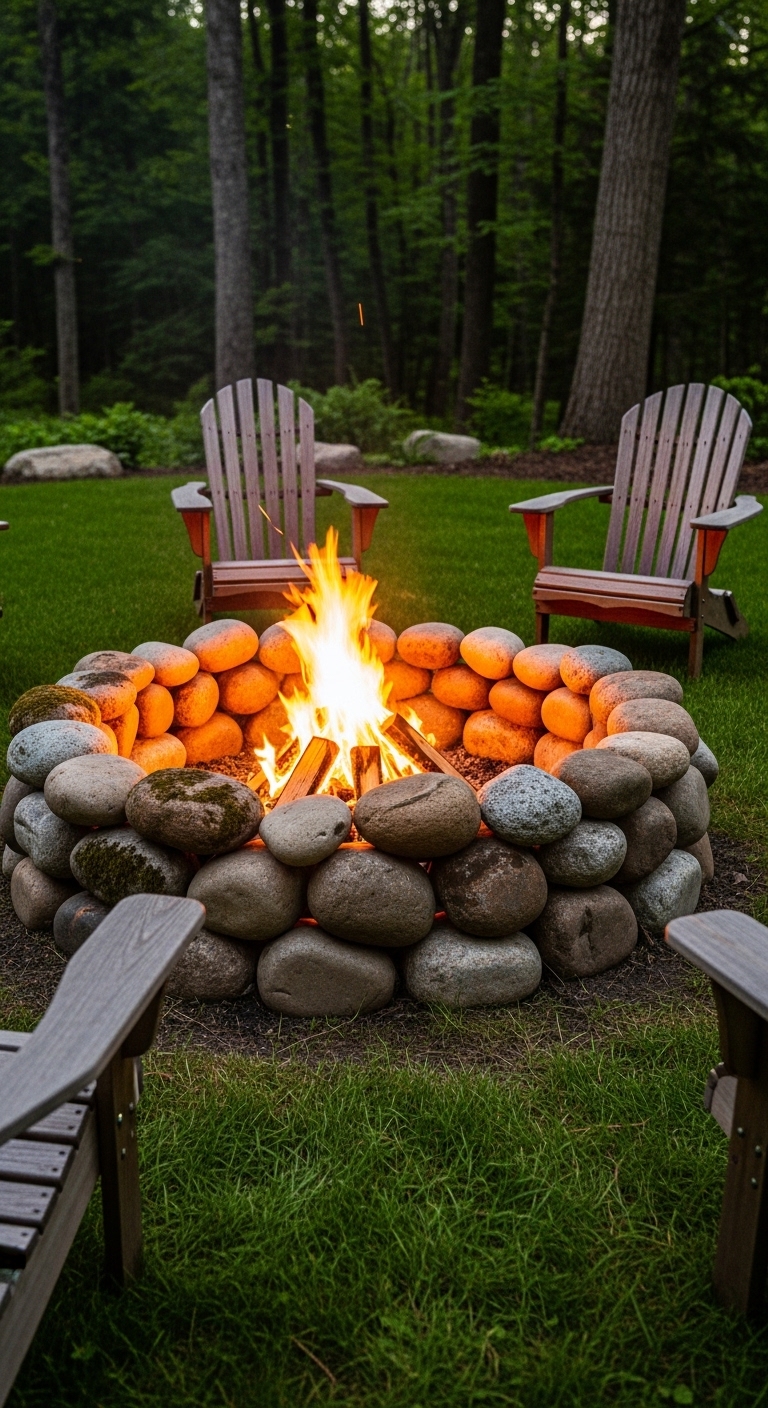
River rocks are those smooth, rounded stones you find at the edges of streams and rivers — and they make an absolutely gorgeous material for a DIY fire pit. The smooth, varied shapes create a natural look that feels almost like you’ve transplanted a piece of wilderness into your backyard.
Important note: you should never use actual river rocks collected from a streambed directly in a fire pit, because rocks that have been submerged in water can contain trapped moisture — when heated rapidly, that moisture turns to steam and the rock can crack or even explode. Always source river rock from a landscape supply company, where the stones have been dried and graded for outdoor use.
The build is essentially the same as a standard stone ring pit — stack the rocks in concentric rings, use a gravel base, and build up three to four courses high. The rounded shapes mean there are natural gaps between stones, which actually improves airflow for a better burn.
What makes river rock especially appealing:
- The color variation (grays, tans, russets) creates a richly textured surface
- Each pit ends up looking totally unique
- River rock blends seamlessly with naturalistic landscaping
- The smooth tops are comfortable to rest against if you’re using the ring as informal seating
Fire Pit With Swing Seats
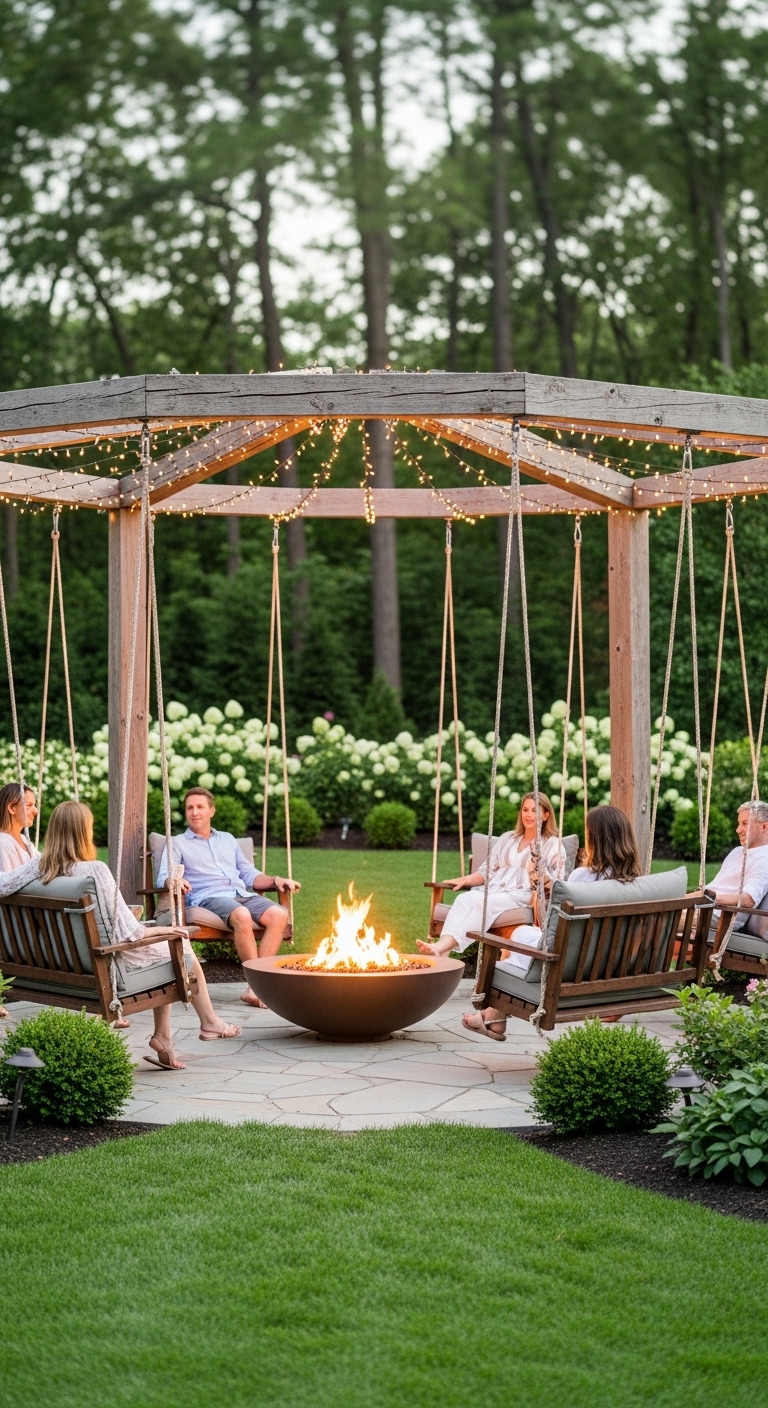
Who says you have to sit still around a fire? A fire pit surrounded by suspended swing seats — hanging from a central overhead structure or from individual frame supports around the pit perimeter — is one of the most joyful and visually arresting backyard setups you’ll come across.
The most common version uses a central timber post or metal pole with a circular “wagon wheel” overhead frame, from which four to six rope or chain swings hang at even intervals around the fire pit. The seats can be simple wooden planks, woven rattan rounds, or upholstered pads.
This setup is especially magical in family backyards where kids are part of the evening gathering — the gentle motion of swinging while watching a fire is as satisfying for adults as it is for children. It also naturally keeps everyone facing the fire and facing each other, which makes for great conversation.
Structural requirements to keep in mind:
- The overhead structure needs to be rock solid — no flex or sway at the attachment points
- Minimum 4 feet of clearance between the outer edge of the fire pit and the nearest swing
- Keep swing lengths consistent so all seats sit at the same height (16 to 18 inches above ground)
- Use weather-rated rope or galvanized chain for outdoor durability
Fire Pit With Cooking Grate
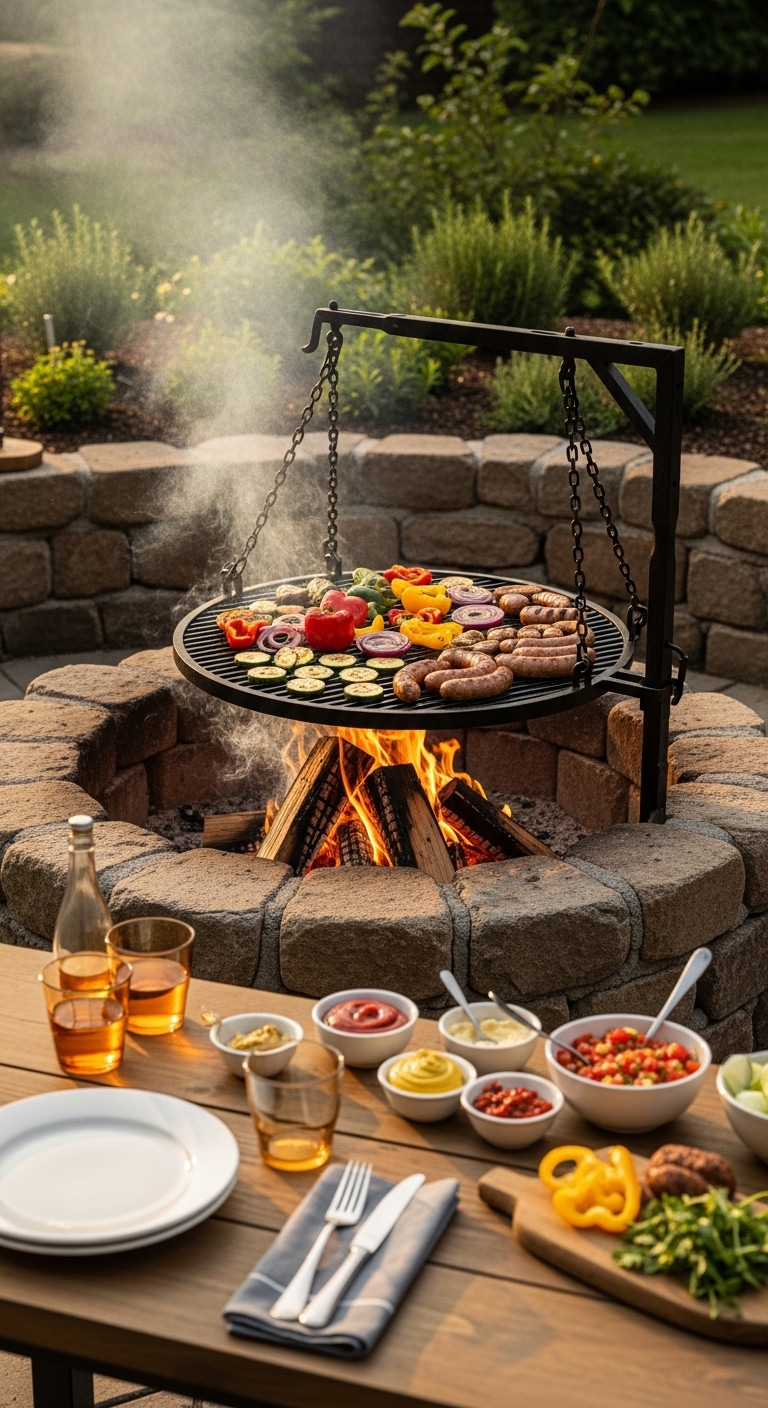
A fire pit that doubles as an outdoor cooking station is one of the most practical and genuinely fun upgrades you can make. By adding a swing-arm grill grate or a rotating spit attachment, you transform your fire pit from a purely atmospheric feature into a functional cooking hearth.
The most practical cooking accessory is a pivoting grate arm — a steel arm that anchors to one side of the fire pit ring and swings the grate in and out over the flames, so you can adjust heat exposure without getting too close to the fire. You can also use a simple campfire tripod with a cast iron pot hook for slow-cooking soups and stews.
Wood-fired cooking over a real fire produces flavors that no gas grill can replicate. The smoke from hardwoods like oak, hickory, or fruit woods infuses food with genuine depth. Let your fire burn down to glowing coals before you cook — they produce steadier, more even heat than open flames.
What you can cook over a fire pit:
- Steaks and chops directly on a cast iron grate
- Foil packets filled with vegetables, potatoes, and butter nestled into the coals
- Cast iron Dutch oven chili or stew hanging from a tripod hook
- Corn on the cob, peppers, and onions directly on the grate
- Campfire nachos in a cast iron skillet placed on the grate
Gabion Cage Fire Pit
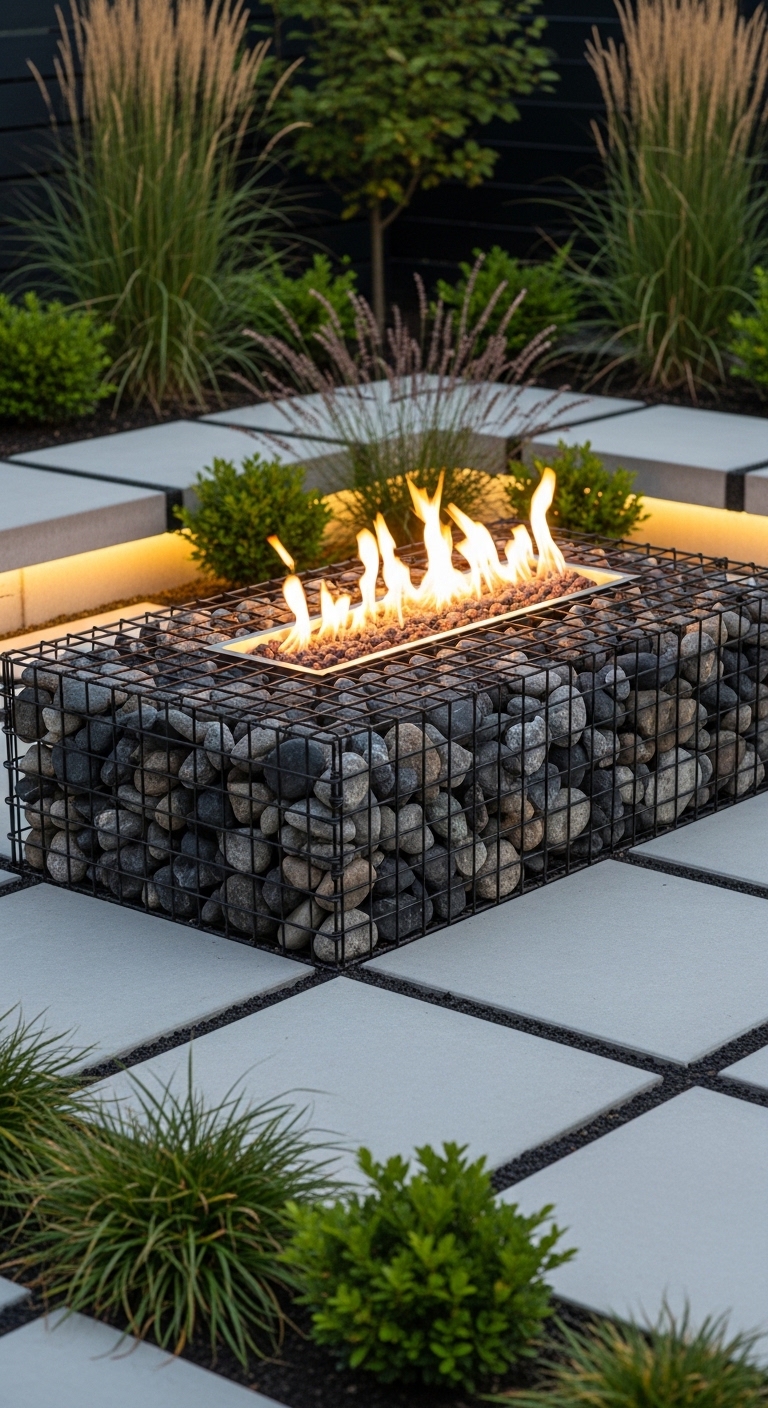
Gabion cages — wire mesh baskets filled with rocks, gravel, or glass — have become popular in contemporary landscape design, and they make incredibly striking fire pit surrounds. You build a square or rectangular cage from welded wire mesh, fill it with your chosen material, and set a fire bowl or fire insert into or on top of the structure.
The industrial texture of the wire mesh combined with the natural stone fill creates a look that’s simultaneously raw and sophisticated. It works especially well in modern minimalist backyards, xeriscaped desert gardens, or any space where architectural materials are the design language.
Building your own gabion surround is surprisingly straightforward:
- Purchase pre-made gabion basket forms from landscape suppliers (they come flat for easy shipping)
- Fold them into shape and secure the edges with hog rings or wire clips
- Fill with your chosen aggregate — river rock, quarry stone, recycled glass, even wine corks
- Set your fire bowl directly into a recessed top section, or rest it on the filled top surface
The filled cage acts as both the visual base and a heat sink — the rocks absorb warmth during the fire and radiate it back out after the flames die down, extending your outdoor comfort time on cool nights.
Pea Gravel Fire Pit Circle
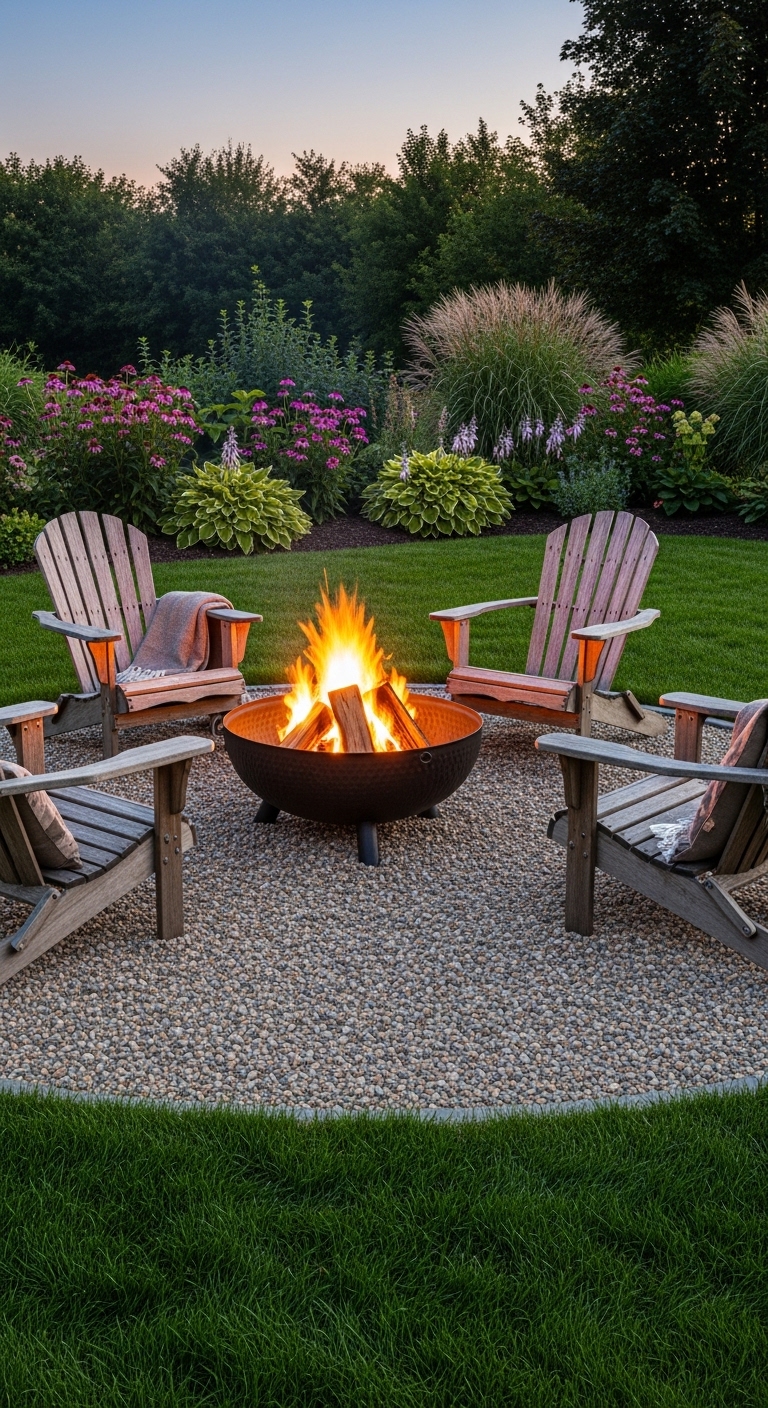
If you want a fire pit setup that looks intentionally designed but comes together quickly and inexpensively, a pea gravel circle is one of the most practical approaches out there. The concept is simple: excavate a defined circle around and including your fire pit, fill it with pea gravel, and use the gravel zone as your gathering area.
Pea gravel solves a number of practical problems at once. It creates a defined boundary for your fire pit zone, which reads as intentional design. It handles drainage perfectly — rain drains straight through. It won’t catch a spark and ignite the way mulch can. And it feels pleasingly underfoot, like a French garden path.
The setup process:
- Mark your circle with spray paint or flour, typically 12 to 14 feet in diameter
- Excavate 3 to 4 inches of soil
- Lay landscape fabric to suppress weeds
- Fill with 3 inches of pea gravel (3/8-inch size is the most comfortable to walk on)
- Edge the circle with metal landscape edging, stone, or brick to keep the gravel contained
This works beautifully as the base for almost any fire pit type — a simple metal bowl, a stone ring, a concrete insert, or a gas table all look polished sitting on a well-defined gravel circle.
Raised Concrete Block Fire Pit
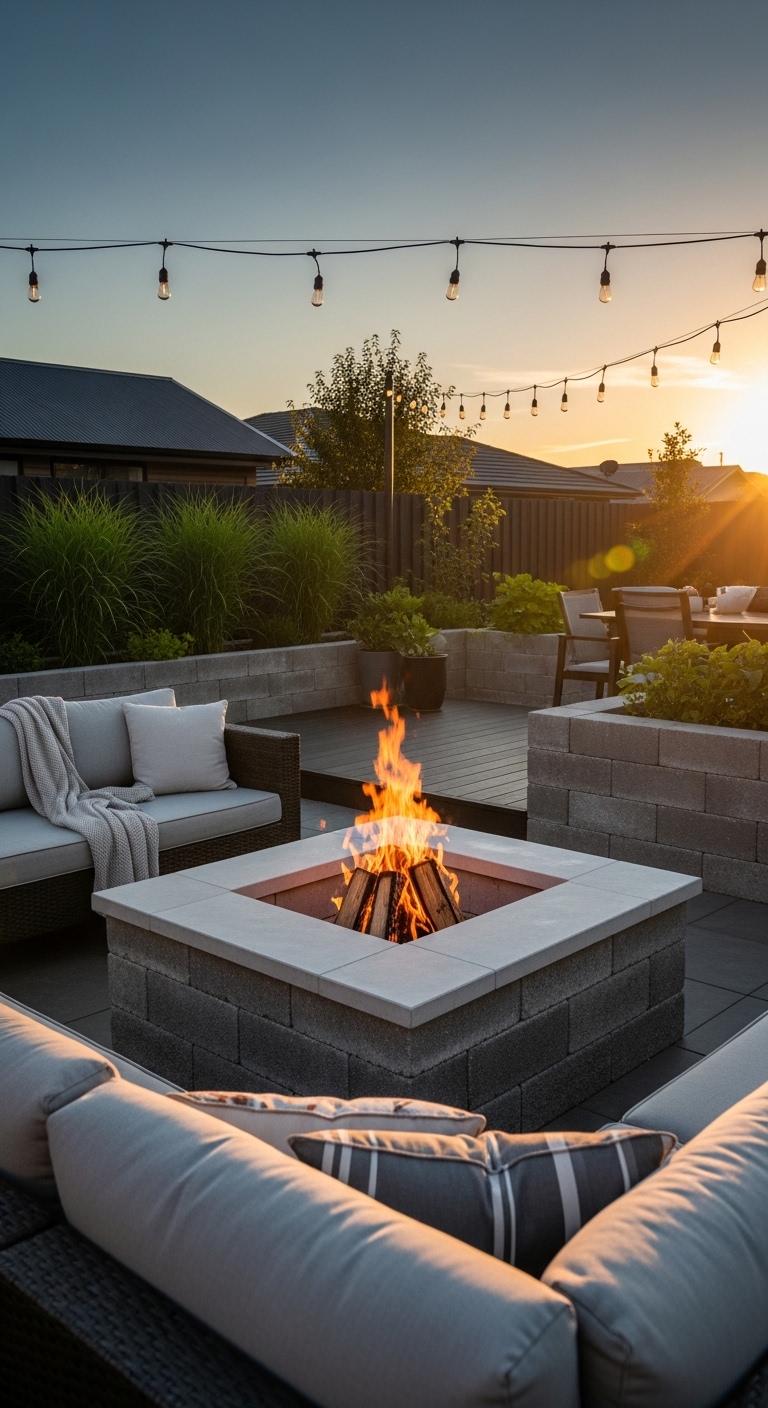
For homeowners who want a substantial, permanent fire pit without the cost of a custom masonry build, a raised concrete block fire pit is the sweet spot. Using standard concrete retaining wall blocks (like those used for garden borders and raised beds), you stack a square or circular pit that sits 18 to 24 inches above grade — a more comfortable height for standing and gathering than an in-ground pit.
The raised height makes this design particularly comfortable for standing and chatting around the fire — no hunching forward or craning down. It’s also more accessible for people who find it difficult to get in and out of low seating.
Concrete retaining wall blocks cost around $2 to $4 each from any home improvement store. A square pit with a 36-inch interior and walls three courses high needs roughly 40 to 50 blocks plus a few cap blocks for the top surface. Use construction adhesive between courses to lock the blocks together, and line the interior with firebrick or a metal insert for longevity.
Finishing touches that elevate the look:
- Apply a stone veneer skin over the concrete block exterior for a premium finish
- Cap the walls with smooth bluestone or natural fieldstone
- Add recessed LED lighting under the cap stones for evening ambiance
- Plant low groundcover or ornamental grasses at the base to soften the transition to lawn
apanese-Inspired Fire Pit
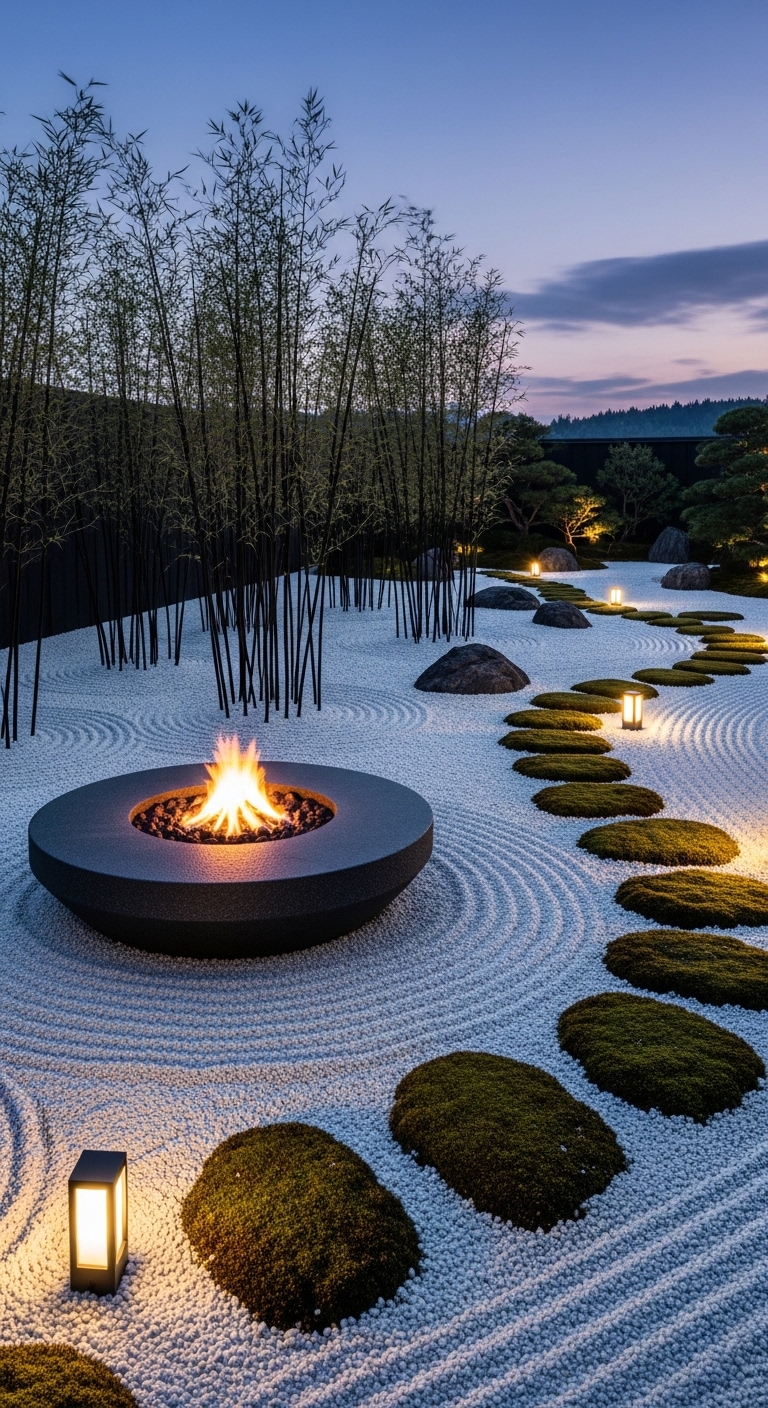
A Japanese-inspired fire pit brings a completely different design sensibility to the backyard — one rooted in restraint, precision, and natural materials. Think clean geometry, dark steel or stone, fine gravel raked around the base, and perhaps a few carefully placed ornamental stones and bamboo plantings nearby.
The fire pit itself in this style tends to be a simple cylinder — black powder-coated steel, dark granite, or basalt — with clean edges and no ornamentation. The design interest comes entirely from the surrounding elements: the precise placement of stones, the texture contrast between smooth metal and raked gravel, the vertical line of a bamboo clump.
Japanese garden design principles that translate beautifully to a fire pit zone:
- Odd-numbered groupings of stones feel more natural than even numbers
- A single large lantern placed near the pit adds both light and visual weight
- Use two or three plant species maximum — repetition feels more intentional than variety
- A stepping stone path leading to the fire pit zone creates arrival and ceremony
This design rewards patience and restraint. Every element earns its place.
Fire Pit With Water Feature
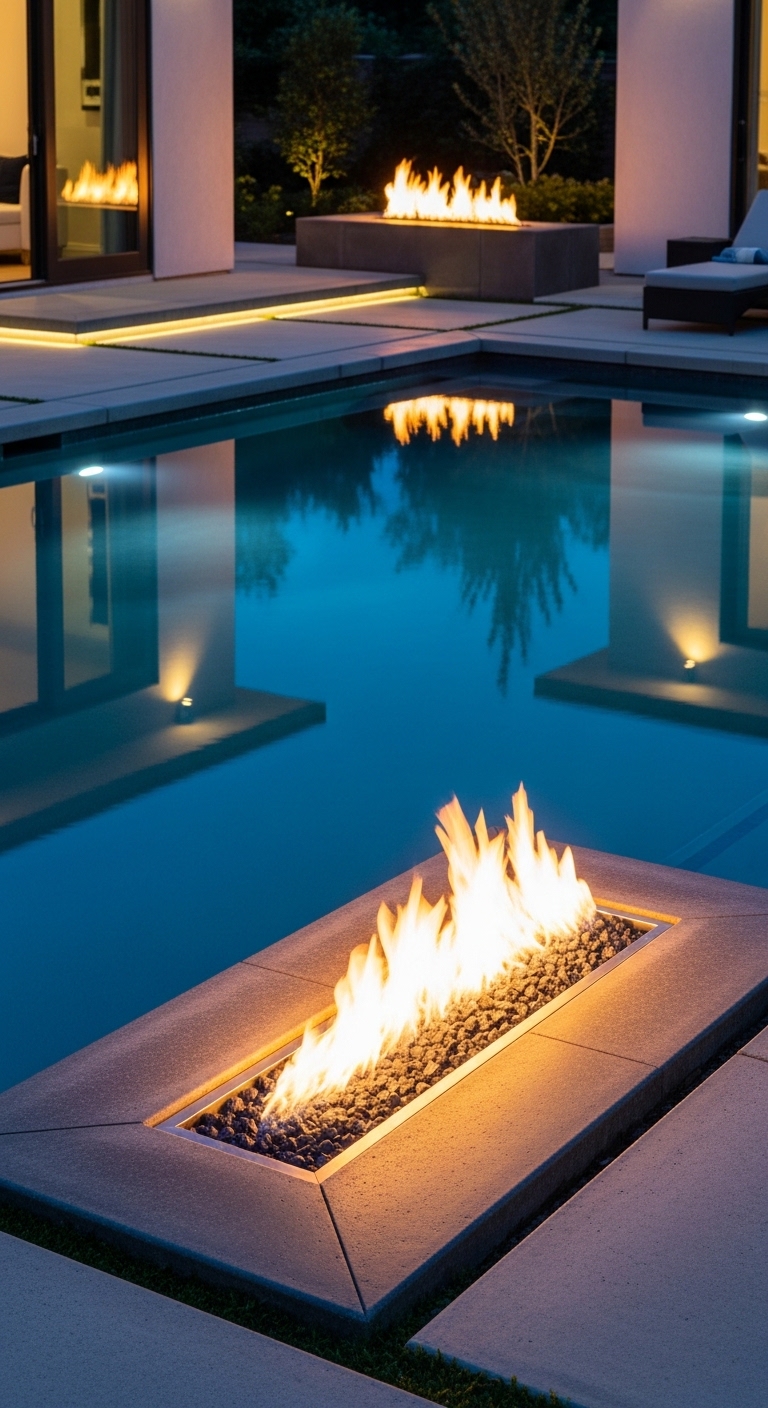
Combining fire and water in the same outdoor space sounds dramatic, but when it’s executed well, the two elements create a balance that feels genuinely extraordinary. The most common approach is a fire pit placed adjacent to — or even partially surrounding — a water feature: a reflecting pool, a shallow basin, or a linear water rill.
The interplay of fire’s warmth and water’s coolness — visually, thermally, and symbolically — creates a space that feels like a destination. The water reflects the firelight, multiplying the glow. The sound of water (if your feature has gentle movement) adds an acoustic layer that makes the whole space feel more alive.
Practical design considerations for fire-water combos:
- Keep the fire element at least 18 inches from any water edge for safety
- Gas fire inserts work better than wood-burning pits near water, since sparks and ash are eliminated
- A linear water rill running alongside a rectangular fire feature creates a clean, modern aesthetic
- A circular basin with a fire pit island in the center is the most dramatic version of this concept — and requires careful waterproofing and structural planning
This is typically a professional-level install, but the results can be genuinely jaw-dropping.
Backyard Bonfire Pit
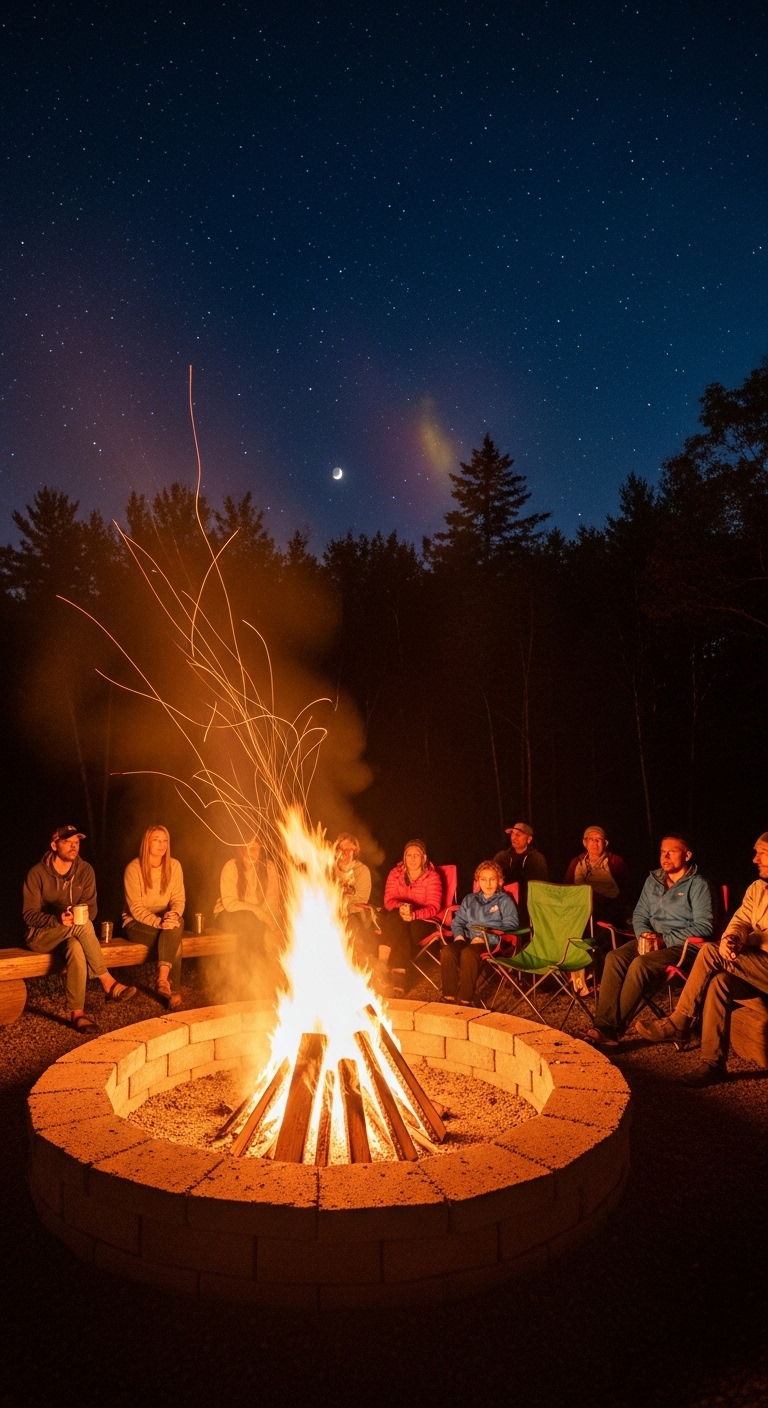
Sometimes you don’t want atmosphere — you want a real fire. A proper bonfire. The backyard bonfire pit is unapologetically large: a wide, deep ring designed for burning logs, making a genuine blaze, and gathering a crowd.
These are typically placed at the far edge of a property — away from structures, overhanging branches, and the main entertaining area — specifically because they need space. A bonfire pit ring should be at least 4 feet in interior diameter, with a 10-foot clear zone around it in every direction.
The best bonfire pits are:
- Simple in construction — a wide stone or concrete block ring without any complex features
- Sited at least 25 feet from any structure (house, garage, shed, fence)
- Located downwind of your home for the prevailing wind direction
- Equipped with a long-handled poker and a bucket of sand or water nearby
There’s something irreplaceable about a genuine bonfire — the scale of it, the heat you feel from 10 feet away, the way it commands a whole evening. It’s the original fire pit experience, and for rural and semi-rural homeowners with the space to do it safely, nothing else quite compares.
Mosaic Tile Fire Pit
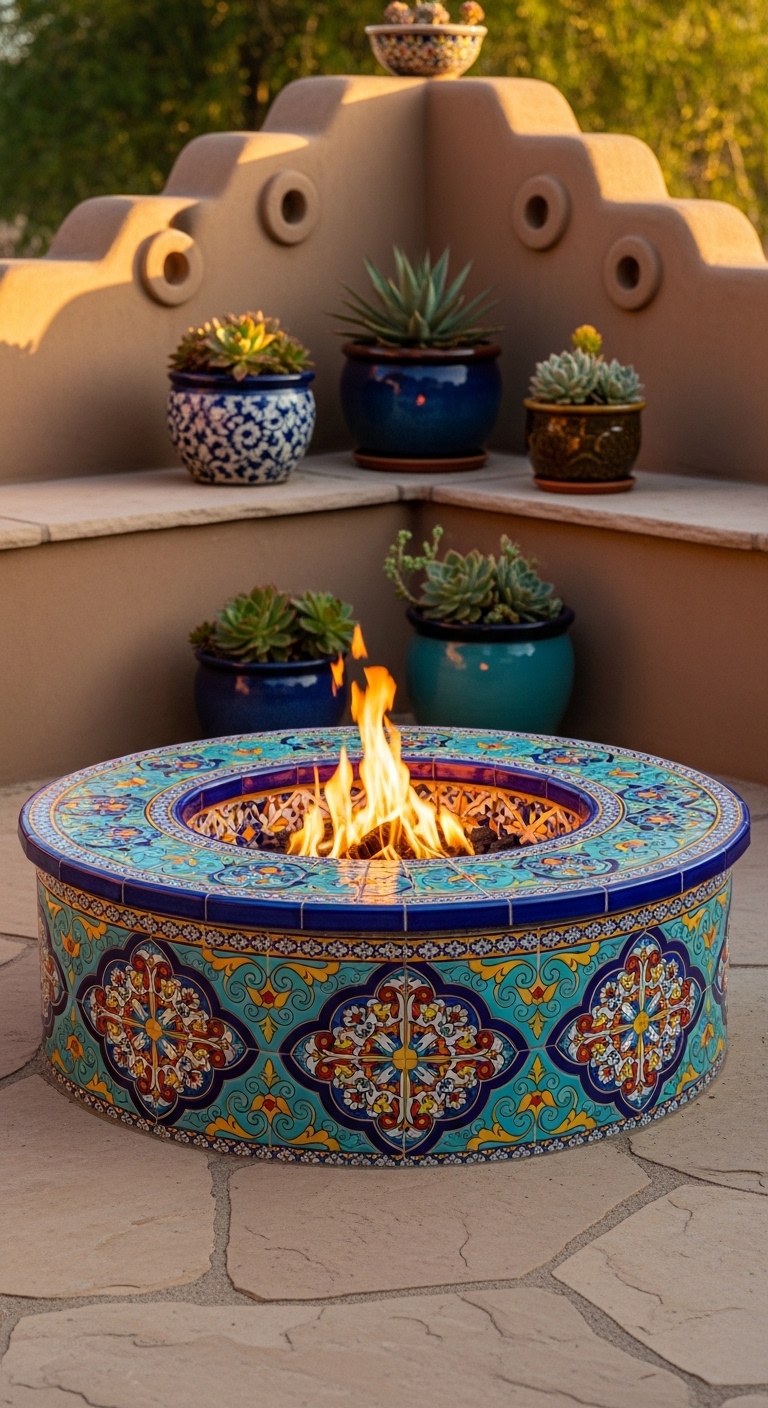
For homeowners who want a fire pit that doubles as a genuine piece of outdoor art, a mosaic tile fire pit is the way to go. The exterior of the fire pit — typically a concrete or block base — gets covered in hand-applied mosaic tiles: fragments of ceramic, glass, or stone arranged in patterns, colors, and designs that are entirely your own.
This is particularly popular in Southwestern, Mediterranean, and bohemian backyard aesthetics, but honestly, a beautifully executed mosaic can work in almost any outdoor setting. The key is committing to a palette — two or three colors that relate to your overall outdoor scheme — and choosing a pattern that complements the shape of the pit.
Materials and process:
- Use exterior-rated glass or ceramic tile rated for freeze-thaw cycles if you live somewhere cold
- Tile adhesive rated for exterior masonry use (cement-based thinset, not mastic)
- Unsanded grout in a color that complements your tile palette
- Seal the finished mosaic with an exterior tile sealer every two to three years
The fire pit base itself is usually a simple pre-made concrete form, which you tile over. The tiling process is meditative and genuinely enjoyable — many homeowners make it a multi-weekend project, working on sections at a time.
Smart Gas Fire Pit With App Control
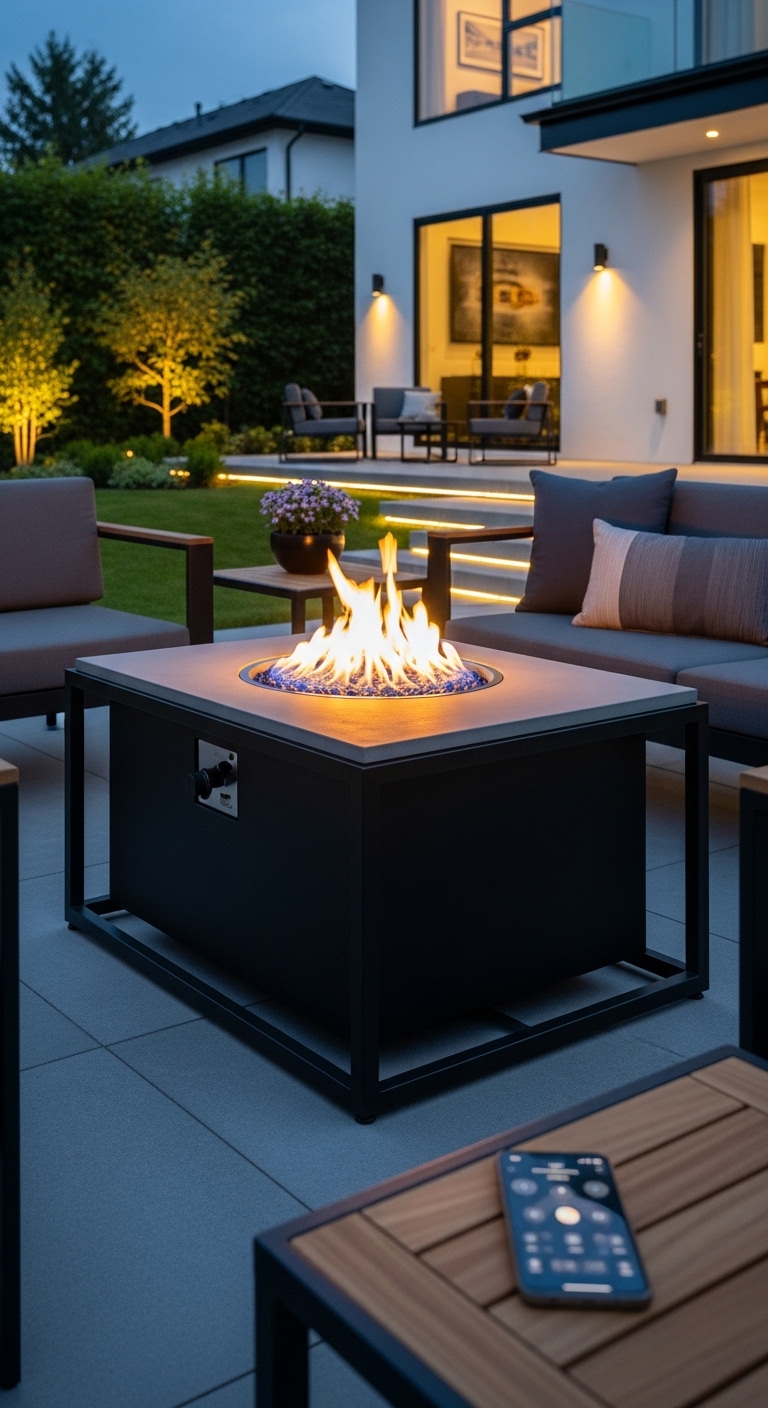
We wrap up with the most technologically current option on the list: a smart gas fire pit that you control from your phone. These units connect to your home Wi-Fi, integrate with smart home systems like Google Home or Amazon Alexa, and let you turn the fire on or off, adjust flame height, and set timers — all from an app.
The practical appeal is real. You can start the fire from inside the house while you’re getting ready for guests. You can turn it off remotely if you forget after heading inside. You can set it to turn off automatically after two hours. For households with children, remote shut-off alone is worth the premium.
Smart fire pit features to look for:
- UL-listed gas components — safety certification matters for any gas appliance
- Compatibility with your existing smart home ecosystem
- Manual override capability so it works even if your Wi-Fi goes down
- A flame sensing safety shutoff that kills the gas if the pilot flame is extinguished
These units run between $800 and $3,000+ depending on size, materials, and smart features. They represent the future direction of outdoor fire features — where beauty, safety, and convenience converge.
Bringing It All Together
A fire pit is one of those rare backyard investments that pays back instantly and keeps paying back for years. Unlike a pool that requires constant maintenance, or a pergola that takes a season to build, a fire pit transforms your outdoor space from the very first evening you light it.
The best fire pit for your backyard is the one that fits your space, your style, and how you actually live. If you host big groups, go for the sunken lounge or the bonfire pit. If you entertain couples and small gatherings, the gas fire pit table gives you the most flexibility. If you want a weekend project you can be proud of, the DIY brick or stone ring is incredibly satisfying to build.
Whatever direction you go, these 20 ideas give you a starting point that’s proven, practical, and genuinely beautiful. Now pick the one that’s calling your name — and get that fire started.