15 Decorating Stairway Walls Ideas That Will Transform Your Home Instantly
You walk past it every single day — sometimes a dozen times — yet somehow that long stretch of blank wall climbing your staircase never quite makes it onto your decorating to-do list. Sound familiar? I kept telling myself I’d get to it eventually, and then one afternoon I finally stopped, looked at that sad empty wall, and decided it deserved so much better than the bare nothing it had been carrying for two years.
That was the afternoon my stairway became my favorite corner of the whole house. In this article I am sharing 15 genuinely beautiful, completely doable ideas for decorating your stairway walls — ideas I have personally tested, loved, and would absolutely do again. Whether you rent, own, have a tight budget, or are ready to go all in, there is something here that will make you fall in love with your stairs all over again.
1. Curated Family Photo Gallery Wall
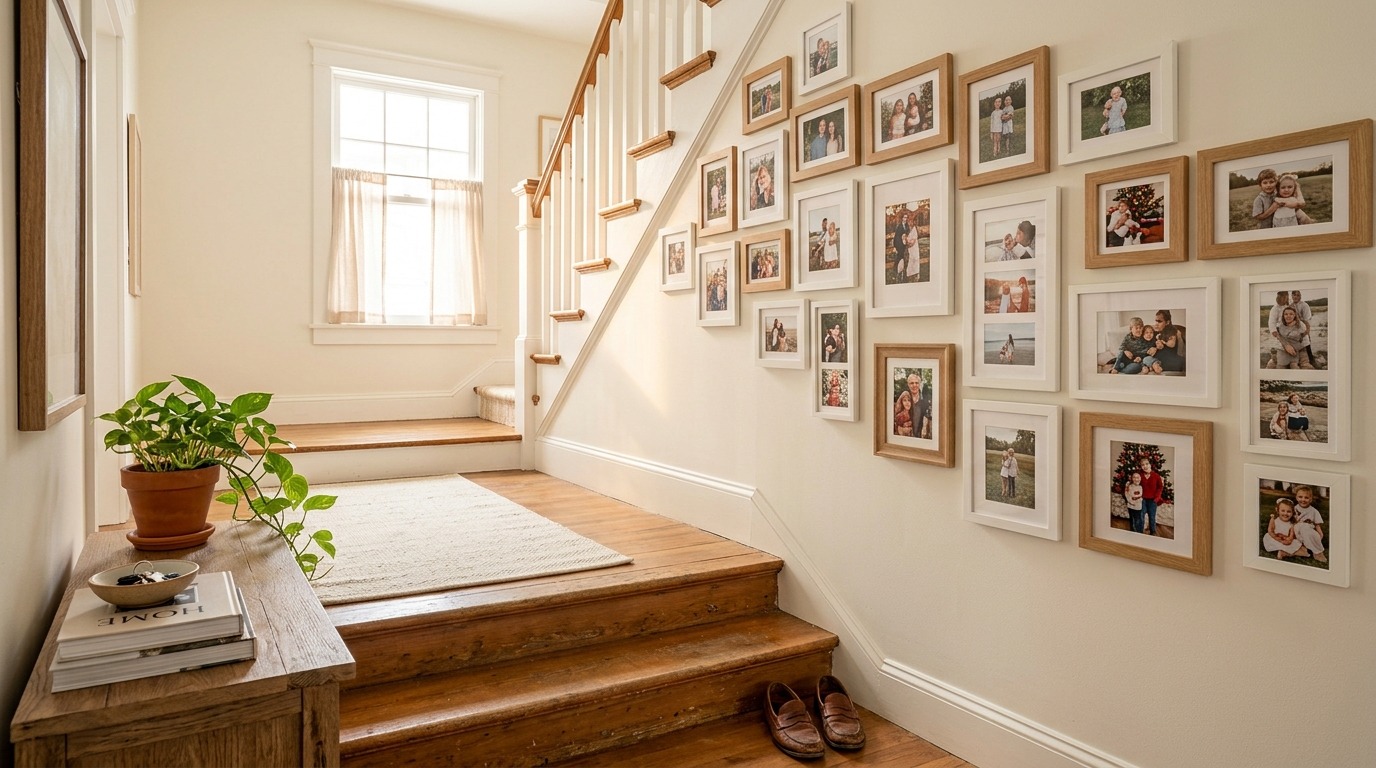
Picture walking up your staircase every morning past the grinning faces of people you love most — the candid birthday moments, the ridiculous holiday card outtake that made everyone cry laughing, the quiet Sunday afternoon you somehow captured perfectly on your phone. A family photo gallery wall does exactly that, turning your daily climb into something genuinely warm and personal rather than just a functional path between floors.
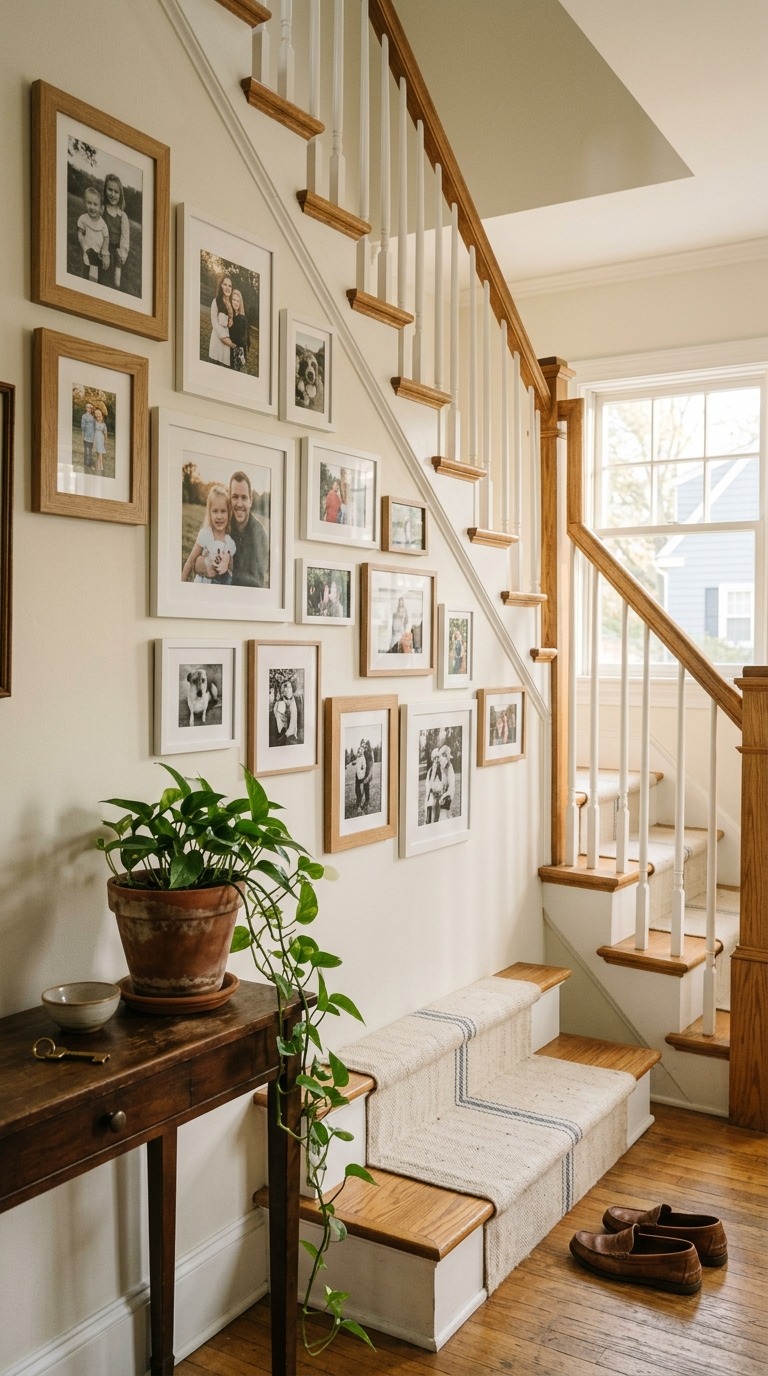
I painted my stairwell in Benjamin Moore White Dove OC-17 before hanging anything, and that single decision made every photo pop like it was lit from within. The trick that nobody tells you is to stick with one frame finish throughout — I chose natural oak — but vary the frame sizes dramatically, mixing 4×6 and 8×10 and even a couple of square 6×6 prints for visual rhythm. Hang your tallest piece at eye level on the mid-stair step and let everything else radiate from there. Your wall will feel intentional, collected, and completely yours.
2. Bold Botanical Wallpaper Accent Wall
The moment I hung botanical wallpaper on my stairway wall I genuinely gasped, and I am not someone who gasps easily at decorating decisions. There is something about oversized foliage running the full height of a staircase that makes a home feel like a place where nature was deliberately invited inside. It is dramatic and lush and completely enveloping, and it makes every single person who visits stop on the stairs and look around like they have just stepped somewhere extraordinary.
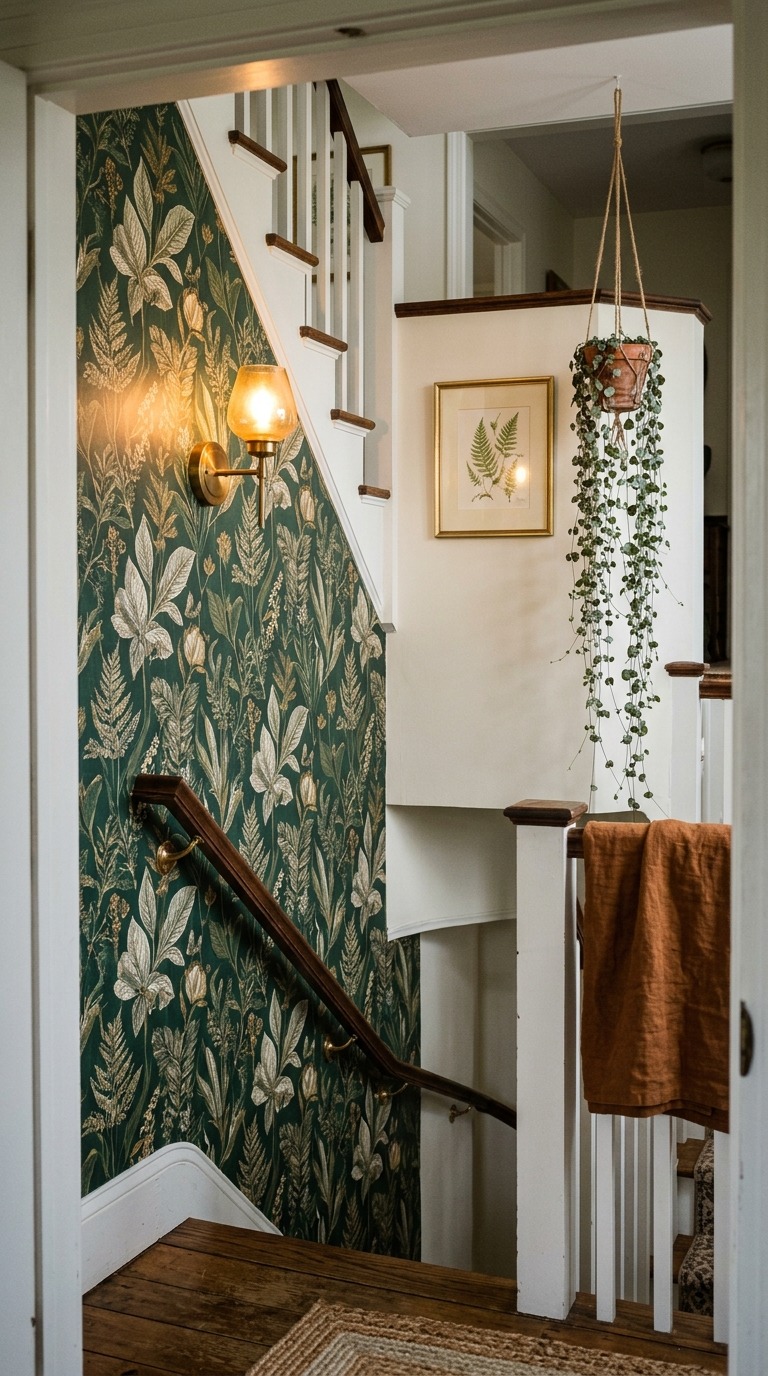
You do not need to wallpaper every surface — just the stairway wall itself is enough to create serious impact. I love the House of Hackney Palmeral print or any similar large-scale botanical pattern from Graham and Brown, which offers excellent peel-and-stick options perfect for renters. Pair deep green botanical wallpaper with unlacquered brass hardware and walnut wood accents for a rich organic palette that feels genuinely sophisticated. Keep your handrail clean and uncluttered so the wallpaper becomes the undeniable star of the whole composition.
3. Floating Shelf Vignette Display
Floating shelves on a stairway wall completely changed the way I think about that vertical space, because suddenly it was not just a wall — it was real, usable square footage that could hold things I actually love. I staggered three pine shelves at different heights following the diagonal rise of the stairs, and the result looks like something between a sculptural installation and a curated little shop that happens to live inside my home. Guests always stop on the stairs to look at what is sitting on each shelf.
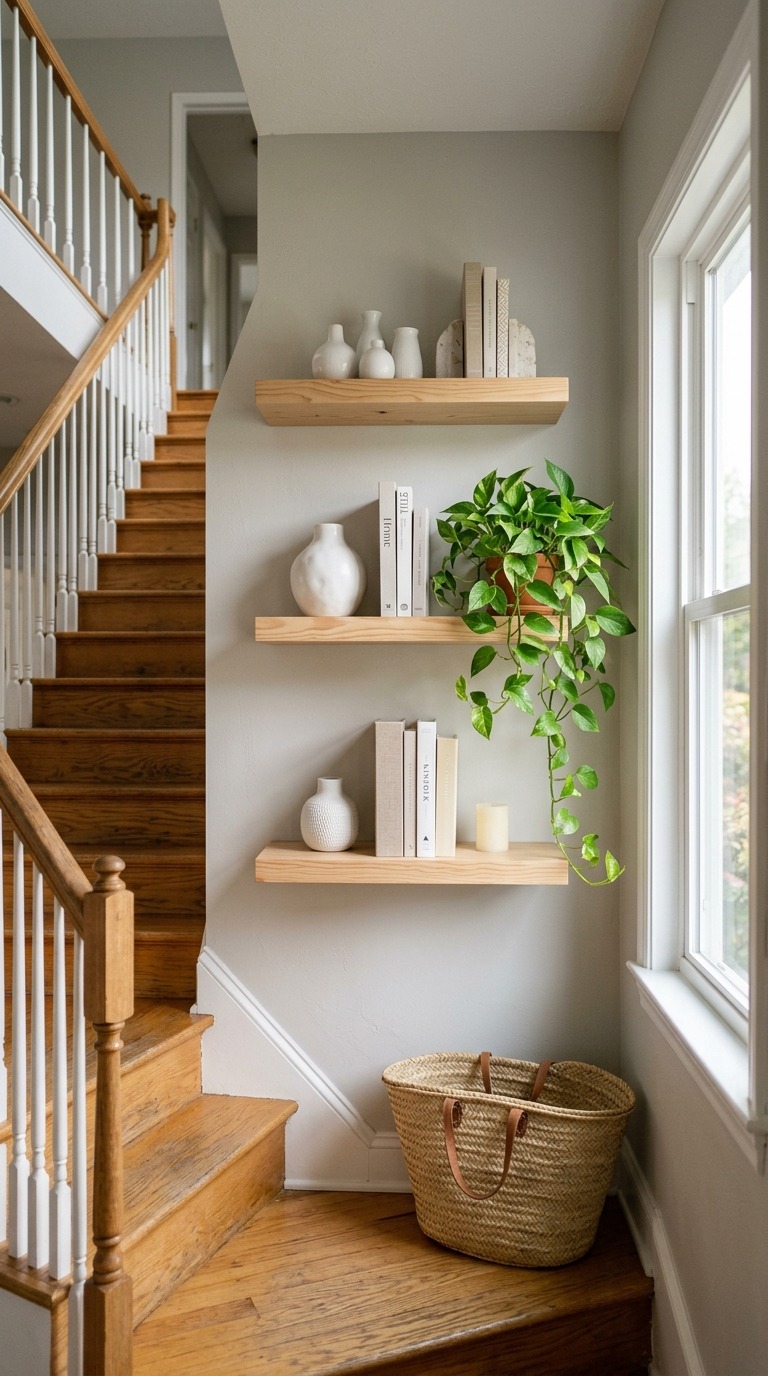
The secret to a shelf vignette that feels intentional rather than cluttered is the rule of odd numbers and varying heights. Group objects in threes — a tall ceramic vase, a medium candle, and a trailing plant — and never let every item on the shelf be the same height. I painted my stairway wall in Farrow and Ball Elephant’s Breath No.229, a gorgeous greige that makes natural wood shelves look warm and expensive without trying hard. Add a few slim hardcover books in neutral spines and one unexpected texture like a small woven tray, and your shelf display will look professionally styled every single time.
4. Black and White Salon-Style Art Arrangement
A black and white salon-style arrangement is one of those ideas that looks like it requires serious design training to pull off, but I promise you it is actually the most forgiving thing you can hang on a wall. The reason it works so effortlessly is that the monochrome palette does all the unifying work for you — you can mix an abstract print next to a landscape photograph next to a vintage map next to a botanical illustration, and the shared color story ties everything together instantly without any of it feeling chaotic or mismatched.
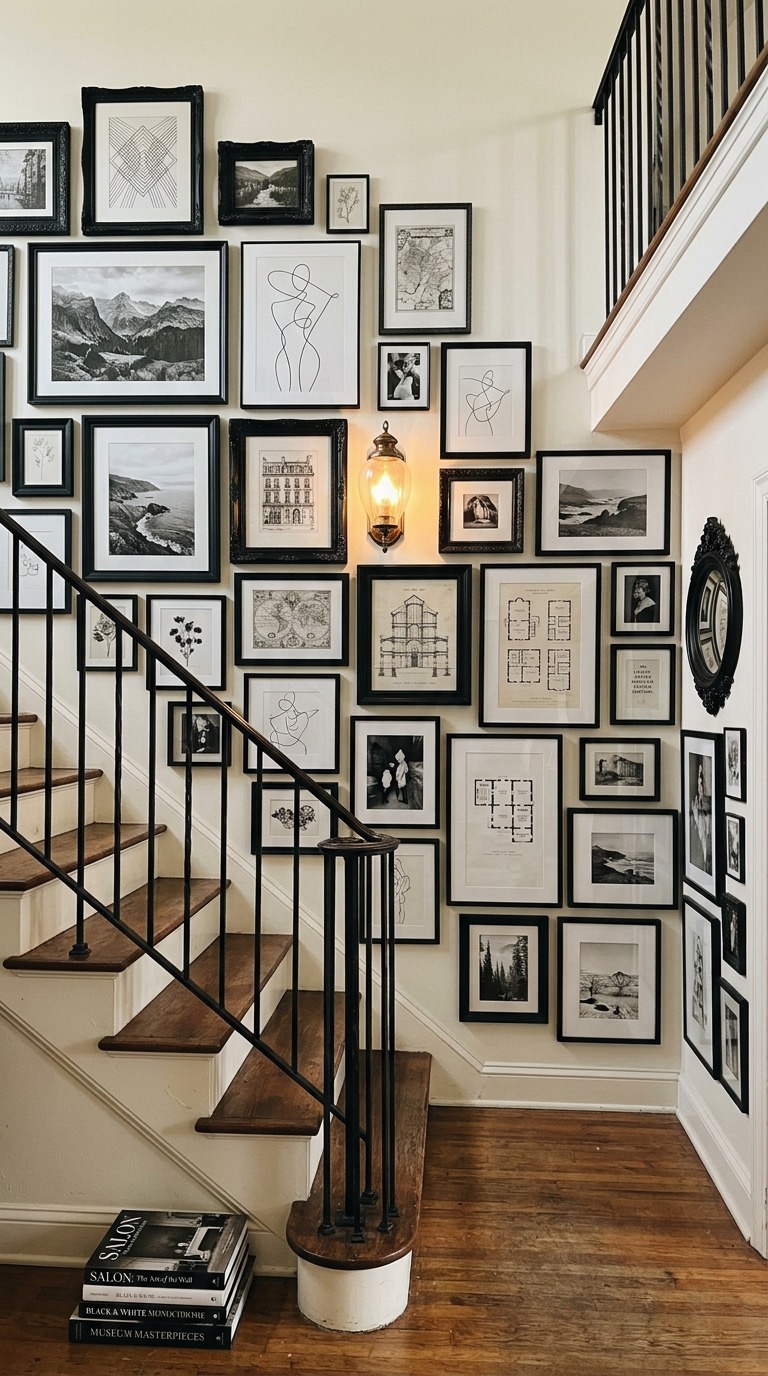
Start by laying all your prints on the floor in roughly the arrangement you want before you put a single nail in the wall. I live by this step because it saved me from at least three bad decisions. Paint the wall in Sherwin-Williams Alabaster SW7008 first — it is just warm enough to stop the gallery from feeling cold and clinical while still reading as clean and crisp. Use ornate black frames in mixed sizes and do not worry about keeping them perfectly aligned. Salon style is supposed to feel collected and layered, like these pieces arrived in your home one by one over years of hunting.
5. Wainscoting with a Deep Contrast Paint Color
The combination of white wainscoting on the lower half of a stairway wall with a deep contrasting color on the upper half is one of those classic architectural moves that makes a home look like it was professionally designed from the ground up. I added beadboard wainscoting to my stairway wall about two years ago and it genuinely doubled the perceived value of the space overnight — suddenly the staircase felt considered and structured rather than just functional. The paneling gives the wall a texture and depth that no amount of art alone can fully replicate.
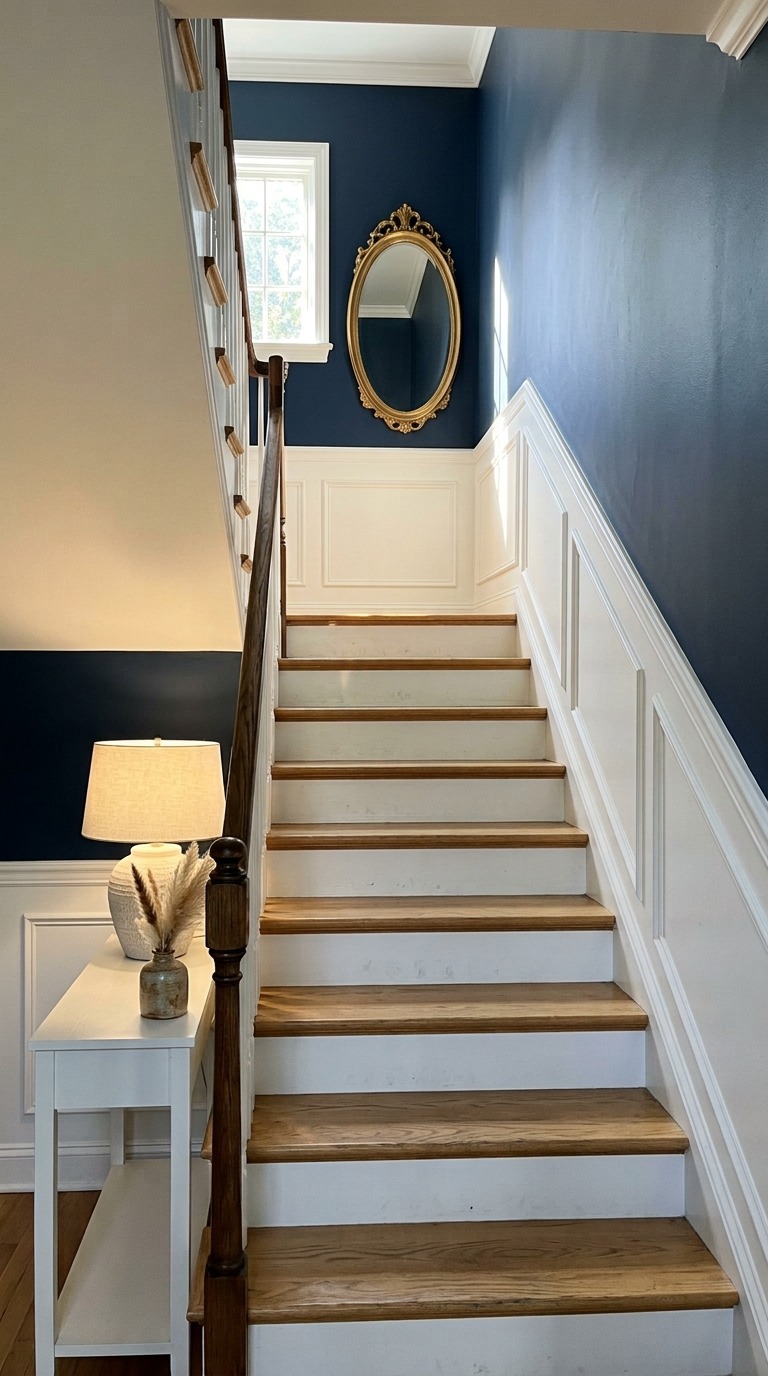
For the upper wall color above the wainscoting, I am completely in love with Sherwin-Williams Naval SW6244, a saturated navy that feels both moody and sophisticated without ever going dark enough to feel oppressive in a stairwell. The key is making sure your wainscoting is painted in the crispest possible white — Benjamin Moore Chantilly Lace OC-65 is my absolute favorite — so the contrast between the two sections is clean and graphic. Hang one large statement mirror or a single oversized art print in the upper section and leave the rest of that beautiful dark wall alone to breathe.
6. Macrame and Woven Textile Wall Hanging
The first time I hung a large macrame piece on my stairway wall I felt like my whole house exhaled. There is something about natural fiber and handcrafted texture in a home that creates an immediate sense of warmth and deliberateness — it says that a real person lives here and makes choices with intention rather than just filling space with whatever was on sale at the home store. A well-chosen macrame piece is simultaneously art and architecture, adding sculptural depth to a flat wall in a way that no framed print quite manages.
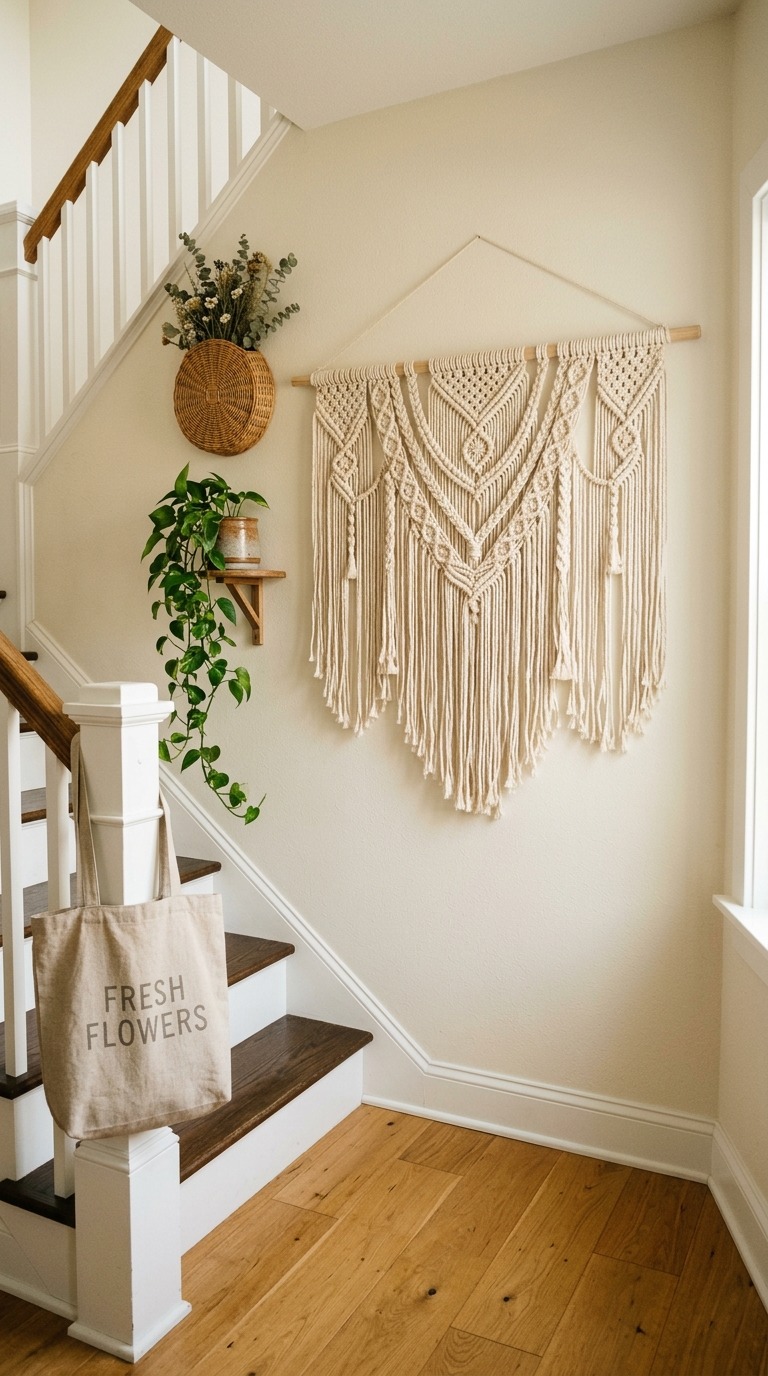
Look for a macrame piece that is at least 24 to 30 inches wide so it holds visual weight proportional to your stairway wall. Pair it with Benjamin Moore Linen White OC-96 on the walls — that particular warm creamy off-white makes natural rope look like it was always meant to live in that exact spot. Add a rattan wall basket or two in varying sizes nearby to build out a texture-rich wall story without overcrowding. The whole arrangement should feel like it grew organically rather than being installed all at once on a single ambitious Saturday afternoon.
7. Statement Oversized Art Print or Canvas
Sometimes the most powerful thing you can do on a stairway wall is resist the urge to fill every inch of it and instead hang one single enormous piece of art and let it speak completely on its own. I did this on my stair landing and it changed the entire energy of the space — instead of a wall that said here are things I own, it said here is something I genuinely love and wanted to live with every day. One oversized canvas stops you in your tracks in the best possible way, making you actually look rather than just walk past.
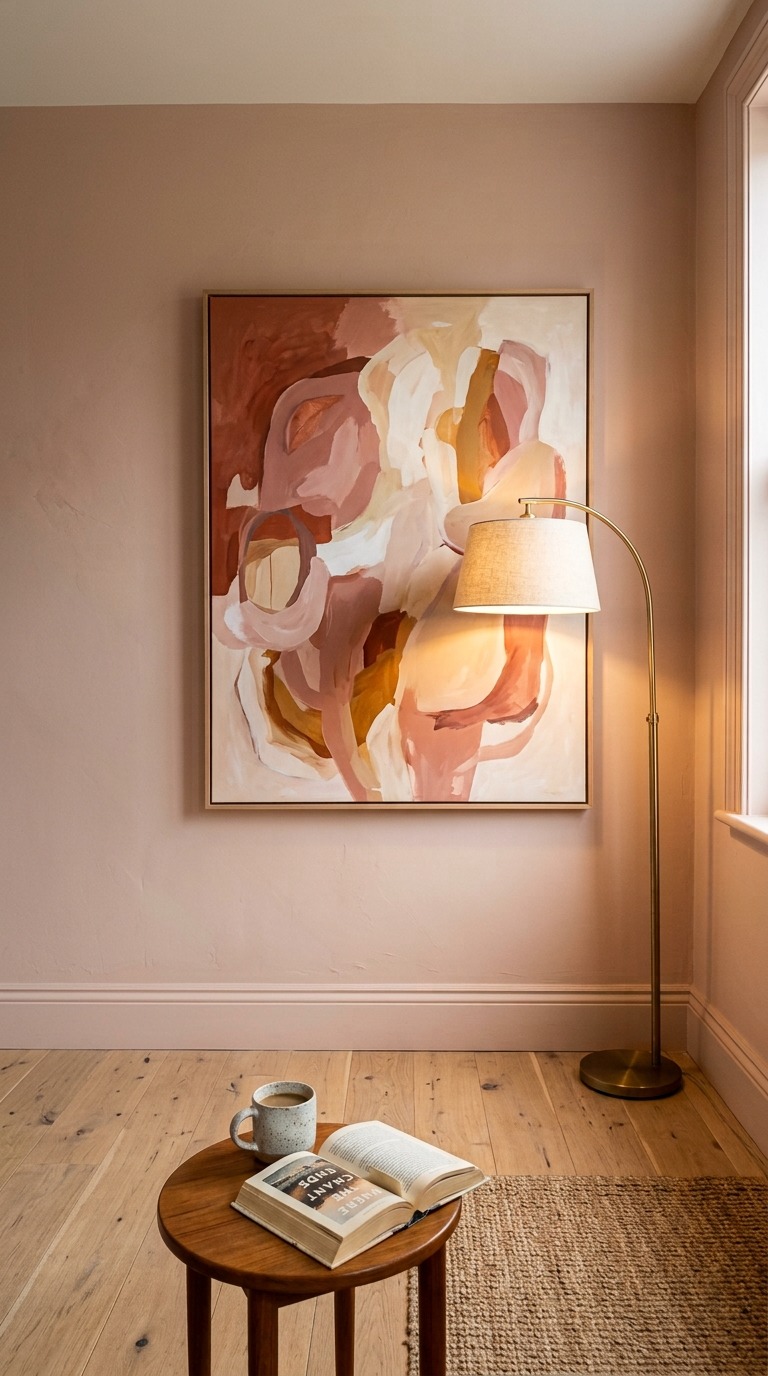
Choose something with personal resonance rather than something that just matches your sofa. I am drawn to loose abstract paintings with warm organic tones — terracotta, dusty rose, warm cream — because they carry so much visual warmth without demanding a specific decorating style around them. Paint your landing wall in Farrow and Ball Dead Salmon No.28, one of the most quietly beautiful colors I have ever put on a wall, before hanging the canvas. The key is sizing up more than you think you need — a piece that feels almost too large in the shop will feel exactly right once it is surrounded by the generous white space of a staircase wall.
8. Mirror Gallery for Light and Drama
A gallery of mixed mirrors on a stairway wall does two extraordinarily clever things simultaneously — it fills a large vertical space with personality and visual interest, and it bounces light around a typically dim corridor in a way that makes the whole staircase feel twice as open and airy. I hung seven mirrors in varying shapes and finishes on my stairway wall last spring and my narrow hallway staircase went from being the darkest corner of my house to the brightest and most interesting. Friends ask about it every single time they visit.
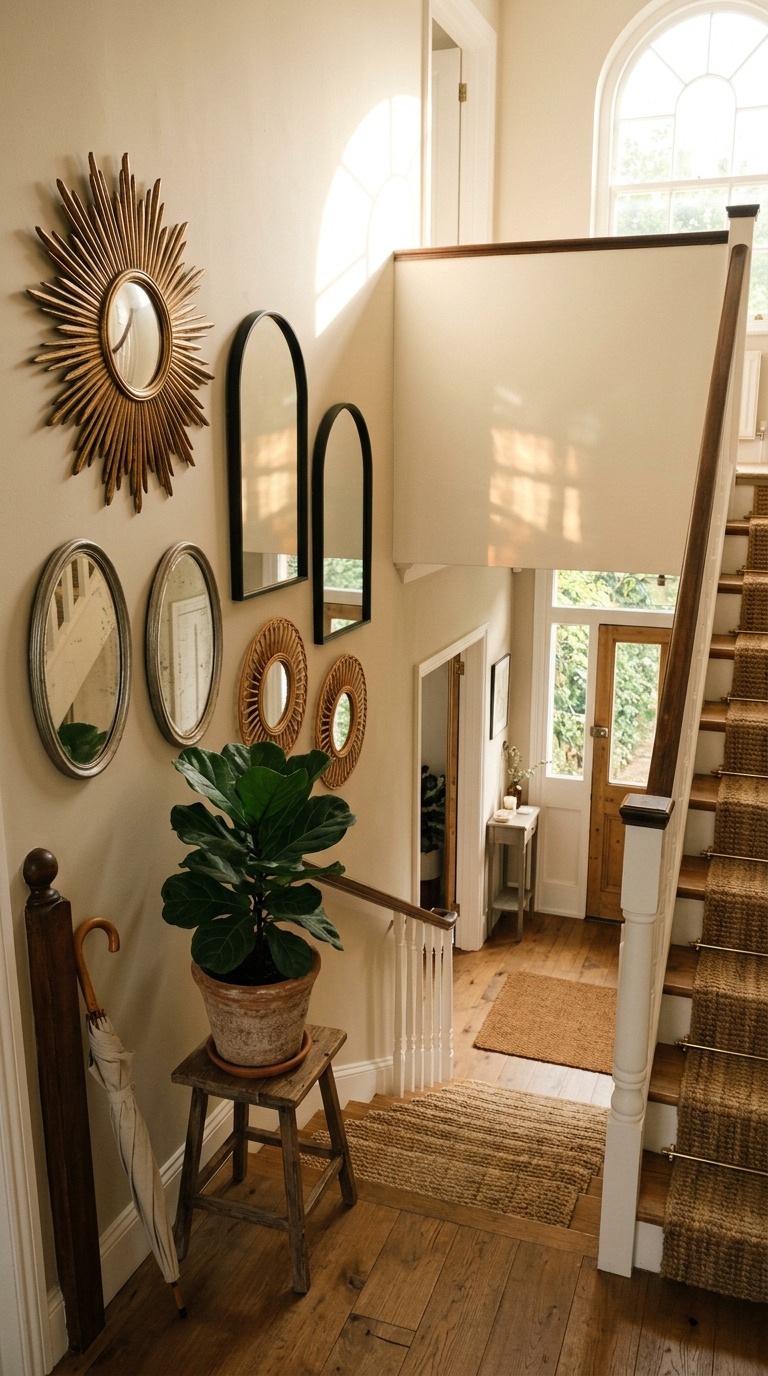
The secret is variety in shape but restraint in finish — I stick to a palette of antique gold, aged brass, and natural rattan tones so every mirror feels like it belongs to the same collected family even though none of them actually match. Hunt for interesting shapes at estate sales, thrift shops, and places like World Market or vintage Etsy shops where you can find unusual silhouettes that a standard home goods store would never carry. Paint the wall in Sherwin-Williams Accessible Beige SW7036 first — that particular warm neutral makes every finish on every mirror look intentional and harmonious rather than thrown together.
9. Architectural Paneling and Trim Detail
There is a reason that almost every house on the pages of Architectural Digest has some form of architectural wall detailing — board and batten, paneling, wainscoting, picture rail molding — and it is because applied trim transforms a flat drywall surface into something that looks genuinely crafted and intentional. Adding board and batten paneling to my stairway wall was one of the most satisfying weekend projects I have ever undertaken, partly because the materials are genuinely affordable at any lumber yard and partly because the impact is completely disproportionate to the effort involved.
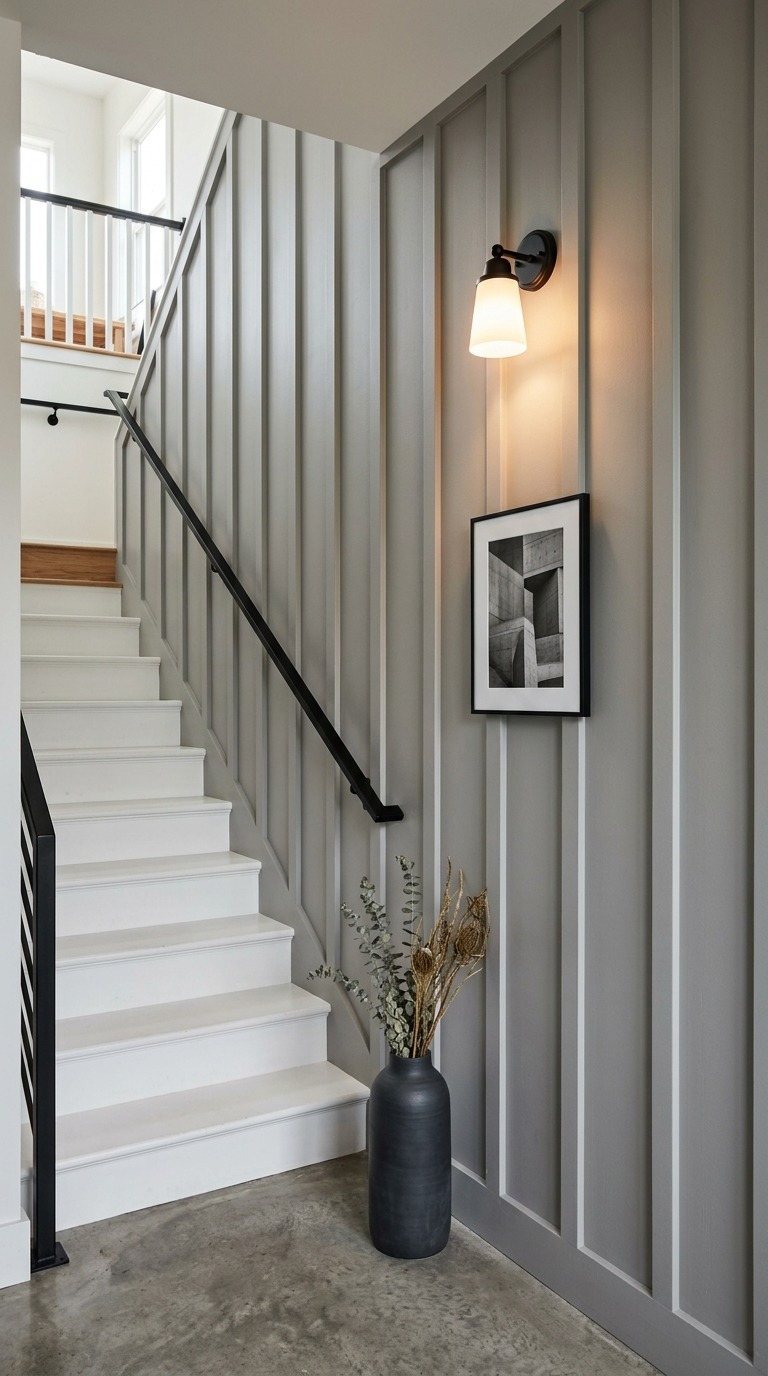
The critical step that most tutorials skip is painting the entire wall, battens included, in one unified color rather than painting the battens a contrasting white. When everything is the same shade — I love Farrow and Ball Pavilion Gray No.242 for this — the shadow lines between battens do all the visual work, creating depth and rhythm without any color contrast at all. The result feels quiet, sophisticated, and architectural rather than decorative, which is a distinction worth chasing if your home leans modern or transitional in its overall style.
10. Vintage Map Collection Display
I have always been drawn to old maps — not just as documents but as objects, the way they combine geography and history and a particular faded beauty that no modern print quite replicates. Hanging a curated collection of vintage maps on a stairway wall creates a gallery that feels both intellectual and deeply personal, like a visual record of all the places that have mattered to someone. Mine tell the story of the cities I have lived in and the coastlines I have walked, and every single time I climb those stairs I get a small jolt of something that feels like gratitude and wanderlust braided together.
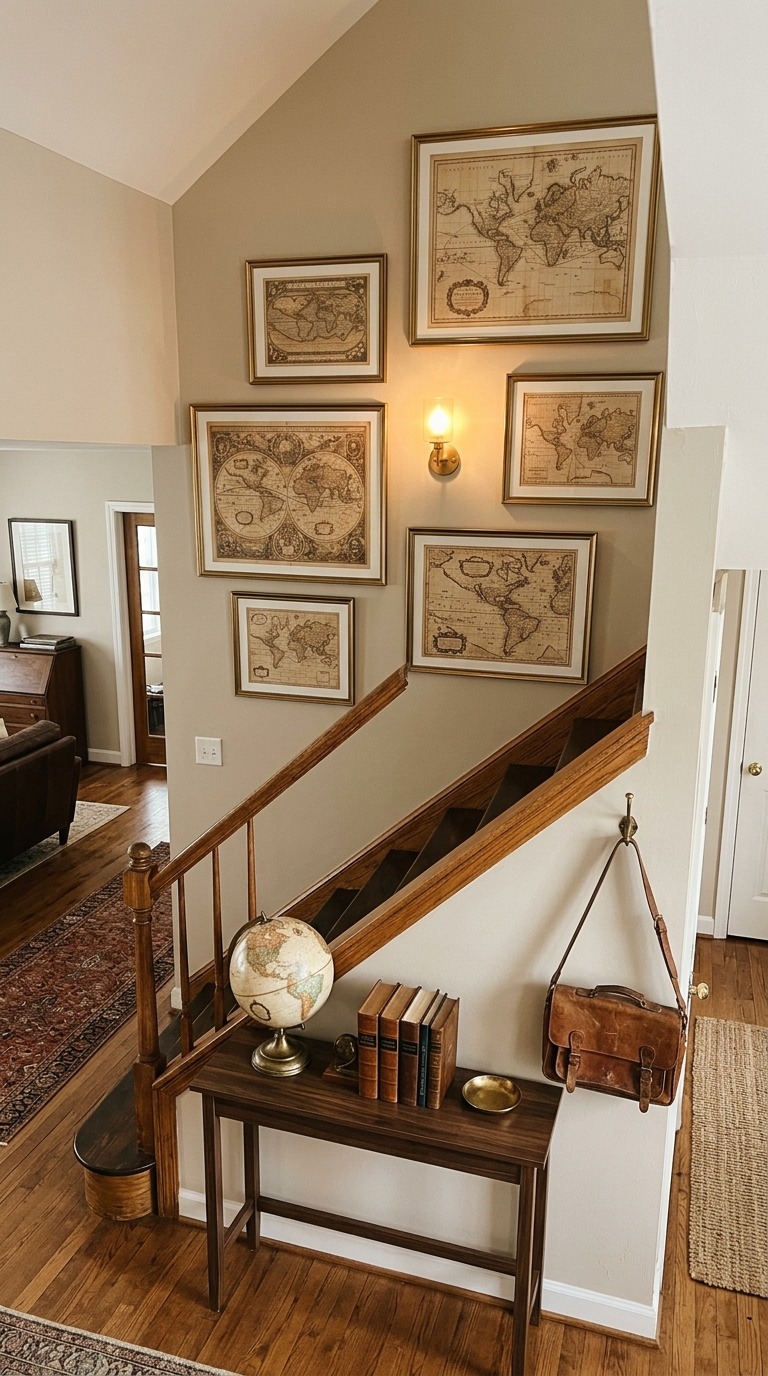
Source your maps from antiquarian print shops, estate sales, and online sellers like Old World Prints or David Rumsey Map Collection prints for authentic aged pieces that carry genuine character. Unify them visually by choosing the same slim antique brass frame for every map, varying only the frame size to match the map dimensions. Hang them in a clean two-column diagonal grid rather than a loose salon arrangement — maps respond beautifully to structure and symmetry. Paint the wall behind them in Benjamin Moore Pale Oak OC-20, which brings out the warm sepia and amber tones in aged cartography like nothing else I have tried.
11. Plant Wall with Trailing Greenery
The idea of a living plant wall along a staircase sounds either incredibly high-maintenance or intimidatingly complicated, but I promise you that a simple staggered arrangement of wall-mounted plant brackets with a handful of genuinely tough trailing houseplants is neither of those things. I put mine up over a single afternoon and it cost less than a hundred dollars total including the brackets, pots, and plants — and it adds more life and personality to that staircase than anything else I have tried in two years of decorating it. Plants breathe warmth into architectural spaces in a way that art simply cannot.
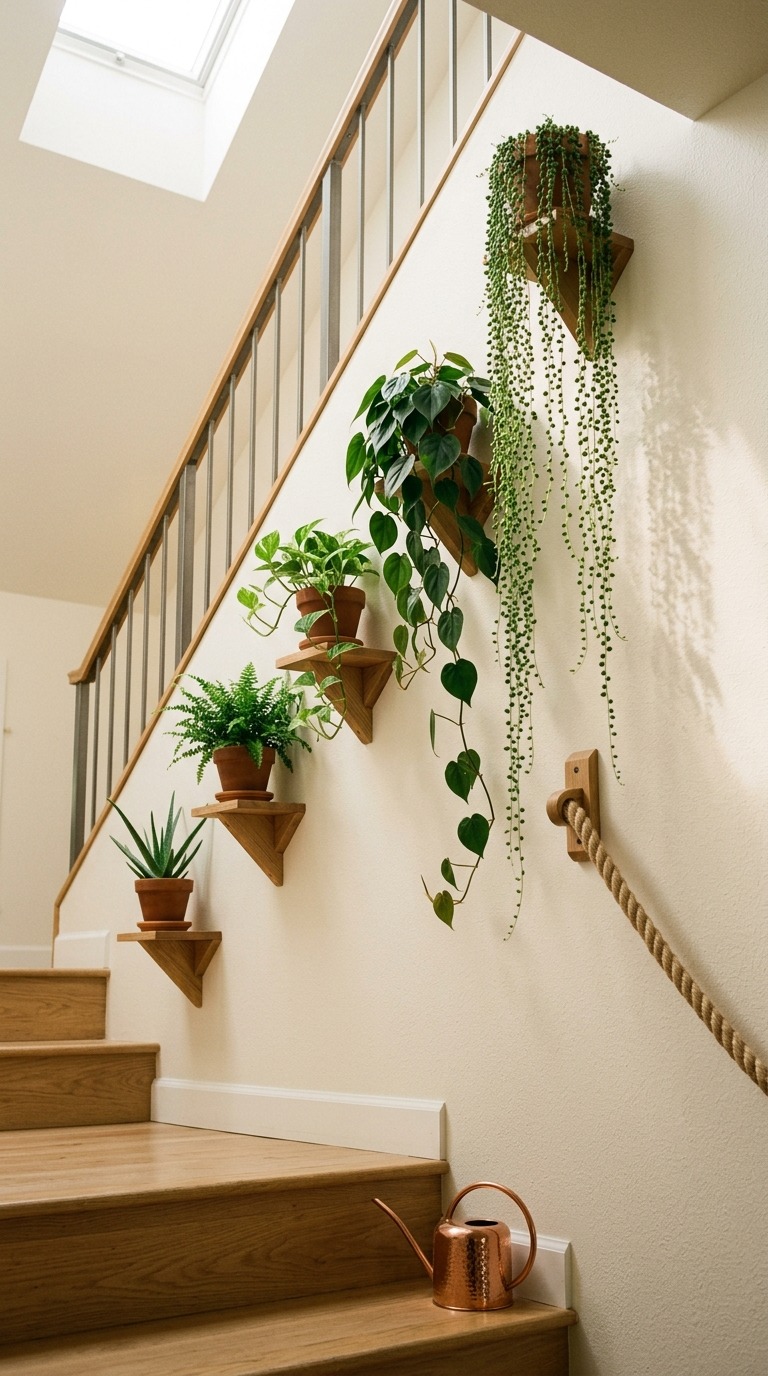
Choose plants that genuinely thrive in indirect light rather than fighting against your stairwell conditions — heartleaf philodendron, golden pothos, string of pearls, and tradescantia are all beautifully trailing, wonderfully forgiving, and genuinely happy with the bright-indirect conditions most stairwells offer. Mount your brackets in a diagonal line that follows the handrail, spacing them roughly 18 inches apart vertically and alternating their horizontal position slightly so the plants do not compete for light. Paint the wall in Sherwin-Williams Egg White SW6364 — it is the warmest possible off-white and it makes every shade of green in every leaf look vivid and alive.
12. Bold Color Drenching — One Saturated Hue
Color drenching — painting the walls, trim, ceiling, and even the handrail in one single saturated hue — is the most quietly brave thing you can do to a staircase, and I say that as someone who spent three years too afraid to try it. The moment you commit to it fully, something extraordinary happens: the staircase stops being a corridor and becomes a space, an experience, a moment inside your home that feels completely unlike anything else around it. Color drenching on a stairway wall does not need art or accessories because the color itself is the decoration.
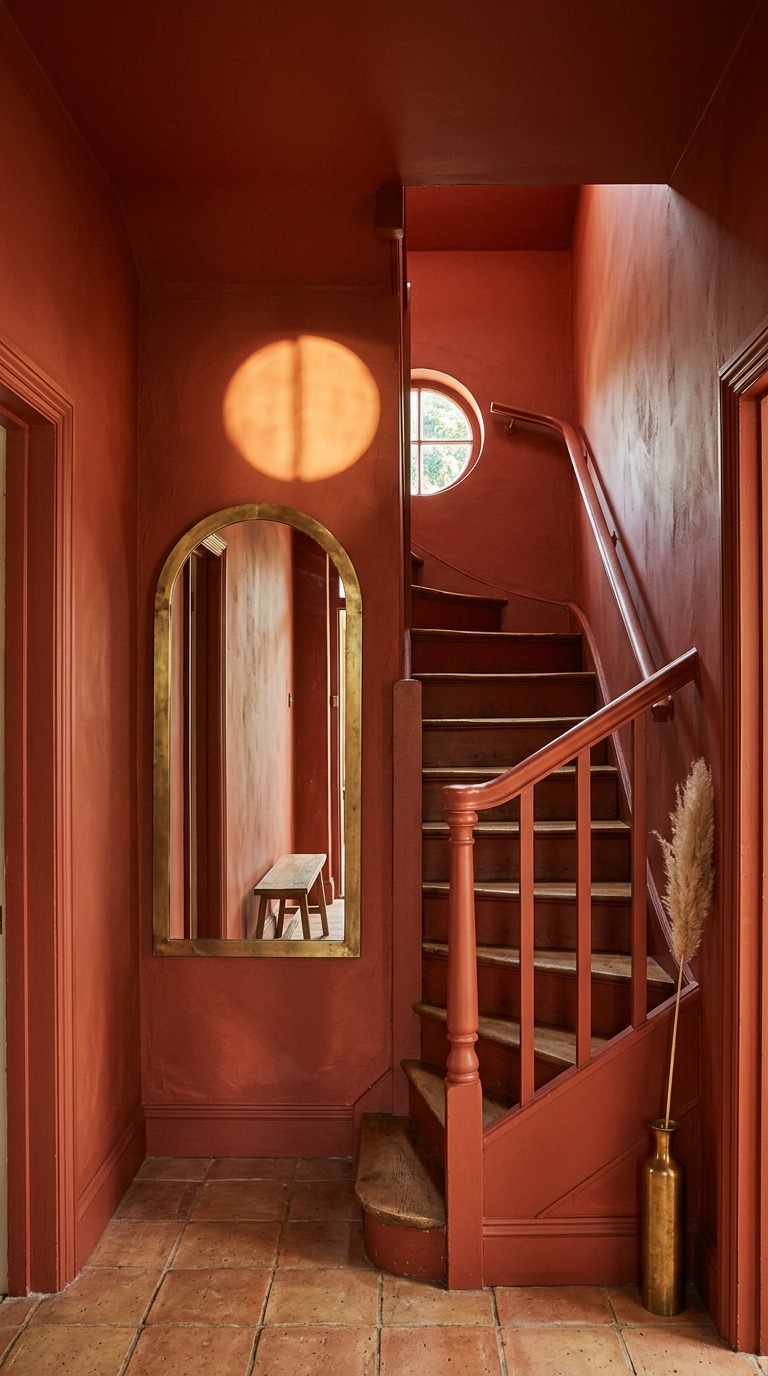
My recommendation is Farrow and Ball Red Earth No.64, a deep burnt terracotta that feels ancient and Mediterranean and somehow both daring and cozy at exactly the same time. The trick to making color drenching work rather than feel like a mistake is painting absolutely everything — not just the walls but the skirting boards, the door frames, and the handrail too. When the color has nowhere to stop, the eye accepts it fully rather than reading it as an error. Hang one large unlacquered brass mirror in an interesting shape as your only decor element and let the color carry everything else entirely on its own.
13. Typography and Meaningful Quote Wall
Words on walls have always felt either deeply personal or deeply generic depending entirely on the choice of words and the way they are rendered, and that distinction matters enormously on a stairway wall where you pass the same phrase hundreds of times. I am not interested in mass-produced vinyl decals of someone else’s favorite quote — what I am interested in is commissioning or hand-painting a line of text that genuinely means something specific to your household, something that makes the person who lives there feel seen rather than just decorated at.
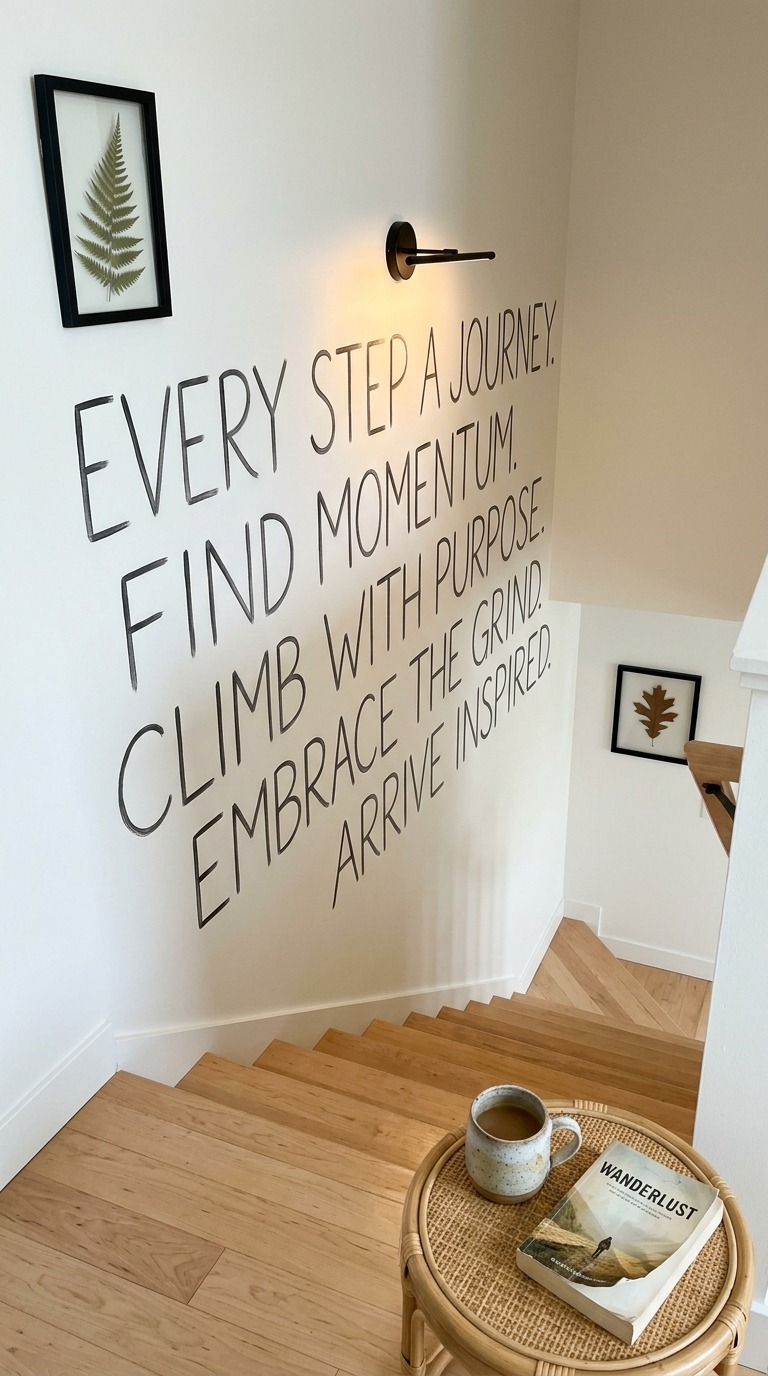
Consider a line from a poem that changed how you saw the world, the latitude and longitude of a place that made you who you are, or a single word in your family’s native language that has no exact English translation but carries enormous emotional weight. Paint the wall in Benjamin Moore Chantilly Lace OC-65 — it is the purest possible white and makes painted or printed lettering read with absolute clarity and crispness. Hire a local sign painter or muralist from Etsy to hand-letter your text in a thin organic brushstroke style, and avoid anything that looks like a computer font that was simply enlarged and traced.
14. Stairway Wall Sconce Lighting Arrangement
The single most transformative and underused idea I have ever applied to a stairway wall is treating the lighting itself as the decoration rather than just the illumination. A series of small wall sconces installed at regular intervals up the diagonal of a staircase wall creates a rhythm that is both functional and deeply beautiful — especially in the evening when each fixture casts its own warm amber pool and the overlapping circles of light become the most inviting visual thing in the entire house. I genuinely look forward to turning on my stair sconces every single evening.
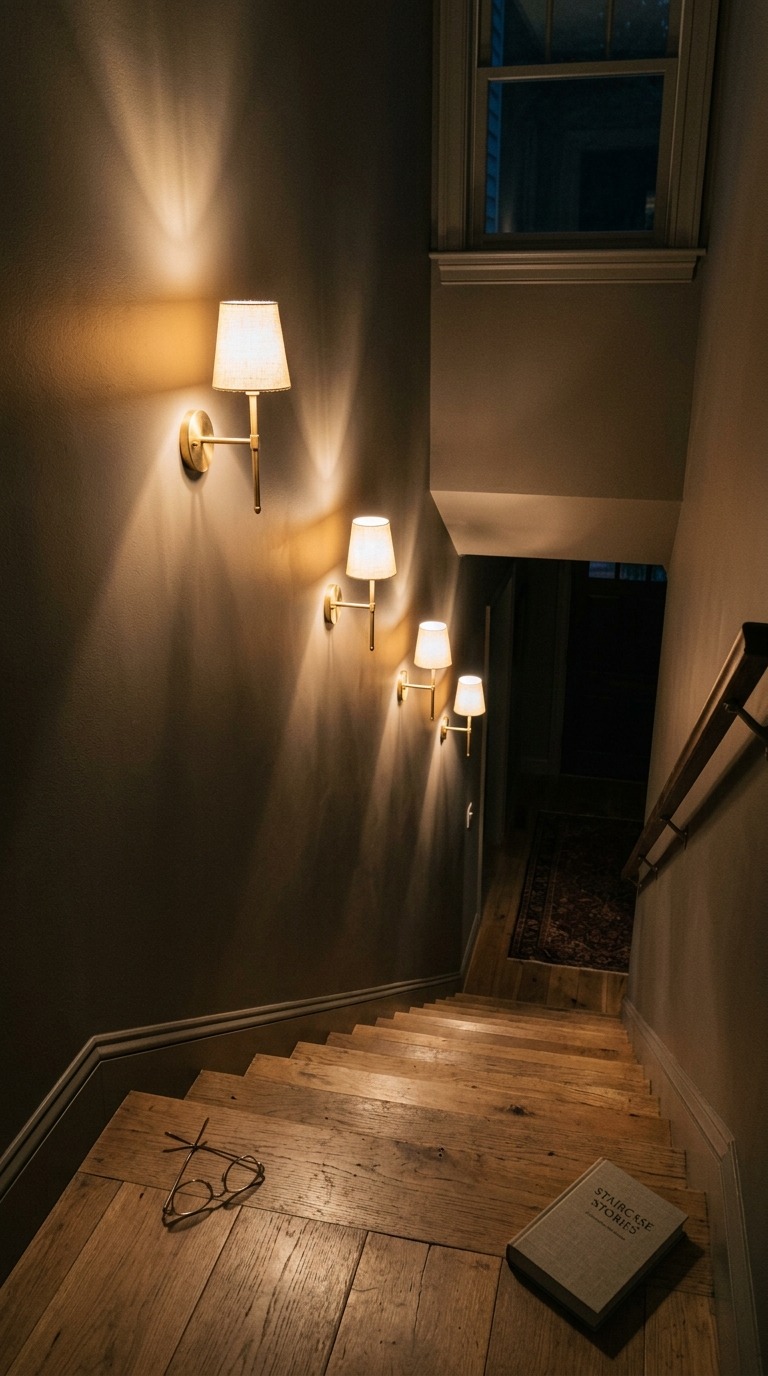
Choose a sconce style with real material weight — unlacquered brass ages beautifully over time, developing a warm patina that only gets more interesting with the years. I recommend the Schoolhouse Electric Wilburn sconce or anything with a small fabric shade in linen or cotton that diffuses the light into that gorgeous warm glow rather than casting a harsh directional beam. Paint the wall in Farrow and Ball Mole’s Breath No.276, a sophisticated warm gray that makes unlacquered brass fixtures look extraordinarily refined. The wall itself needs nothing else — let the light be the art.
15. Eclectic Collected Objects and Curiosities Wall
A curiosities wall on a staircase is the decorating equivalent of inviting someone into your actual interior life rather than just showing them a version of yourself that you think they will approve of. This is my absolute favorite type of stairway wall because it is the only one that cannot be faked or purchased wholesale from a single shop — it has to be genuinely built over time from things that came to you through travel, inheritance, discovery, and intention. Every object asks a question of the person climbing your stairs, and that is a wonderful thing for a wall to do.
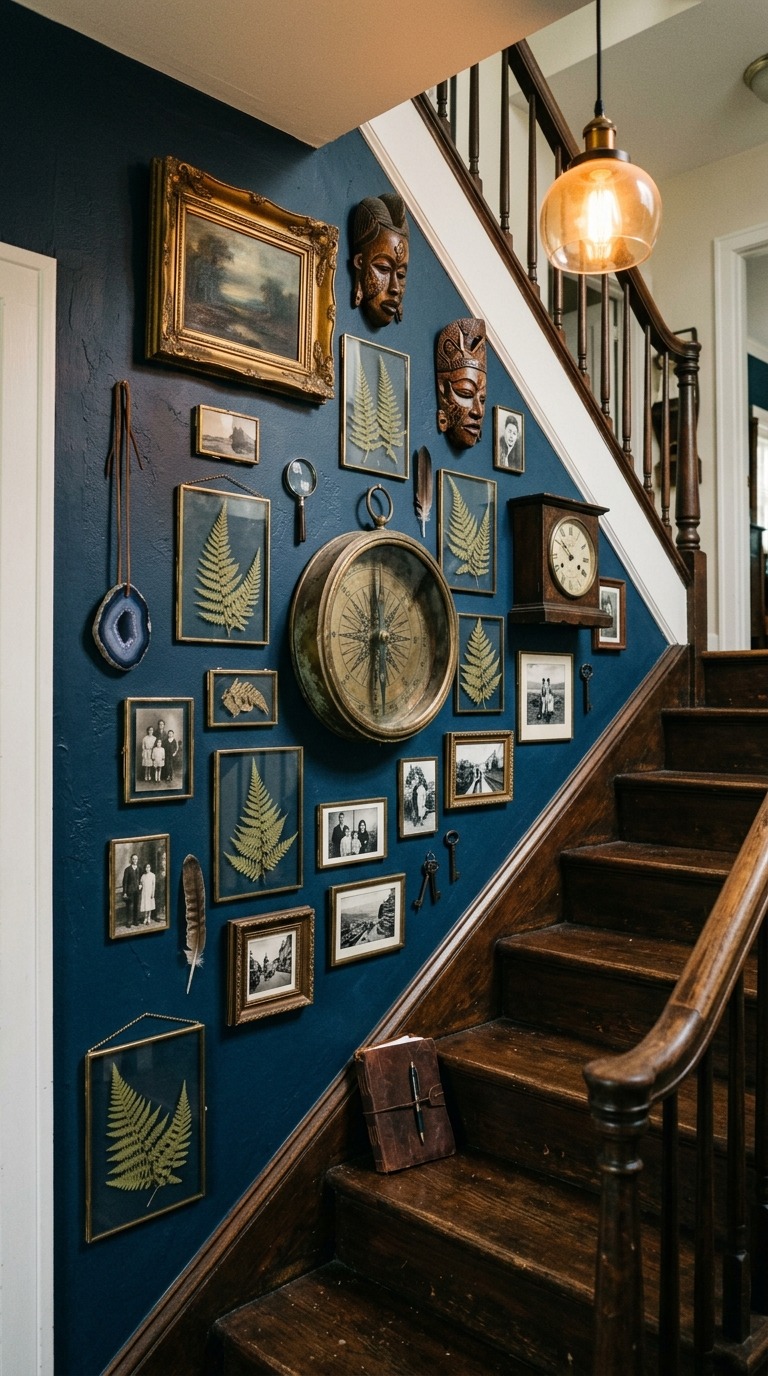
Start with one anchor piece that has real weight — an antique map, a large botanical print, a carved wooden object with age and history — and let everything else orbit it slowly over months rather than populating the whole wall in a single afternoon. The objects that end up on this kind of wall should be able to withstand the question why is this here and have a real honest answer waiting. Paint the wall in Benjamin Moore Hale Navy HC-154, which creates a dramatic backdrop that makes every brass, aged wood, and cream-toned object on the wall read with incredible richness and depth. The navy turns the stairway into a theater and everything hanging on it into the cast.
Your stairway wall has been waiting patiently for exactly this kind of attention, and now you have fifteen completely distinct ways to give it what it deserves. You do not need to tackle every idea at once — pick the single one that made your stomach flip with excitement when you read it, and start there today. That is how every beautiful home corner I have ever created actually began: with one good decision that made everything else feel possible.
The staircase is not a corridor to rush through. It is a vertical gallery, a personal museum, a daily experience that you and everyone you love walks through multiple times a day. Make it mean something. Make it beautiful. Make it so completely, unmistakably yours that every time you climb those stairs you feel genuinely glad to be home, and that is all the permission you need to begin right now.