18 Small Living Room Ideas for a Cozy Apartment Aesthetic
Your small living room is not a problem to solve. It’s a canvas. Here’s how to make every inch feel warm, intentional, and absolutely yours.
You walk into your apartment, drop your bag, and look around. The living room feels cramped. There’s not enough light. The sofa takes up too much floor space. You’ve rearranged the furniture three times, and it still doesn’t feel right. Sound familiar? You’re not alone — and the good news is, you don’t need a bigger apartment. You need smarter ideas.
Small spaces have this sneaky superpower: when you design them thoughtfully, they feel more intimate, more personal, and honestly more beautiful than big, half-decorated rooms ever do. These 18 ideas will show you exactly how to pull that off — with real tips you can actually use today.
Use Floating Shelves to Reclaim Floor Space
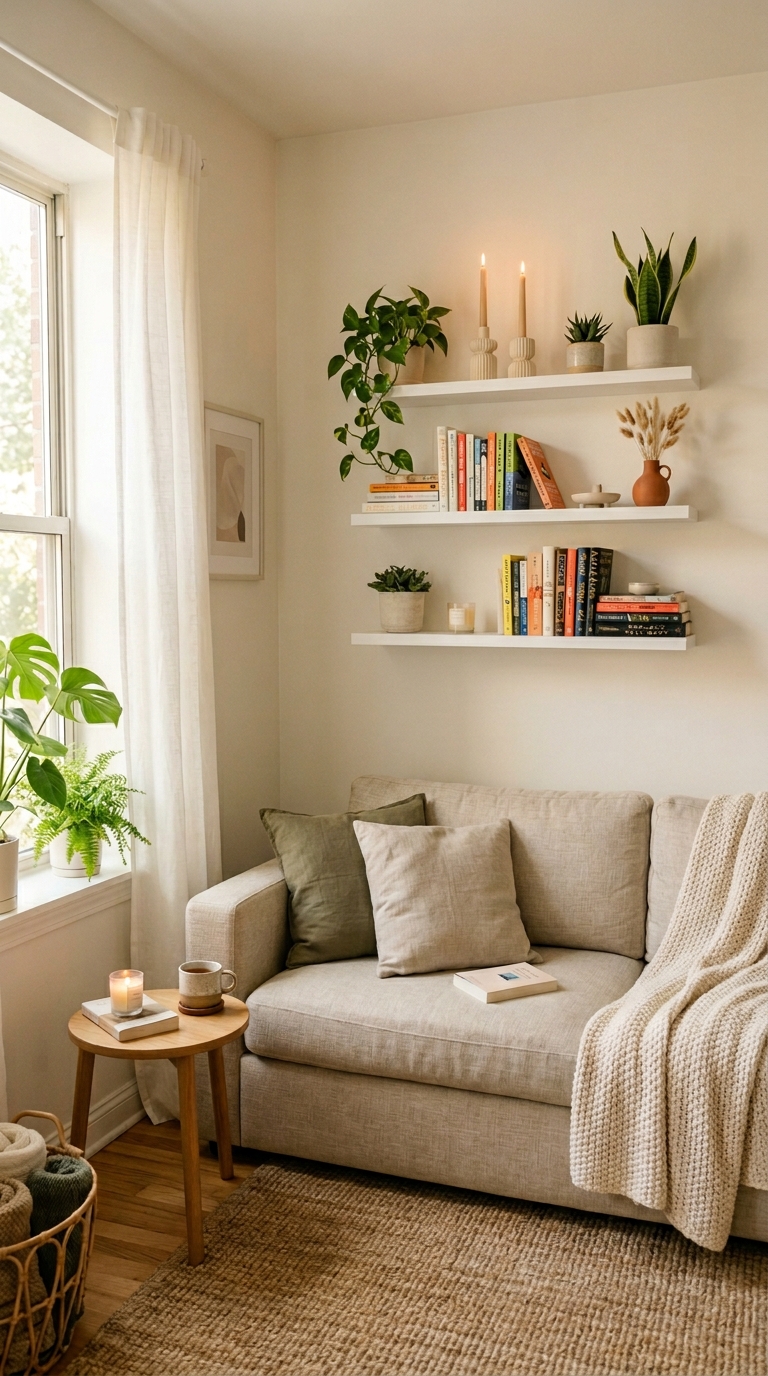
The floor is the most precious real estate in a small living room. The moment you lift storage off the ground and onto walls, the whole room breathes. Floating shelves do exactly that — they give you display space, storage, and personality without sacrificing a single square foot.
Put them above the sofa, flank a window, or create a tall column on an empty wall. Style them with a mix of books, small plants, candles, and a few personal objects. Keep two-thirds full — not packed, not bare. That balance is what makes shelves look curated rather than cluttered.
- Install shelves at eye level and above to draw the eye upward, making ceilings feel taller
- Use brackets that match your hardware (matte black or brushed brass both work beautifully)
- Vary the heights of objects — tall, medium, short — for visual rhythm
Use Mirrors to Double the Feel of Space
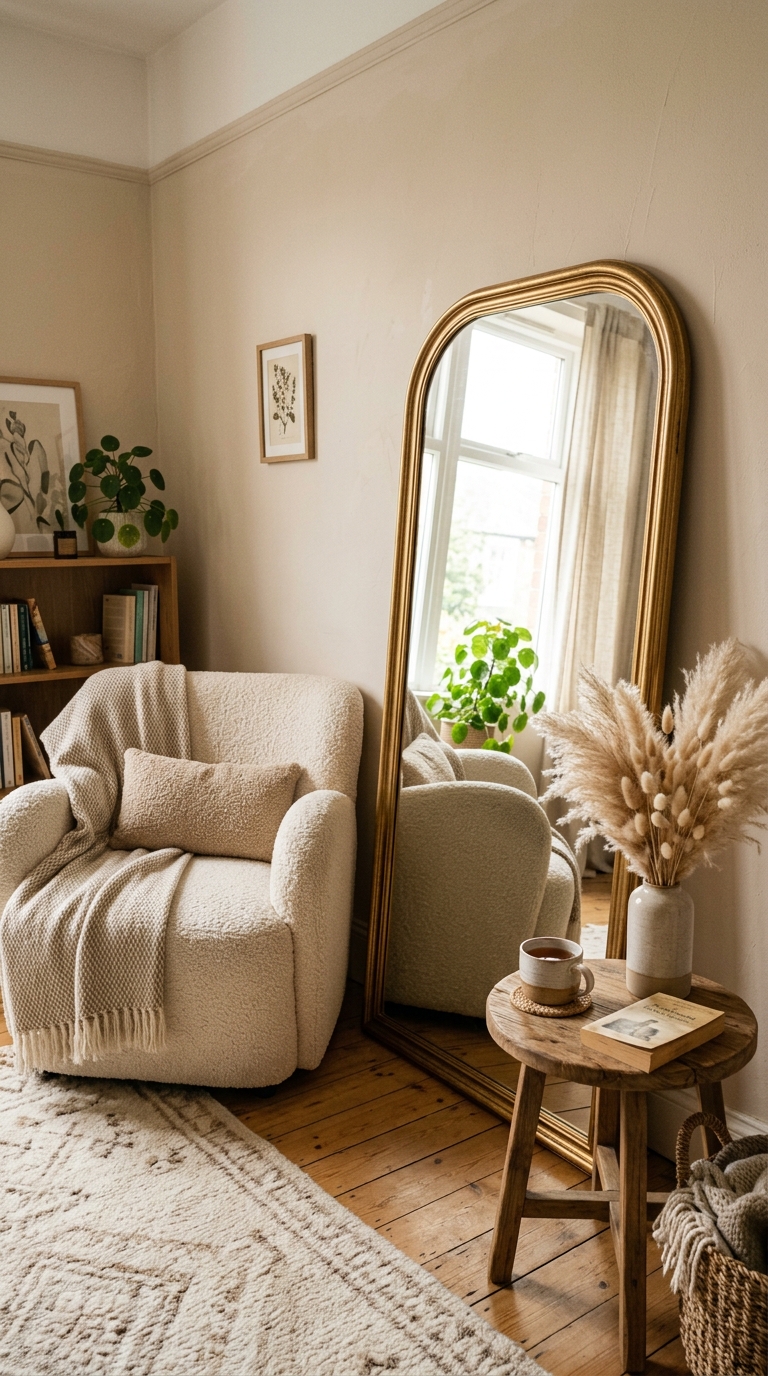
A well-placed mirror is the oldest trick in the interior design playbook — and it works every single time. Mirrors bounce light around the room, create the illusion of depth, and make a small living room feel like it goes on forever. The key is placement, not size.
Hang a large mirror opposite your biggest light source — usually a window. The mirror captures daylight and throws it back across the room. Even on cloudy days, your space will feel noticeably brighter. A full-length leaner mirror in a corner works beautifully in apartment living rooms because it doesn’t require wall anchoring and adds an airy, editorial feel.
- Arched mirrors are having a major moment — they soften angular rooms
- Cluster three small mirrors at different heights for a gallery-style effect
- Avoid placing a mirror directly facing the front door — it creates visual chaos
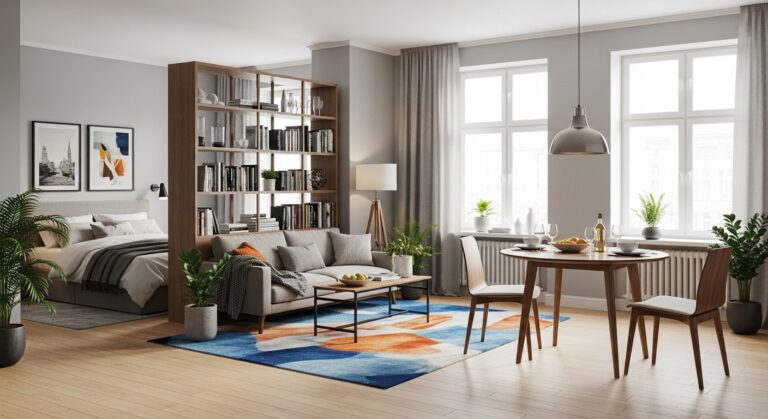
Choose Dual-Purpose Furniture That Works Twice as Hard
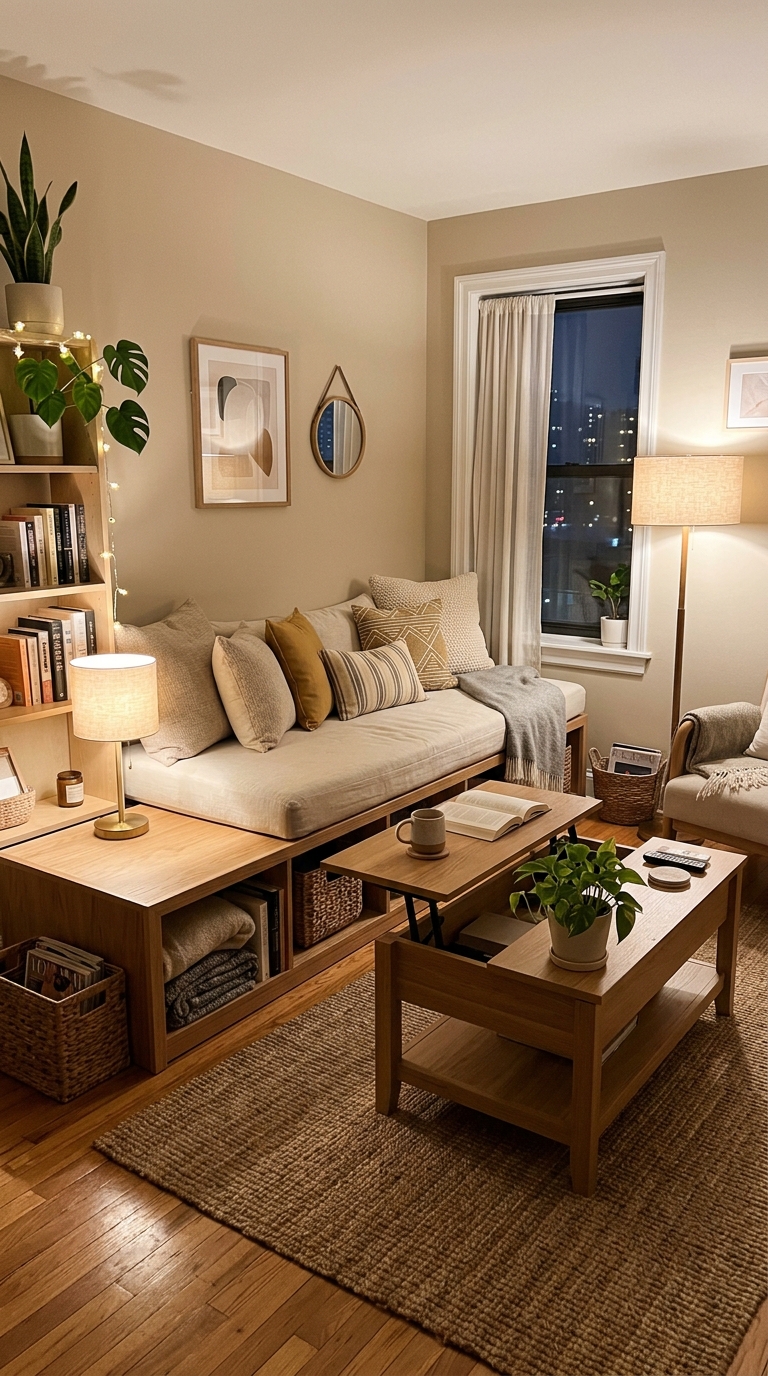
In a small living room, every piece of furniture needs to earn its place. Dual-purpose furniture is the game-changer that lets you have everything you need without everything you don’t have room for. Think: a daybed that doubles as a sofa, a bench with a lift-top that stores blankets, a coffee table that converts to a desk.
The best dual-purpose pieces feel intentional, not like compromises. A sleek storage bench at the foot of your seating area looks just as good as a decorative one — but it also holds your extra throw pillows, board games, or chargers.
- Murphy wall beds with integrated shelving are transformative for studio apartments
- Look for coffee tables with drawers or lift-top surfaces for hidden desk space
- A pouf or ottoman that opens up = instant extra seating + blanket storage
Use Vertical Lines to Make Ceilings Feel Taller
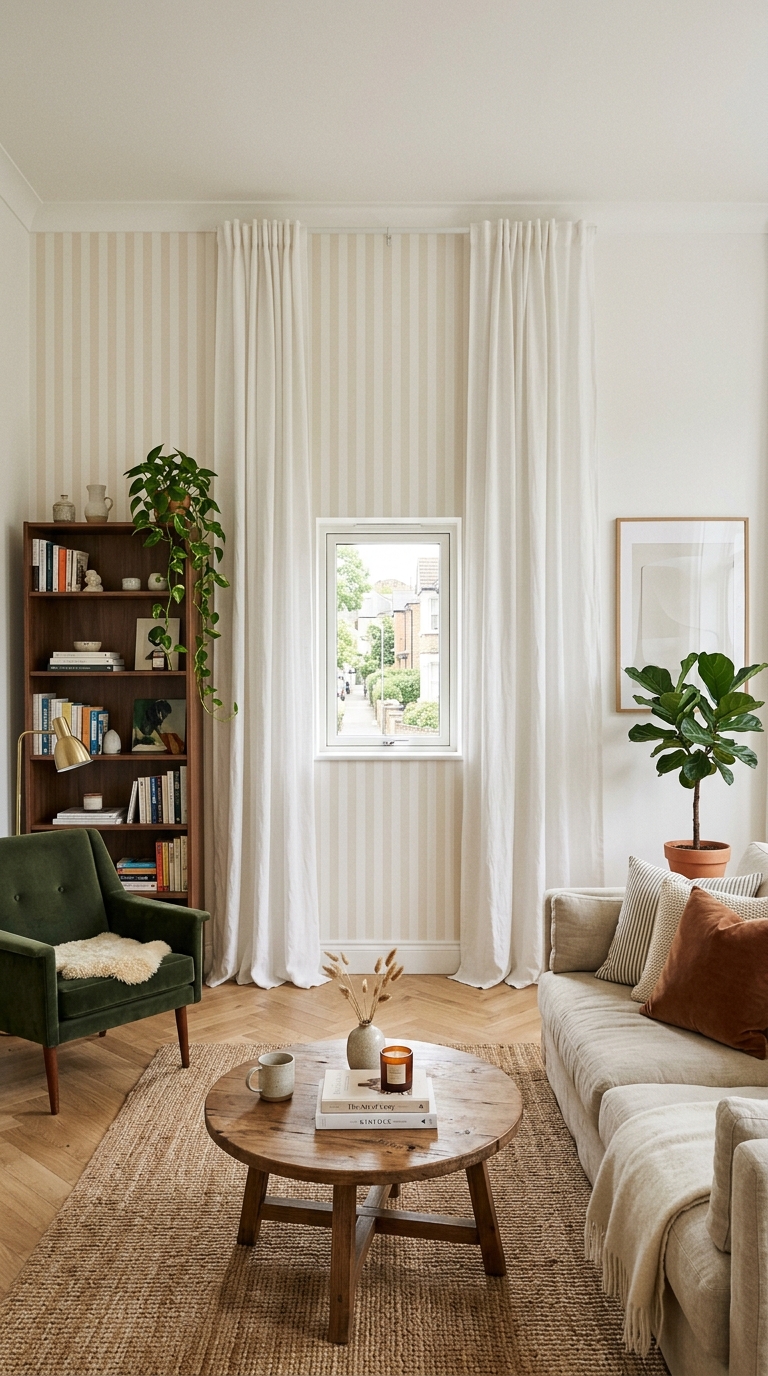
Low ceilings are the number one spatial complaint in apartments — and vertical lines are the visual fix. When your eye is guided upward by vertical elements, your brain reads the space as taller than it actually is. This works with wallpaper, curtains, furniture arrangement, and even tile patterns.
Hang your curtains as close to the ceiling as possible and let them fall all the way to the floor — even if your actual window is much smaller. This simple curtain trick is probably the fastest way to make a small living room feel more spacious without spending much money at all.
- Floor-to-ceiling curtains add height instantly — go for linen or cotton in soft neutrals
- Vertical stripe wallpaper on one wall creates elongation without overwhelming the room
- Tall, narrow bookshelves emphasize vertical space and keep floor area open
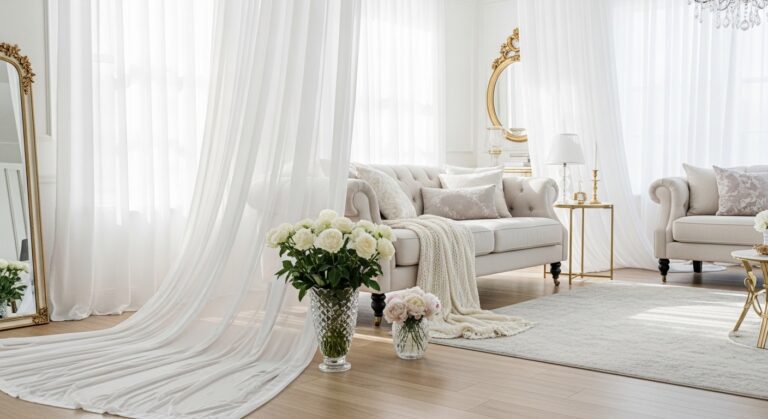
Let the Light In With Sheer Curtains
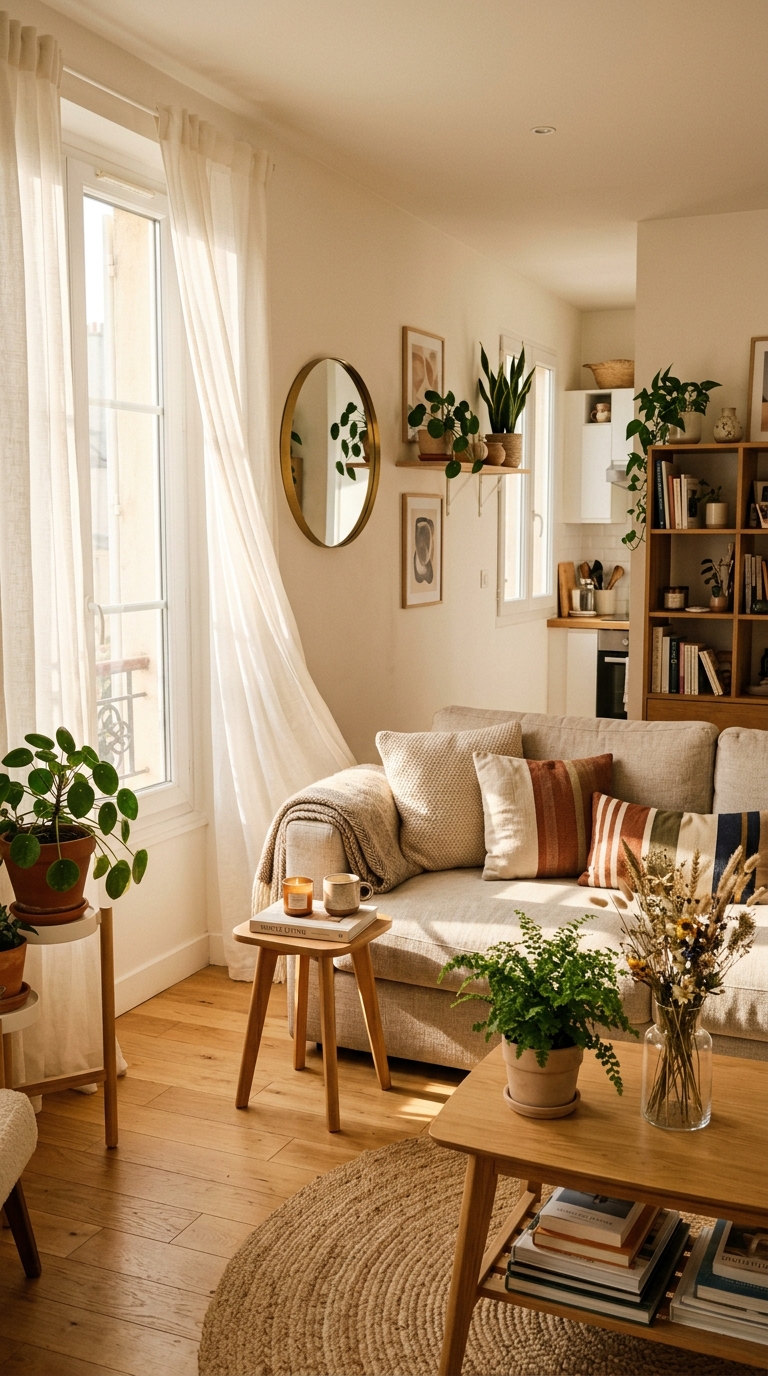
Heavy curtains swallow light and make small rooms feel like caves. Sheer curtains do the opposite — they soften the window, give you privacy, and still allow natural light to flood in. In a small apartment living room, natural light is your best friend and sheer panels are the most affordable way to maximize it.
Layer sheer whites or creams with a heavier blackout panel on the same rod if you need total darkness at night. During the day, push the heavy panels all the way to the sides and let the sheers work their magic. The room will feel lighter, softer, and more open immediately.
- Choose sheers in ivory, white, or barely-there beige for the most light reflection
- Linen-look sheers add texture without weight
- Use a double curtain rod to layer sheer + blackout without replacing hardware
Build a Warm Neutral Color Palette From the Ground Up
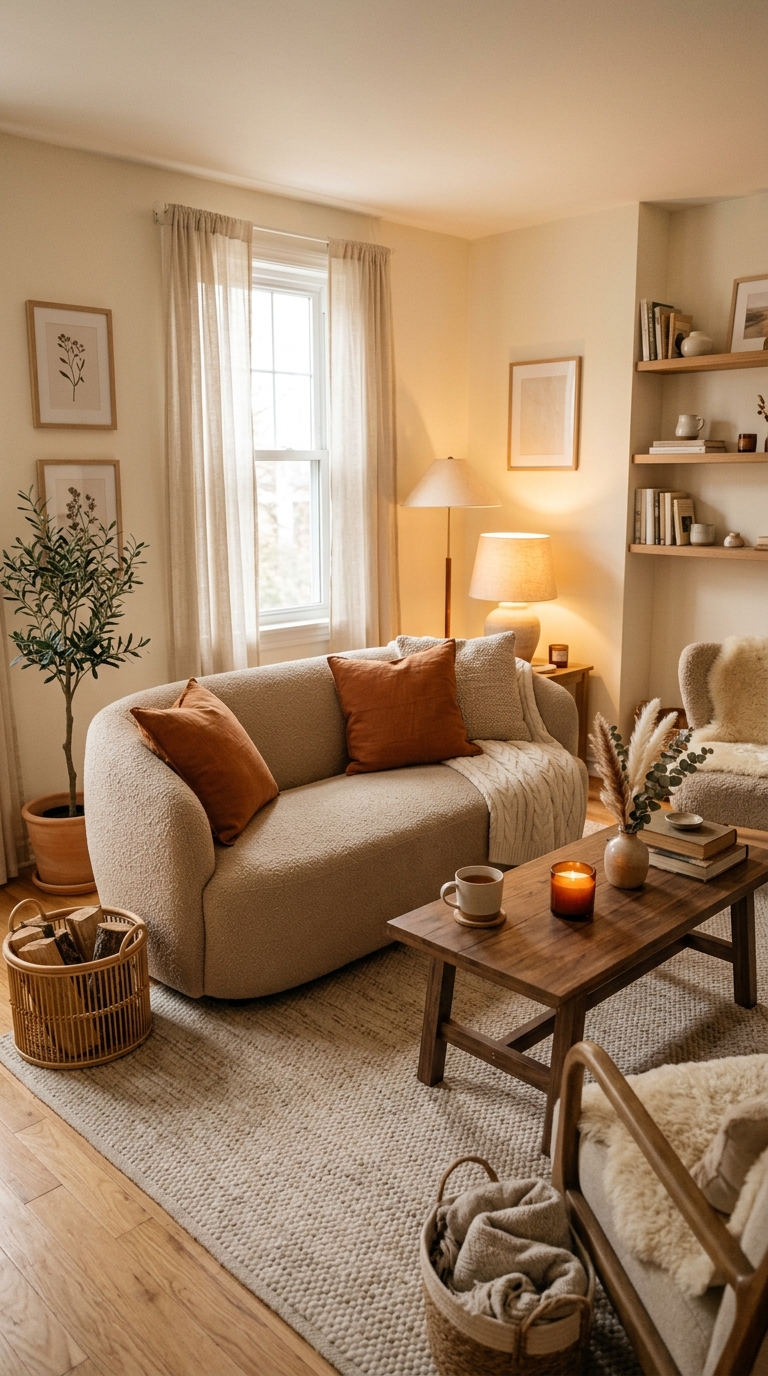
Color is one of the most powerful tools you have in a small room — and warm neutrals are the secret weapon of every cozy apartment aesthetic you’ve ever admired on Pinterest. Warm whites, soft taupes, sandy beiges, and creamy off-whites make a small living room feel enveloping rather than cramped.
The trick is to stay within one warm family and layer tones of it. Your walls, your sofa, your rug, your shelves — they don’t have to match exactly, but they should all share the same undertone. Warm undertones (yellow, pink, or orange-leaning) feel cozy and lived-in. Cool undertones (blue or green-leaning) can feel stark in small spaces unless you balance them carefully with texture.
- Benjamin Moore’s “White Dove” and Farrow & Ball’s “Elephant’s Breath” are legendary small-room colors
- Add depth with one deeper tone — a terracotta cushion, a walnut side table, a rust-toned throw
- Use the 60-30-10 rule: 60% dominant neutral, 30% secondary tone, 10% accent
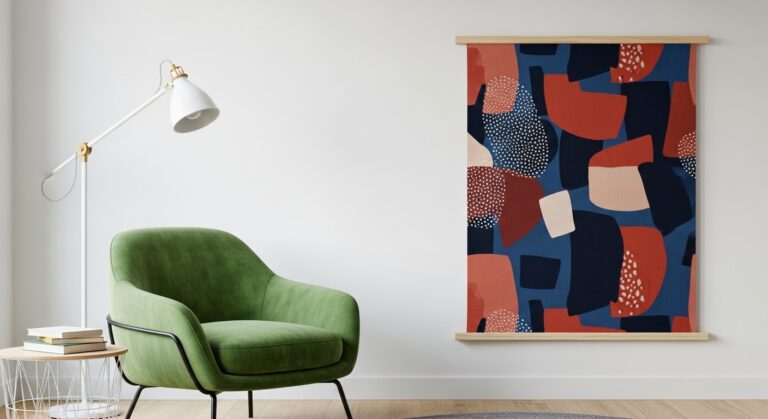
Create a Cozy Corner Seating Nook
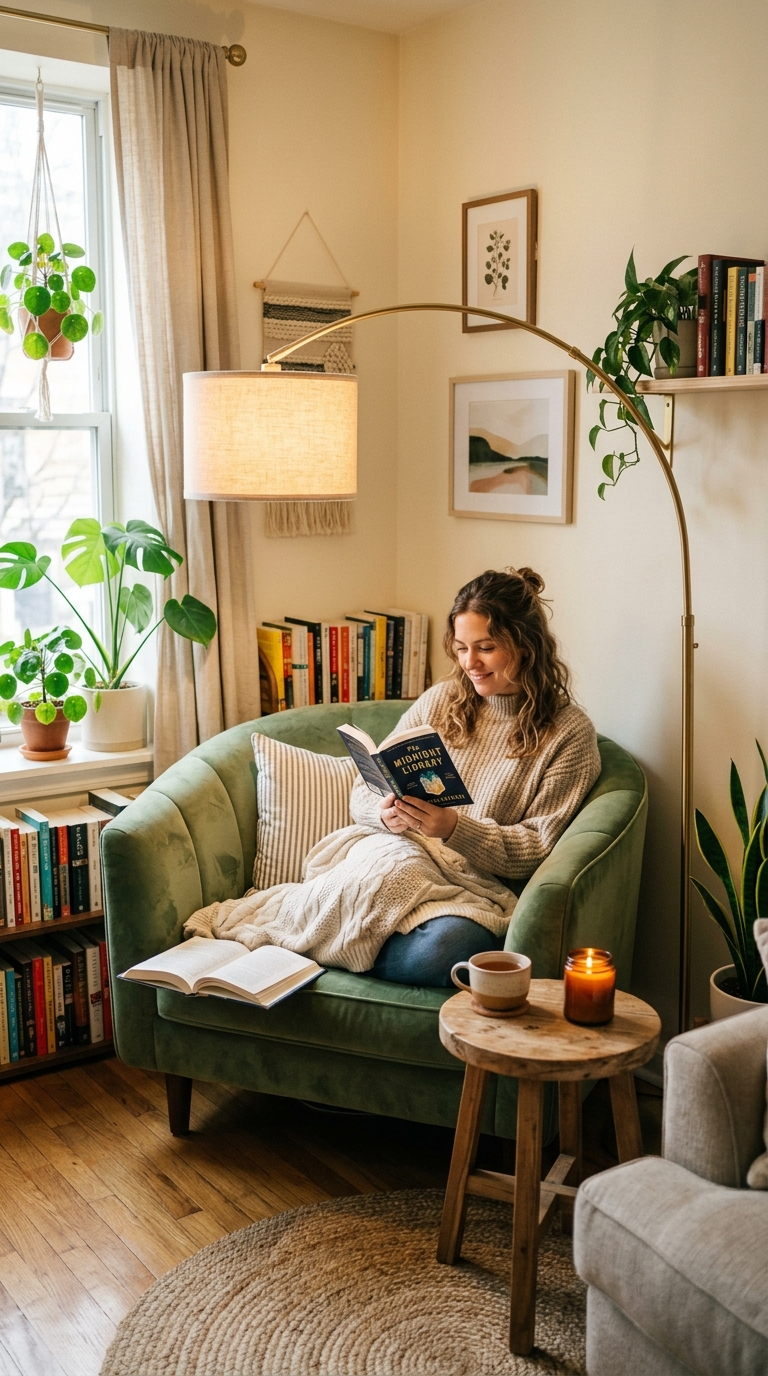
Corners are the most underused real estate in small living rooms. Most people leave them empty or shove a plant there and call it a day. But a well-designed corner nook becomes the favorite spot in the entire apartment — a place to read, have a coffee, or just breathe. And it makes the room feel intentionally designed rather than randomly arranged.
All you need is a compact armchair or a small curved loveseat, a floor lamp arching overhead, a tiny side table, and a soft throw draped over the arm. That’s it. Five elements, and suddenly you have a destination within your own living room.
- Curved or egg-shaped chairs take up less visual space than boxy recliners
- An arc floor lamp frees up surface space while providing focused light
- Add a small stack of books or a tray with a candle to make it feel inhabited
Anchor the Room With a Statement Rug
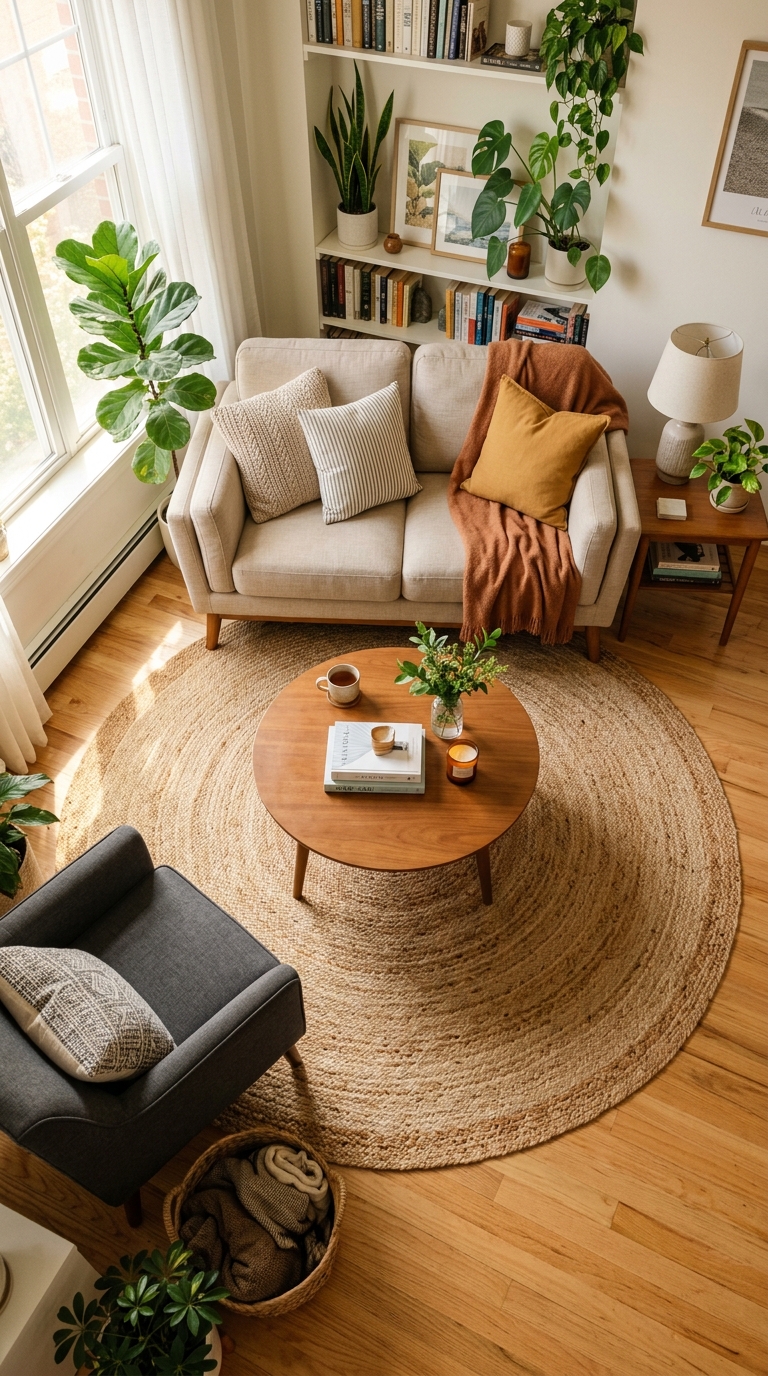
A rug does something no other piece of furniture can: it defines the space. In an open-plan apartment or a room that feels undefined, a rug says “this is the living room.” It pulls everything together and creates a sense of groundedness that makes even minimal furniture arrangements feel intentional and complete.
The most common mistake people make with rugs in small rooms is going too small. A tiny rug floating in the middle of the floor actually makes a room look more cramped. Go bigger than you think — ideally large enough that at least the front legs of your sofa and chairs sit on it.
- In a small living room, a 5×8 ft rug is usually the minimum — 6×9 ft is often better
- Low-pile rugs (flatweave, jute, sisal) work well in tight spaces — high pile feels heavier
- Warm tones in the rug bring everything in the room together effortlessly
Pick Furniture With Slim Legs to Create Visual Breathing Room
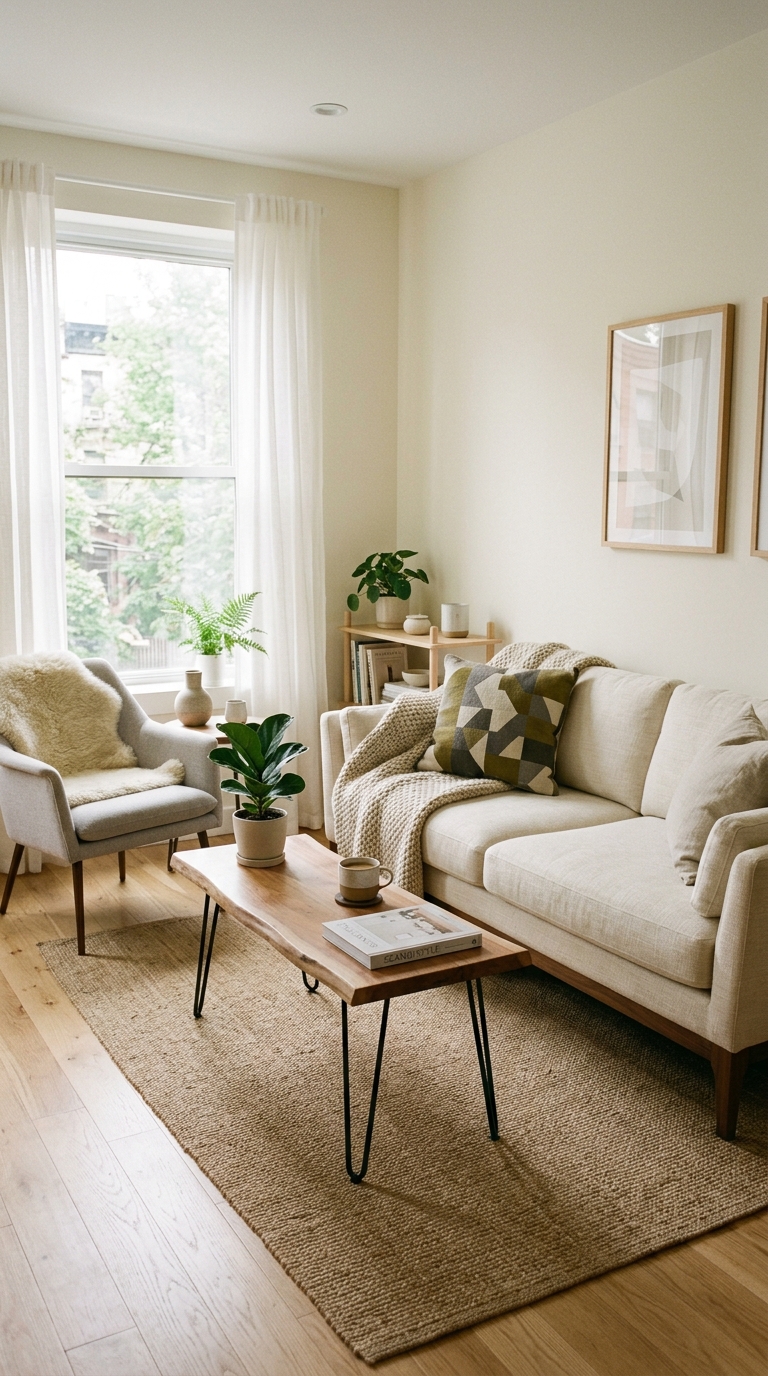
Furniture that sits flat on the floor creates a visual block — your eye hits a solid mass and the room stops feeling open. Furniture with slim, tapered legs does something visually fascinating: it lifts the piece off the floor, lets light pass underneath, and makes the room feel airier and more spacious even without changing the actual square footage.
Mid-century modern and Scandinavian furniture are built on this principle. Think of a sofa on tapered walnut legs versus one that sits on a solid base. The room with the legged sofa always feels larger. Same goes for armchairs, coffee tables, and even your TV stand.
- Look for sofas with legs at least 4–6 inches off the ground for the best visual lift
- Hairpin legs on side tables and coffee tables keep things feeling open and modern
- Avoid skirted sofas or furniture with solid box bases in small rooms
Create a Gallery Wall That Tells Your Story
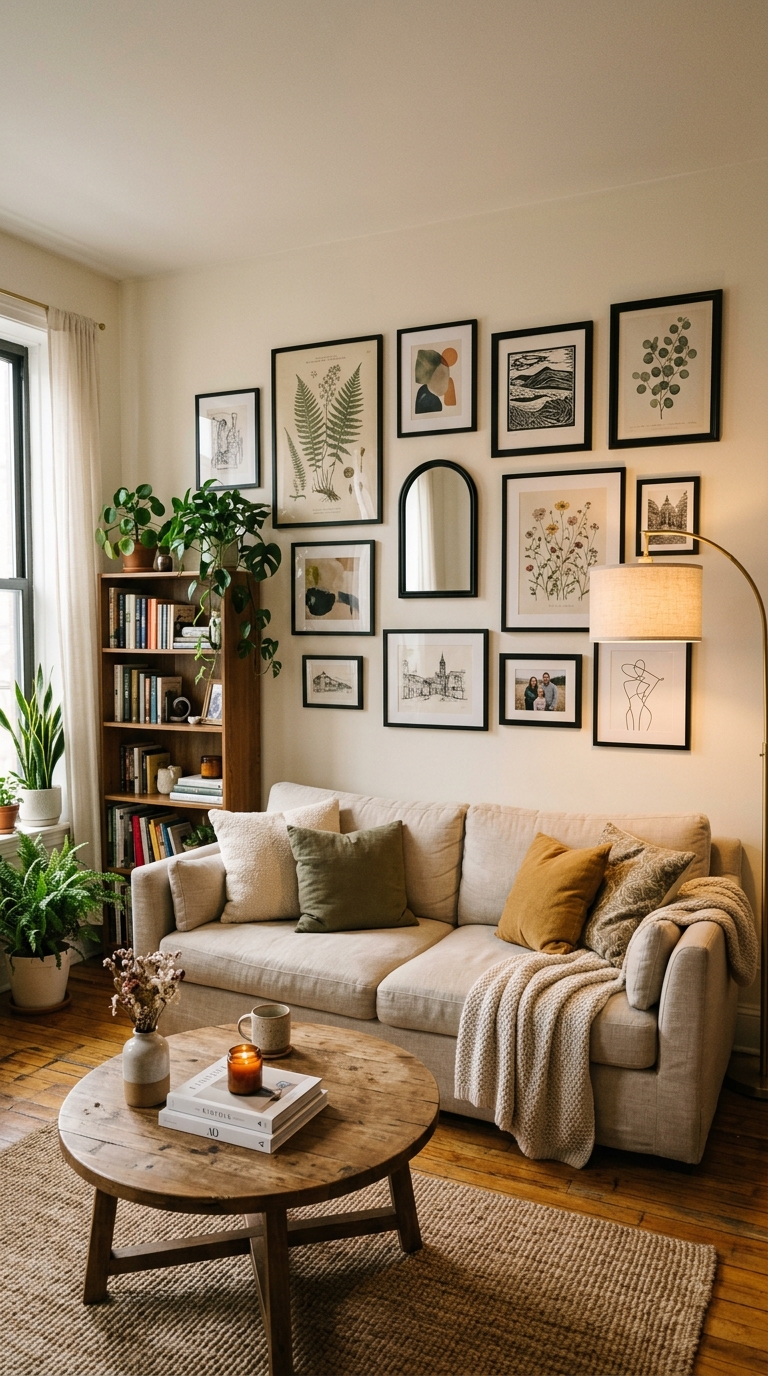
A gallery wall adds personality, warmth, and visual interest to a small living room without taking up any floor space. Done right, it becomes the soul of the room — the first thing people notice and comment on. Done wrong, it looks like a collection of mismatched frames hung with no logic. The difference is composition and intention.
Start by gathering your pieces on the floor and arranging them before a single nail goes into the wall. Mix frame sizes, but keep your color palette cohesive — all black frames, all natural wood, or all white creates harmony even when the art inside varies. Leave about 2–3 inches between each frame for breathing room.
- Center the gallery wall at eye level — roughly 57 inches from floor to center of the arrangement
- Mix art prints, photos, and one or two 3D objects (a small mirror, a ceramic piece) for depth
- Use paper templates taped to the wall to plan your layout before nailing anything
Layer Your Lighting for Warmth and Mood
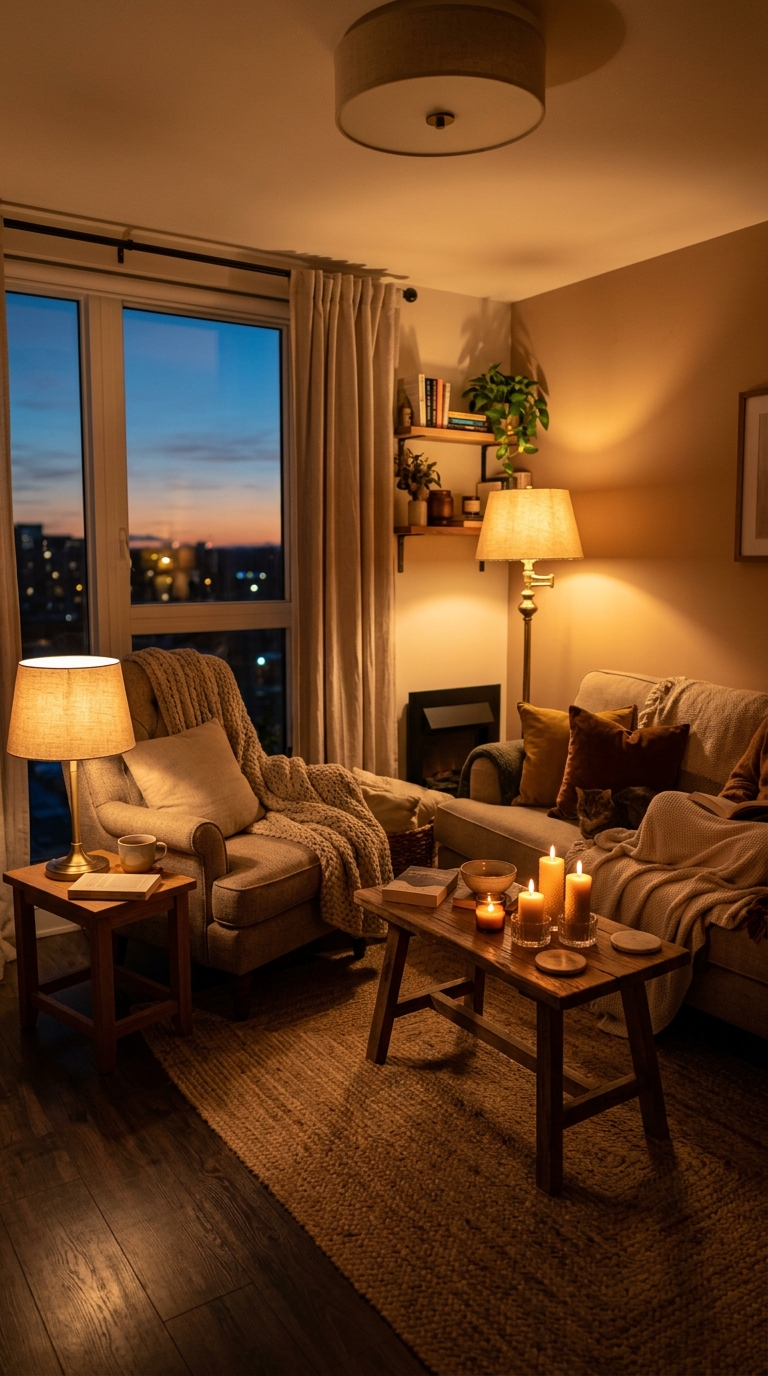
Relying on a single overhead ceiling light is the fastest way to make a small living room feel clinical and flat. Layered lighting — multiple light sources at different heights — transforms the same room into something warm, dimensional, and genuinely cozy. This is one of those changes that costs relatively little but has an outsized impact on how the space feels.
Think in three layers: ambient (the main overhead or ceiling light), task (a floor lamp or table lamp for reading), and accent (candles, fairy lights, or a small lamp behind the sofa for a warm glow). When all three are working together at a low-medium intensity, the room wraps around you in the best possible way.
- Swap cool white bulbs for warm white (2700K–3000K) — this single change is transformative
- Put your overhead light on a dimmer switch if possible
- A lamp placed behind the sofa (on the floor or on a shelf) creates a beautiful warm backlight
Use Hidden Storage Ottomans to Beat the Clutter
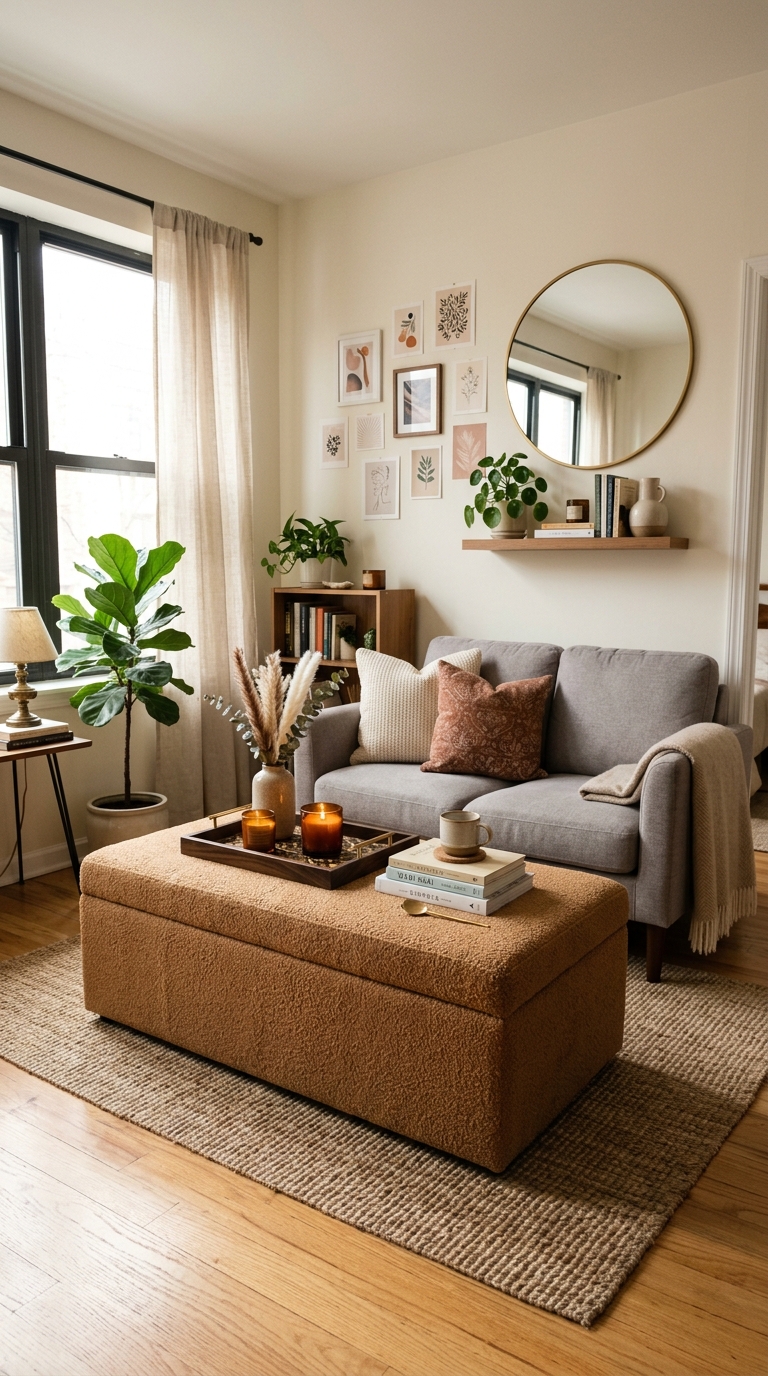
Clutter is the enemy of cozy. A small living room that’s visually busy feels anxious rather than relaxing — no matter how beautifully decorated it is. Hidden storage ottomans solve two problems at once: they give you a place to put your feet up (or extra seating for guests), and they swallow everything you don’t want to look at — blankets, remotes, kids’ toys, magazines.
An upholstered cube or round ottoman with a removable lid is one of the most hardworking pieces of furniture you can own in a small apartment. Place it at the center of your seating arrangement as a coffee table alternative and add a small tray on top to give it a finished look.
- A tray on top of an ottoman creates a stable surface for drinks and books
- Choose a fabric that wipes clean — velvet looks gorgeous but shows every footprint
- Square ottomans offer more interior storage volume than round ones
Bring Life In With Hanging and Trailing Plants
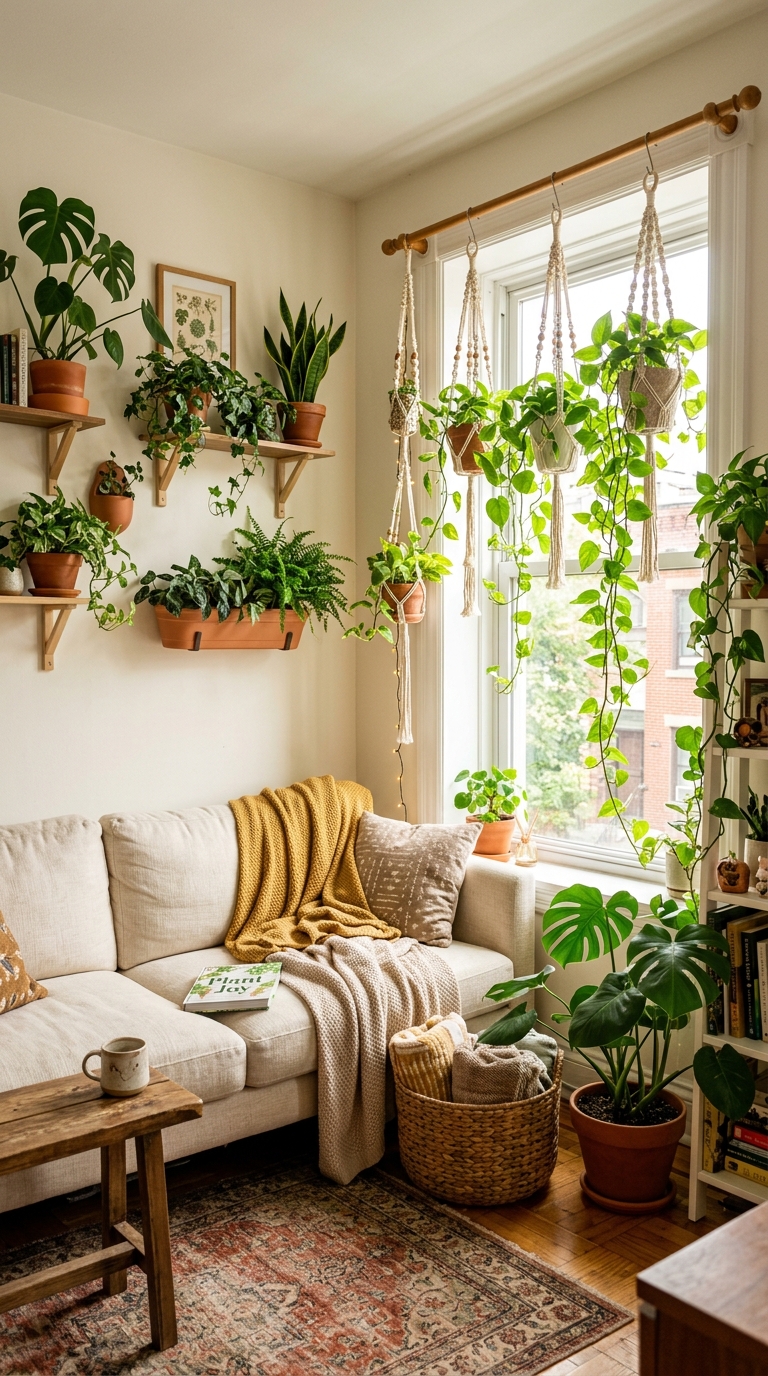
Plants bring a living room to life — literally. They add color, texture, and a sense of vitality that no decoration can replicate. In a small apartment, the challenge is fitting plants in without losing floor space. The solution is to go vertical: hang them, trail them from shelves, or mount them in wall planters.
Trailing plants like pothos, string of pearls, or heartleaf philodendron are perfect for this — hang them in a macramé hanger near a window and let the vines drape down. They grow in light that’s often too low for other plants and they’re nearly impossible to kill. A couple of these in the room and suddenly your living space feels like a little greenhouse retreat.
- Pothos is the easiest and most forgiving plant for apartments — thrives in indirect light
- Mount a wall-hung planter above the sofa for greenery without floor clutter
- Group plants in odd numbers (3 or 5) — odd groupings look more natural than even
Switch to Nesting Tables for Flexible, Space-Saving Style
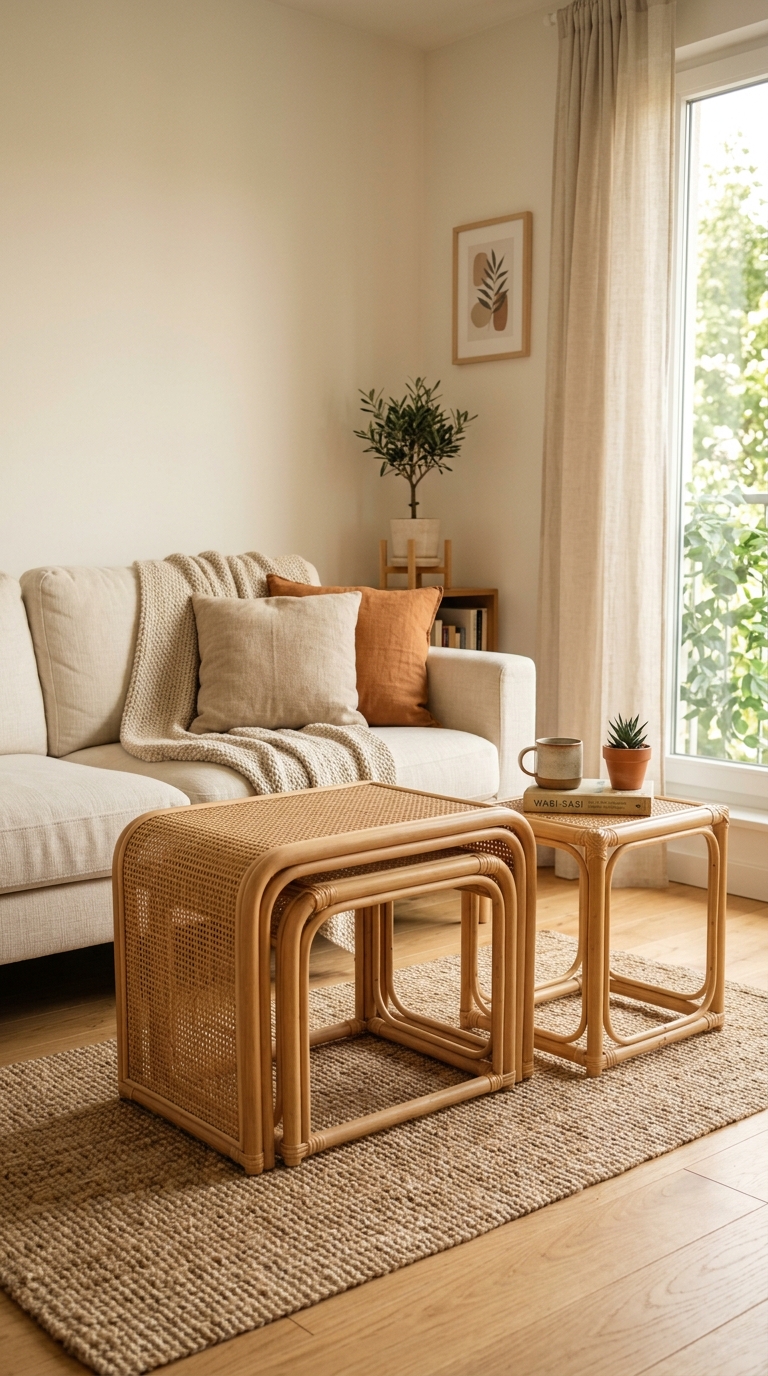
A traditional coffee table is often too big for a small living room — it eats up the floor and makes the space feel boxed in. Nesting tables are the smarter alternative. They tuck together when you’re not using them, freeing up floor space, and spread out when you need surface area for drinks, snacks, or your laptop.
They also have this quality that large coffee tables sometimes miss: flexibility. You can pull one table to the side of the sofa as a drink table, use the other as a footstool riser, and keep the third near the armchair. That versatility is exactly what small-space living demands.
- Choose nesting tables in materials that complement your sofa — rattan for boho, marble for minimal, wood for warm traditional
- Metal or acrylic nesting tables feel lighter visually and don’t crowd the space
- Look for sets where the largest table is still under 24 inches in diameter
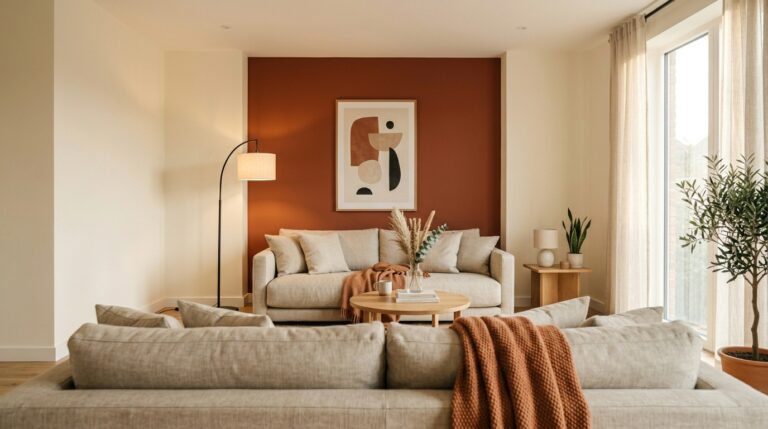
Paint an Accent Wall to Add Depth Without Closing In
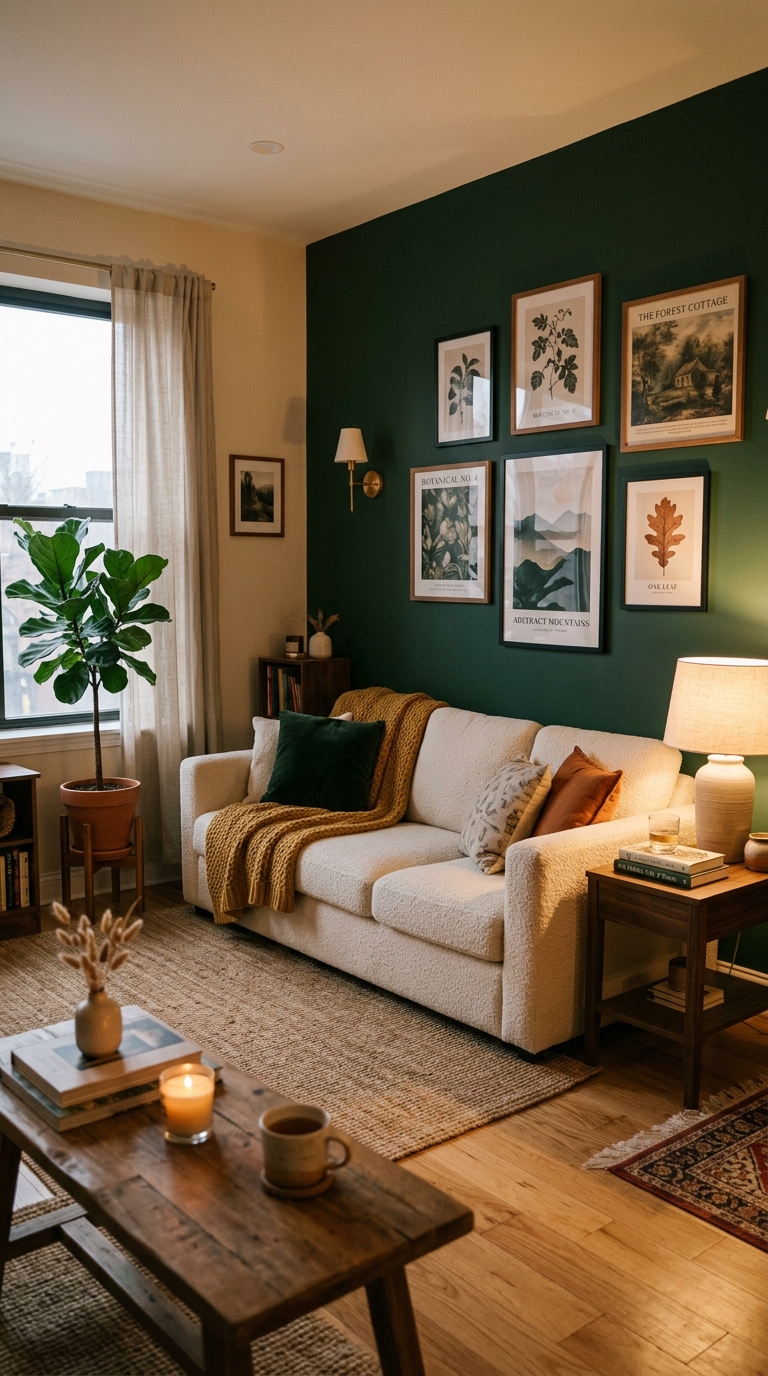
An accent wall in a small living room is a bold move — but when it works, it works brilliantly. A deeper color on one wall adds depth, drama, and a focal point that makes the whole room feel more composed. The trick is choosing the right wall (always the one your eye naturally travels to first — usually the wall behind the sofa or the one facing the door) and the right color.
Deep earthy tones — terracotta, forest green, dusty blue, warm charcoal — work better in small spaces than most people expect. They create a sense of intimacy rather than constriction. Pair with warm lighting and the wall becomes a cozy backdrop rather than a heavy wall closing in on you.
- Keep the three remaining walls in a light neutral to balance the depth
- Matte finishes work better than glossy in small spaces — they absorb rather than reflect harsh light
- A dark accent wall actually makes art and furniture pop in front of it beautifully
Layer Cozy Textiles for That Irresistible Lived-In Feel
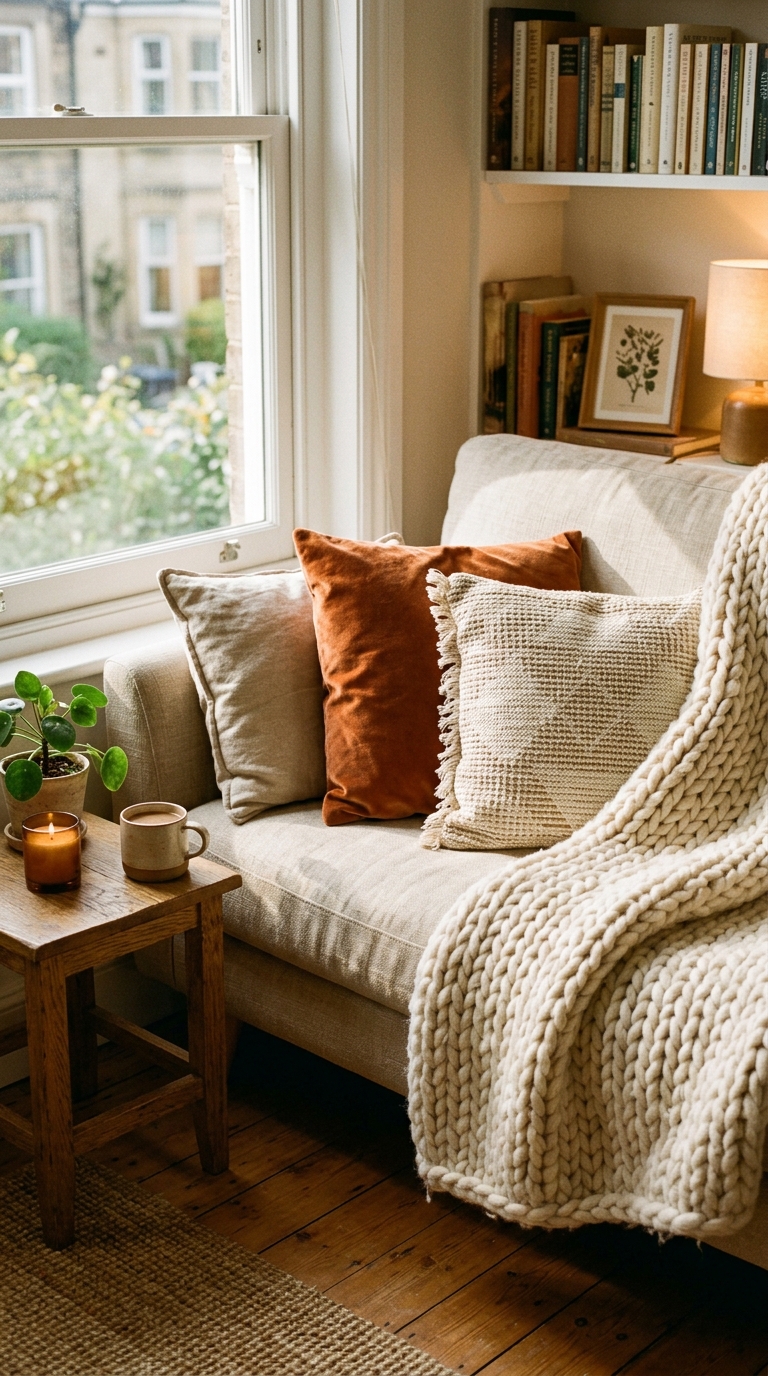
Textiles are the fastest and cheapest way to turn a cold, lifeless room into a cozy one. Throw blankets, cushions, a soft rug, curtain panels — these are the warmth-givers of any space. In a small living room, textiles do double duty: they add physical warmth on cold nights AND visual warmth all day long.
The secret to making textiles feel intentional and not chaotic is to vary texture while keeping color cohesive. Mix a chunky knit throw with a smooth velvet cushion and a woven cotton pillow — all in the same warm color family. That contrast of textures makes everything feel rich and layered without looking mismatched.
- Drape a throw casually over one sofa arm — deliberate-looking imperfection is the goal
- Odd numbers again: three cushions or five cushions tend to look better than two or four
- Swap out cushion covers seasonally to refresh the room without buying new furniture
Choose a Sofa With Built-In Storage or a Chaise That Pulls Out
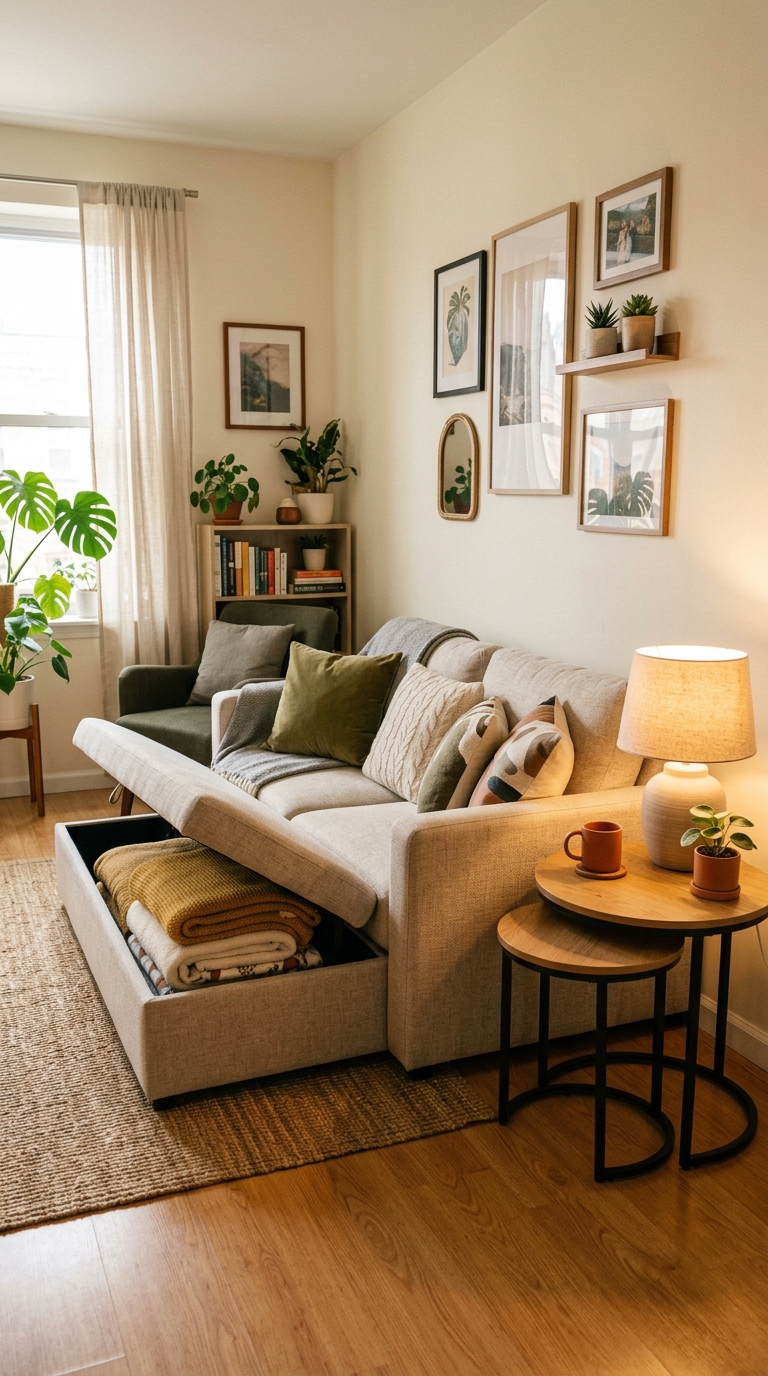
The sofa is the biggest piece of furniture in your living room, so it might as well work hard. Sofas with built-in storage — usually a lift-up seat cushion base — are genuinely life-changing in small apartments. They hold extra bedding for guests, seasonal items, board games, spare cushions — things that would otherwise eat up closet space or sit in visible stacks.
A chaise sofa that converts into a guest bed is another smart option for small spaces where you still want to host overnight visitors. It keeps the living room looking like a living room every single day, but pulls out into a comfortable bed when needed — without a bulky sofa bed mechanism that shows.
- Look for sofas where the entire base lifts — not just one section — for maximum storage volume
- Storage sofas in light fabrics (oatmeal, sand, pale gray) don’t visually bulk up small rooms
- Measure your doorway before buying — large sofas often need to be disassembled to get inside
Set the Mood With Scent, Candles, and Sensory Ambiance
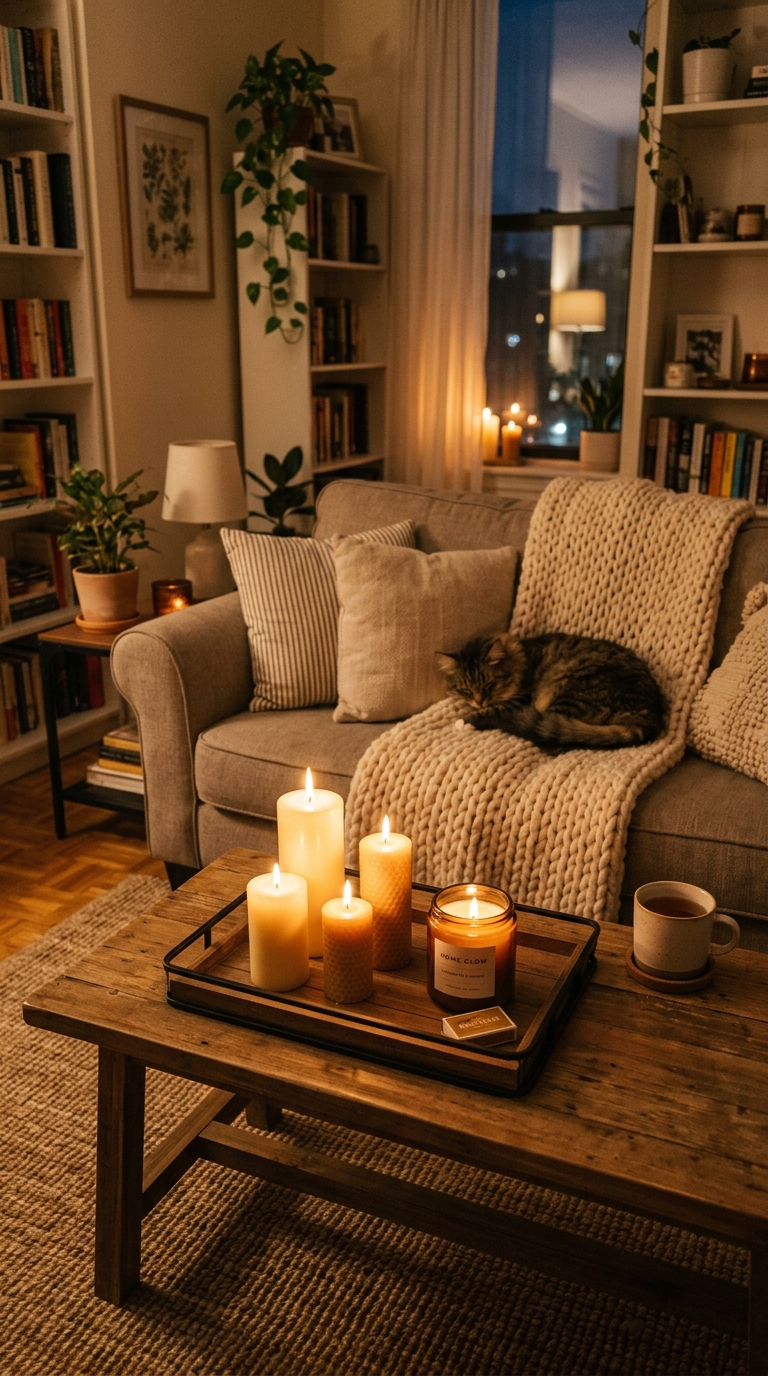
Coziness is not just visual — it’s deeply sensory. A room can look perfect in photos but feel cold and uninspiring in real life. The final layer of any cozy apartment aesthetic is ambiance: the way the room smells, sounds, and feels when you’re sitting in it. This is the detail that separates a decorated room from a home.
Candles are the easiest first step — a few pillar candles or a quality scented candle in a warm scent (sandalwood, amber, vanilla, cedar) change the emotional temperature of a room instantly. Pair that with soft background music or even just silence and the absence of harsh overhead light, and your small living room becomes the most restorative place in your whole day.
- Beeswax or soy candles burn cleaner and last longer than paraffin
- A reed diffuser provides constant low-level scent without needing to light anything
- A small Bluetooth speaker tucked on a shelf adds ambiance without visual clutter
AI Image Prompt
Intimate small apartment living room at evening, several lit pillar candles and a glass-jar scented candle on a tray, warm amber glow, soft shadows, cozy throw on sofa, completely relaxing hygge atmosphere interior photo
Your Small Room Has Everything It Needs
Here’s the truth nobody tells you: the most beautiful apartments aren’t the biggest ones. They’re the most intentional ones. Every single idea in this list works because it’s rooted in the same principle — respect the space you have, make each element earn its place, and layer warmth deliberately.
You don’t need to do all 18 things. Start with two or three that feel most relevant to your specific room. Replace that heavy coffee table with nesting tables. Hang a big mirror opposite the window. Drape a chunky throw over the sofa arm and light a candle. See how the room changes.
Small rooms reward the people who pay attention to them. Start paying attention, and yours will reward you back.
Frequently Asked Questions
What colors make a small living room look bigger?
Warm whites, soft creams, and sandy beiges are the most effective. They reflect light and create a sense of openness. Avoid cool grays in small rooms — they can feel stark without careful balancing.
Should I use a rug in a small living room?
Absolutely — but size it correctly. A too-small rug makes the room feel more cramped. Aim for a rug large enough that the front legs of your sofa and main chair rest on it.
How do I make a small living room feel cozy, not cramped?
Layer your lighting, use warm textiles, keep clutter out of sight, and focus on quality over quantity with furniture. A few well-chosen pieces create more coziness than a room full of mismatched items.
What size sofa should I use in a small living room?
A two-seat or two-and-a-half-seat sofa (usually 60–80 inches wide) is ideal for most small living rooms. Anything larger tends to dominate the space and leave no room to move comfortably.